
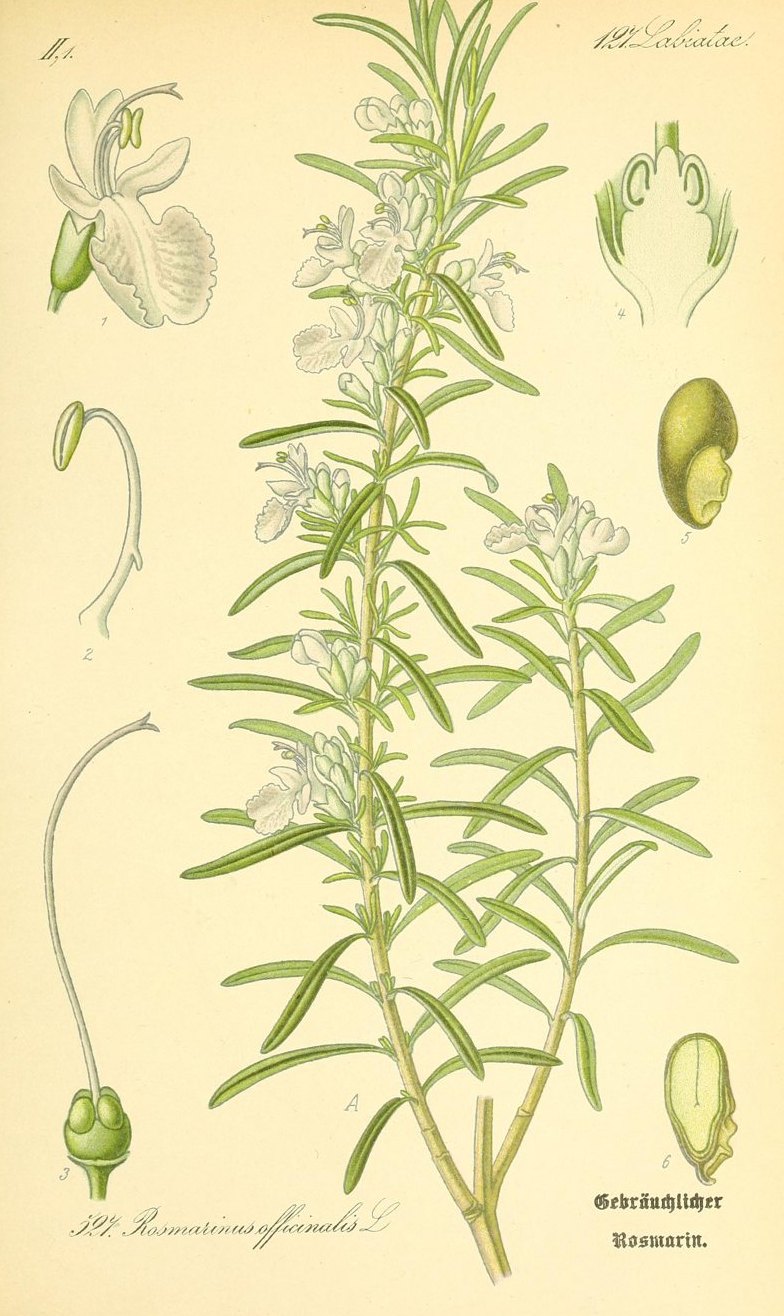
Rosemary rice water
Fermented rice water with rosemary; a rice-wash rinse; Oryza sativa and Rosmarinus officinalis in water
- Known today as
- A rinse for the hair and the skin made in the kitchen: the cloudy water from rinsing rice, with sprigs of rosemary in it, left to stand a day or two until it turns faintly sour, then strained.
- Kind
- Compound, in 5 older authorities
- Constituents
- carnosic acid, oil of rosemary, rice starch, and 2 more
- Earliest authority here
- Pliny (AD 23/24–79)
Caution. Rosemary is generally considered safe on the skin, but allergic reactions and dermatitis have been reported, and in the one trial of rosemary oil on the scalp itching rose in both groups. In the one laboratory study of rice-washing water on hair, used alone it left a flaking on the hair surface. No study read for this entry has tested a home ferment of rice water; it is a kitchen preparation, not a medicine.
Rosemary rice water: what was it used for?
Poured over washed hair and left a few minutes before rinsing, or patted on the face. A preparation of the present day that joins two old practices: rosemary boiled in water or wine to wash the face and the hair, and the water from washing rice, with which, as Inamasu and colleagues report from the histories of Japanese hairstyles, the court ladies of Heian Japan combed their floor-length hair each day.
Rosemary rice water: what does modern science say?
Rosemary’s claim on the hair rests on one trial: fifty patients with androgenetic alopecia on rosemary oil against fifty on minoxidil 2 percent for six months, both groups with more hairs at six months than at the start, and neither better than the other. A survey of 994 people in Saudi Arabia found rosemary oil associated with a lower likelihood of greying, which is an association, not a cause. Rice water has one laboratory study behind it: Inamasu and colleagues, taking the Heian practice as their cue, found that yu-su-ru reduced the surface friction of hair and increased its elasticity, but left a flaking on the hair when used alone, so that they turned to extracts of it; their paper names phytic acid, inositol, and ferulic acid among its constituents. A 2022 systematic review in the Journal of Drugs in Dermatology, of rice bran extracts rather than the washing water, found ten studies and reported that rice bran applied to the skin raises the growth factors of the anagen phase and inhibits TGF-β and type I 5α-reductase, and is neither genotoxic nor cytotoxic. The 2024 systematic review of rice-washed water itself found the research scarce, and a 2025 study found antioxidant vesicles bearing gamma-oryzanol in soaked rice water, harmless to skin cells in the dish. What a day or two of fermentation in a jar does to it has not been studied. A 2026 paper from an Indian school of pharmacy made a hair serum of rice water fermented a day with lemongrass, with neem extract in a cellulose gel; its evaluation went no further than the serum’s pH, its flow, and its look on a glass slide, and it reports no test on hair or scalp.
Pharmacognosy & Toxicology
- Constituents
- carnosic acid ChEMBLa diterpene of rosemary, named with ursolic, oleanolic, and micromeric acids for suppressing the inflammatory cascade; one study laid the antiandrogenic effect to 12-methoxycarnosic acid
- oil of rosemaryborneol, bornyl acetate, a camphor, cineol, pinene, and camphene, by Grieve’s account; the oil of the trial
- rice starchthe cloud in the water; the smallest starch granules known, by Grieve
- gamma-oryzanolan antioxidant of rice bran, found in vesicles isolated from soaked rice water that skin cells took up without harm
- inositol, phytic acid, and ferulic acidnamed among the constituents of rice-washing water in the one laboratory study of it on hair
- Mechanism
- In androgenetic alopecia dihydrotestosterone binds the androgen receptors of the scalp and miniaturizes the follicle; minoxidil, the approved treatment, widens the arterioles around the follicle. Rosemary’s effect is laid to its anti-inflammatory diterpenes and, by one study, to an antiandrogenic one. Rice bran extracts, by the 2022 review, raise β-catenin and other signals of the anagen phase and inhibit TGF-β and type I 5α-reductase; rice-washing water, by the one study of it, lowers the surface friction of the hair shaft and raises its elasticity. Fermentation has been studied on rice bran under chosen microbes, where it frees phenolic compounds and raises antioxidant activity; a jar of rice water on a counter is not that, and has not been studied.
- Toxic dose
- A rinse, not a dose: poured over washed hair and left a few minutes, or patted on the skin. The trial applied rosemary oil to the scalp for six months, with hair counted at three and six.
- Standing
- A cosmetic. A 2026 network meta-analysis of off-label therapies for male androgenetic alopecia ranked minoxidil 5 percent most effective and did not name rosemary among the therapies it found effective. An open-label, single-arm study of a commercial serum containing both rice water extract and rosemary oil reported gains over 120 days, with no control group to measure them against; a 2026 formulation paper on a fermented rice water hair serum evaluated only the serum’s pH, viscosity, and appearance. The 2022 review counted 119 rice-containing hair products on sale at one retailer and judged rice bran appropriate for use in cosmetics.
- Inamasu, S., Ikuyama, R., Fujisaki, Y., & Sugimoto, K. (2010). The effect of rinse water obtained from the washing of rice (Yu-Su-Ru) as a hair treatment. Journal of Society of Cosmetic Chemists of Japan 44: 29–33. doi:10.5107/sccj.44.29. Its English abstract also in International Journal of Cosmetic Science 32 (2010), doi:10.1111/j.1468-2494.2010.00605_3.x Verified against its record · doi:10.5107/sccj.44.29
- Hashemi, K., Pham, C., Sung, C., Mamaghani, T., Juhasz, M., & Mesinkovska, N. (2022). A systematic review: application of rice products for hair growth. Journal of Drugs in Dermatology 21: 177–185. doi:10.36849/jdd.6345 Verified against its record · PMID 35133117
- Panahi, Y., Taghizadeh, M., Marzony, E. T., & Sahebkar, A. (2015). Rosemary oil vs minoxidil 2% for the treatment of androgenetic alopecia: a randomized comparative trial. Skinmed 13: 15–21. Verified against its record · PMID 25842469
- Bin Rubaian, N. F., Alzamami, H. F. A., & Amir, B. A. (2024). An overview of commonly used natural alternatives for the treatment of androgenetic alopecia, with special emphasis on rosemary oil. Clinical, Cosmetic and Investigational Dermatology 17: 2495–2503. doi:10.2147/ccid.s470989 Verified against its record · PMID 39524109
- Aldhafiri, H. J., et al. (2026). Hair greying associated with rosemary use: a cross-sectional study in Saudi Arabia. Dermatology Reports 18. doi:10.4081/dr.2025.10126 Verified against its record · PMID 40888724
- Chithambharan, A., et al. (2024). Conventional and scientific uses of rice-washed water: a systematic review. Journal of Food Science and Technology 61: 414–428. doi:10.1007/s13197-023-05722-2 Verified against its record · PMID 38327867
- Ravilla, J., et al. (2025). Plant-derived nanovesicles from soaked rice water: a novel and sustainable platform for the delivery of natural anti-oxidant γ-oryzanol. Antioxidants 14: 717. doi:10.3390/antiox14060717 Verified against its record · PMID 40563350
- Liang, D., et al. (2026). Research progress review on the activation of bioactive substances by targeted fermentation of rice bran. Foods 15: 1881. doi:10.3390/foods15111881 Verified against its record · PMID 42279668
- Gupta, A. K., et al. (2026). Beyond minoxidil: off-label therapies for male androgenetic alopecia, a systematic review with network meta-analyses. Medicina 62: 1282. doi:10.3390/medicina62071282 Verified against its record · PMID 42512824
- Patel, M., Tuli, N., Patel, N., & Merja, A. (2025). A clinical evaluation of the safety, efficacy, and tolerability of the Soulflower Rosemary Redensyl Hair Growth Serum, Tetragain, in healthy female subjects for the treatment of alopecia. Cureus 17: e77066. doi:10.7759/cureus.77066 Verified against its record · PMID 39917132
- Ghasemzadeh Rahbardar, M., & Hosseinzadeh, H. (2025). Toxicity and safety of rosemary (Rosmarinus officinalis): a comprehensive review. Naunyn-Schmiedeberg’s Archives of Pharmacology 398: 9–23. doi:10.1007/s00210-024-03336-9 Verified against its record · PMID 39096378
- Jaiswal, S., Goyal, T., Sahu, P., Dewangan, R., Rajwade, H., Sahu, P., Sahu, G., & Kaur, C. D. (2026). Formulation and evaluation of fermented rice water-based herbal hair serum for hair growth and scalp health. International Journal of Pharmaceutical Sciences 4(4): 1379–1387. doi:10.5281/zenodo.19479633 Verified against its record · doi:10.5281/zenodo.19479633
The abstract of each source, beneath its citation. For Club members. About the Club or sign in.
Constituent names open the compound’s record at PubChem, and “ChEMBL” beside a name opens its record at ChEMBL, the European Bioinformatics Institute’s database of bioactive molecules. Where a mechanism line was checked against ChEMBL (ChEMBL 37, read 1 October 2026), the check is shown with the measured value and its source paper, or says plainly that nothing has been measured. Doses are as the references give them, for description only; this is not medical advice. Each source carries the result of its check against Crossref, PubMed, or the authority’s page: see Verification.
Rosemary rice water: what lore surrounds it?
Rosemary is the herb of remembrance, worn in brides’ wreaths dipped in scented water and cast on coffins, and Sir Thomas More let it run all over his garden walls because his bees loved it and because it is sacred to friendship. Hungary water, rosemary tops steeped in spirits of wine and distilled, was first made, Grieve says, for a Queen of Hungary who was cured by it, and a formula dated 1235, said to be in Queen Elizabeth of Hungary’s hand, is said to be kept in Vienna. Banckes’ Herbal promised that a box of rosemary wood, smelled often, would preserve one’s youth. The water of the rice pot is the humbler partner: a demulcent of the Indian pharmacopoeia, the daily comb-water of the Heian court’s floor-length suberakashi, and the stuff of a modern kitchen rinse whose fame runs ahead of its evidence.
The Recipe
The recipe: 3 ingredients, with the apothecaries’ weights in modern measure. For Club members. Create a free account or sign in.
Rosemary rice water: what did the older authorities say?
- Pliny
- Counts eighteen remedies in rosemary: the root applied fresh for wounds, the juice for jaundice and for the sight, the seed in drink for diseases of the chest. “It acts also as a detergent upon freckles,” and the leaves and stem are applied with vinegar to scrofulous sores.
- Banckes’ Herbal
- As Mrs. Grieve quotes it from Miss Rohde: “Boyle the leaves in white wine and washe thy face therewith and thy browes, and thou shalt have a faire face.” And again: “Also if thou be feeble boyle the leaves in cleane water and washe thyself and thou shalt wax shiny.”
- Nicholas Culpeper
- An herb of the Sun under the celestial Ram, “of as great use with us in these days as any whatsoever.” The leaves “are very much used in bathings”; and the oil drawn from the flowers by insolation, a stopped glass of them set in the sun, is kept as a balm “to clear dim sights, and to take away spots, marks, and scars in the skin.”
- The Heian court, as Inamasu reports
- From the histories of the hairstyles and hair-care practices of Japanese women: the court ladies of the Heian period, whose beautiful long hair, called suberakashi, reached to the floor, “were said to have combed their hair each day using Yu-Su-Ru (rinse water obtained from the washing of rice).” Rice being the most important food of the Japanese diet, the authors found the historical fact that it was used for hair care very interesting, and took it as the cue for their study.
- Mrs. M. Grieve
- Rosemary is employed chiefly, as spirit of rosemary, “in hair-lotions, for its odour and effect in stimulating the hair-bulbs to renewed activity and preventing premature baldness”; an infusion of the dried plant with borax, used cold, “makes one of the best hairwashes known” and prevents scurf and dandruff. Of rice she records that a decoction, called rice-water, is a demulcent drink of the Pharmacopoeia of India; that rice flour serves, like wheat flour, for erysipelas, burns, and scalds; and that fashionable women and girls a few years before her time chewed the raw white grains “to produce a white velvety complexion,” an injurious habit.
Sources
- Pliny the Elder. The Natural History, trans. John Bostock and H. T. Riley, vol. 5, Book 24, ch. 59, “Rosemary: eighteen remedies.” Project Gutenberg, 60688. Primary text
- Culpeper, N. The Complete Herbal, “Rosemary.” Project Gutenberg, 49513. Primary text
- Grieve, M. A Modern Herbal, “Rosemary.” As published on botanical.com. Standard reference work
- Grieve, M. A Modern Herbal, “Rice.” As published on botanical.com. Standard reference work
- Thomé, O. W. (1889). Flora von Deutschland, Österreich und der Schweiz, Bd. 4, “Gattung 705: Rosmarinus,” and Tafel 527. Internet Archive, profdrthomesflor41889thom. Primary text
Verification
- Checked
- October 1, 2026
- Passes
- Every sentence read against its sources, in the pass over the remaining 343 entries
- The Standing line checked against the authority it names (EMA, WHO, FDA, CITES, Commission E)
- Every dated or regulatory claim checked by category across the database
- Sources
- 17 cited: 12 verified against its record, 3 primary text, 2 standard reference work. 12 with the abstract on file.
- Corrections
- None were needed.
What was checked, how, and what was found is set out on the Verification page. A checked source is one whose record was found; it does not make the entry medical advice.
Cite This Entry
Version 1 · first published October 4, 2026
- Chicago
“Rosemary rice water.” In Materia Medica, edited by B. C. P. Statema. Version 1. The Thinking Press, 2026–. Last modified October 4, 2026. https://thethinkingpress.org/materia-medica/rosemary-rice-water.
- MLA
“Rosemary rice water.” Materia Medica, edited by B. C. P. Statema, version 1, The Thinking Press, 4 Oct. 2026, thethinkingpress.org/materia-medica/rosemary-rice-water. Accessed 8 Oct. 2026.
- APA
Rosemary rice water. (2026, October 4). In B. C. P. Statema (Ed.), Materia medica (Version 1). The Thinking Press. Retrieved October 8, 2026, from https://thethinkingpress.org/materia-medica/rosemary-rice-water
Club members keep entries on a shelf with private notes, print the plates as cards, and receive an entry by email each week. Create a free account before January 1, 2027 and all of it is yours for good. About the Club
See Also
Sharing carnosic acid
Also in Pliny the Elder
Rowan in Pliny the Elder · Rocket in Pliny the Elder · Rue in Pliny the Elder · Ragwort in Pliny the Elder · everything Pliny the Elder names →
Also in Nicholas Culpeper
Self-heal in Nicholas Culpeper · Red roses in Nicholas Culpeper · Shepherd’s purse in Nicholas Culpeper · Raisins in Nicholas Culpeper · everything Nicholas Culpeper names →
Also in M. Grieve
Sumac in M. Grieve · Pokeweed in M. Grieve · Bloodroot in M. Grieve · Pawpaw in M. Grieve · everything M. Grieve names →
Drawing on the same sources: Culpeper, Grieve, Gupta, Patel
Sandalwood · Round birthwort · Rosemary · Sulfur · Dragon’s blood · the bibliography →
Nearby in the alphabet
Rose · Rosary (Strings of prayer beads) · Saffron (The stigmas of Crocus sativus) · Roquefort mould (The blue mould of blue cheeses)
Historical description, not medical advice.