
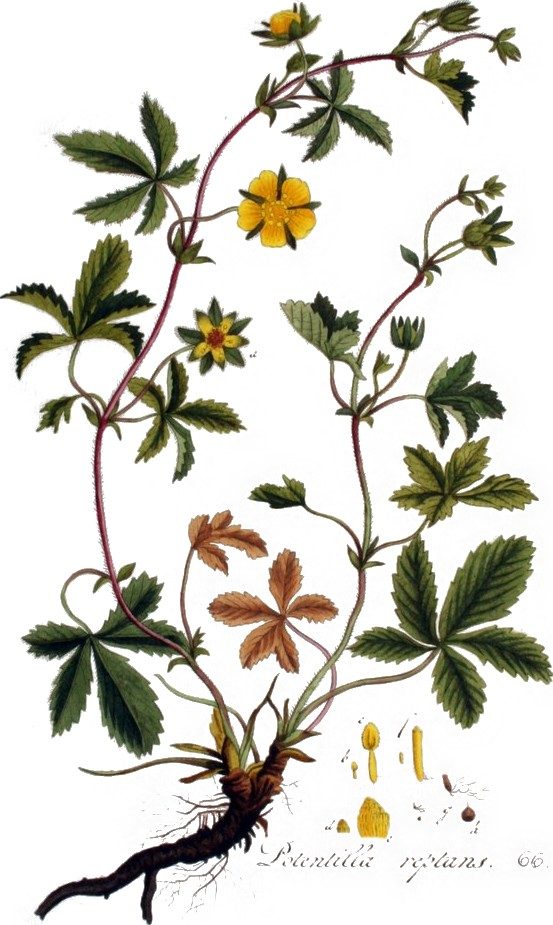
Cinquefoil
Pentafillo
- Known today as
- Potentilla reptans.
- Kind
- Plant, in 1 older authority
- Constituents
- tannins, agrimoniin, quercetin
- Earliest authority here
- Pliny (AD 23/24–79)
- In other databases
- Plants of the World Online search · GBIF search · Wikidata search
- In the Canale glossary
- On the Manner of Discerning and Healing the Bewitched, Appendix A: Part Three, Chapter 5: Vomitory Medicines
Revised October 1, 2026: An older authority added from a text read in full. Lore added from texts read in full. Version 1, first published September 25, 2026.
Cinquefoil: what did Canale use it for?
In an infusion of bean-trefoil bark with rue and peony (ch. 5).
Cinquefoil: what does modern science say?
Astringent, not emetic. Its five-fingered leaf gave it a long career in charms, especially love divinations.
Pharmacognosy & Toxicology
- Constituents
- tanninsellagitannins, 5–10 per cent
- agrimoniin ChEMBL
- quercetin ChEMBL
- Mechanism
- Potentilla reptans and its kin are astringents like tormentil, their stronger cousin: protein precipitation in the gut and on the skin.
- Toxic dose
- Safe at ordinary doses.
- Standing
- Neither creeping cinquefoil nor silverweed has an EMA monograph; tormentil, their stronger cousin, has one (2011), and both are used the same way in the German tradition.
- Tomczyk, M., and Latté, K. P. (2009). “Potentilla: a review of its phytochemical and pharmacological profile.” Journal of Ethnopharmacology 122. Verified against its record · doi:10.1016/j.jep.2008.12.022
The abstract of each source, beneath its citation. For Club members. About the Club or sign in.
Constituent names open the compound’s record at PubChem, and “ChEMBL” beside a name opens its record at ChEMBL, the European Bioinformatics Institute’s database of bioactive molecules. Where a mechanism line was checked against ChEMBL (ChEMBL 37, read 1 October 2026), the check is shown with the measured value and its source paper, or says plainly that nothing has been measured. Doses are as the references give them, for description only; this is not medical advice. Each source carries the result of its check against Crossref, PubMed, or the authority’s page: see Verification.
Cinquefoil: what lore surrounds it?
“In former days, Cinquefoil (Potentilla) much prevailed as an heraldic device; the number of the leaves answering to the five senses of man. The right to bear Cinquefoil was considered an honourable distinction to him who had worthily conquered his affections and mastered his senses.” In wet weather, Folkard adds, the leaves “contract and bend over the flower, forming, as it were, a little tent to cover it,” and the plant “was formerly believed to be a cure for agues; four branches being prescribed for a quartan, three for a tertian, and one for a quotidian.”
Thiselton-Dyer adds that “for ague, cinquefoil and yarrow were recommended.”
Grieve records Dioscorides' rule that “one leaf cured a quotidian, three a tertian, and four a quarten ague,” and the darker use: “In an old recipe called ‘Witches' Ointment’ the juice of Five-leaf Grass, smallage and wolfsbane is mixed with the fat of children dug up from their graves and added to fine wheat flour.”
Cinquefoil: what did the older authorities say?
- Pliny
- “There is no one to whom quinquefolium is unknown, being recommended by a sort of strawberry which it bears”: the Greeks call it pentapetes, pentaphyllon, and chamaezelon; its root is red when taken up and dries black and angular; it puts forth and withers with the leaves of the vine, and “this plant also is employed in the purification of houses”; its juice is given to those who have taken poison, and it serves for the bite of the phalangium and, bound to the head with iberis, for defluxions of the eyes.
Sources
- [54] Grieve, M. (1931). A Modern Herbal. Online edition, botanical.com, cited under the plant concerned. Read in part · the text read
- Pliny the Elder, Natural History 25.62, 25.72, 25.79, 25.91, trans. J. Bostock & H. T. Riley (1855), Perseus Digital Library. Primary text
- Folkard, R. (1884). Plant Lore, Legends, and Lyrics, “Cinquefoil.” Project Gutenberg #44638. Primary text
- Thiselton-Dyer, T. F. (1889). The Folk-lore of Plants. Project Gutenberg #10118. Read in part · the text read
- Grieve, M. (1931). A Modern Herbal, “Five-Leaf Grass.” botanical.com/botanical/mgmh/f/fivele20.html Standard reference work
Verification
- Checked
- October 1, 2026
- Passes
- Every sentence read against its sources, in the pass over the remaining 343 entries
- The Standing line checked against the authority it names (EMA, WHO, FDA, CITES, Commission E)
- Every dated or regulatory claim checked by category across the database
- Each quotation from the older authorities checked word for word against the text, read in full
- Sources
- 6 cited: 2 read in part, 1 verified against its record, 2 primary text, 1 standard reference work. 1 with the abstract on file.
- Corrections
- None were needed.
What was checked, how, and what was found is set out on the Verification page. A checked source is one whose record was found; it does not make the entry medical advice.
Cite This Entry
Version 1 · first published September 25, 2026 · last revised October 1, 2026
- Chicago
“Cinquefoil.” In Materia Medica, edited by B. C. P. Statema. Version 1. The Thinking Press, 2026–. Last modified October 1, 2026. https://thethinkingpress.org/materia-medica/cinquefoil.
- MLA
“Cinquefoil.” Materia Medica, edited by B. C. P. Statema, version 1, The Thinking Press, 1 Oct. 2026, thethinkingpress.org/materia-medica/cinquefoil. Accessed 8 Oct. 2026.
- APA
Cinquefoil. (2026, October 1). In B. C. P. Statema (Ed.), Materia medica (Version 1). The Thinking Press. Retrieved October 8, 2026, from https://thethinkingpress.org/materia-medica/cinquefoil
Club members keep entries on a shelf with private notes, print the plates as cards, and receive an entry by email each week. Create a free account before January 1, 2027 and all of it is yours for good. About the Club
See Also
Sharing tannins, agrimoniin, quercetin
Succisa pratensis · Bistorta officinalis · Diascordium · Betonica officinalis · Alchemilla vulgaris · Agrimonia eupatoria · Potentilla erecta · Allium cepa
Also in Pliny the Elder
Citron in Pliny the Elder · Cinnamon in Pliny the Elder · Clary, garden in Pliny the Elder · Cinnabar in Pliny the Elder · everything Pliny the Elder names →
Drawing on the same sources: Folkard, Thiselton-Dyer, Grieve
Coriander · Cinchona · Cumin · Colocynth · Caper spurge · Clove · Chicory · Coltsfoot · the bibliography →
Historical description, not medical advice.