
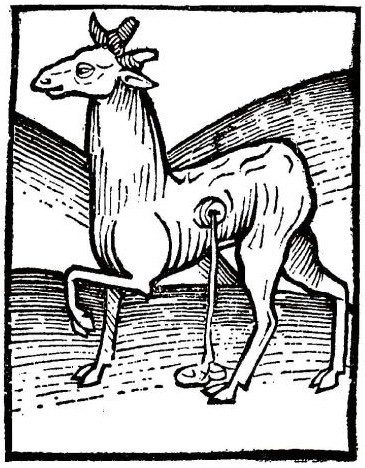
Musk
Muschio
- Known today as
- The secretion of the musk deer’s gland.
- Kind
- Animal, in 3 older authorities
- Constituents
- muscone, muscopyridine, steroids
- Earliest authority here
- Its name
- In the Canale glossary
- On the Manner of Discerning and Healing the Bewitched, Appendix A: Part Three, Chapter 6: Remedies Given by Mouth After the Purge
Revised October 3, 2026: Tradition, lore, modern assessment, and sources extended. Checked against its sources, each read in full, in part, or in its abstract. Version 1, first published September 25, 2026.
Musk: what did Canale use it for?
Tied at the nose of the alembic; in the fumigation and the oil (chs. 6, 8, 9).
Musk: what does modern science say?
Perfume. The trade is now restricted to protect the animal. Its scent is muscone, a large ring ketone, synthesised in 1926 after the first artificial musks were found by Albert Baur in 1888 while he was working on explosives. The musk deer is protected under CITES, and nearly all musk in perfume is now synthetic; the natural grain still enters Chinese medicine, where the Chinese Pharmacopoeia gives it for coma in critical illness, and poaching continues.
Pharmacognosy & Toxicology
- Constituents
- muscone ChEMBL3-methylcyclopentadecanone, the chief odorant
- muscopyridine
- steroids
- Mechanism
- From the preputial gland of the male musk deer: its macrocyclic ketone, muscone, is the chief odorant, and musk has been a perfume fixative since ancient times. In Chinese medicine (shexiang) it is given for coma and studied for stroke; muscone is anti-inflammatory in mice and protects the heart after infarction in rats. Synthetic musks replaced it in perfumery.
- Toxic dose
- Natural musk carries phenol, up to a tenth in some samples, whose toxicity has to be watched in medicinal preparations.
- Standing
- The trade is controlled under CITES, though poaching and illegal trade continue; Chinese medicine, save for specially exempt drugs, uses an artificial musk created in 1994.
- Chinese Pharmacopoeia Commission (2020). Pharmacopoeia of the People’s Republic of China, “Moschus.” Primary text
- CITES (2023). Appendices I, II and III, Moschidae. Primary text
Constituent names open the compound’s record at PubChem, and “ChEMBL” beside a name opens its record at ChEMBL, the European Bioinformatics Institute’s database of bioactive molecules. Where a mechanism line was checked against ChEMBL (ChEMBL 37, read 1 October 2026), the check is shown with the measured value and its source paper, or says plainly that nothing has been measured. Doses are as the references give them, for description only; this is not medical advice. Each source carries the result of its check against Crossref, PubMed, or the authority’s page: see Verification.
What Medicine Makes of It
- The Purge, the Vomit, and the BathWhat the regimen did to the body.
Musk: what lore surrounds it?
To take the pod the deer is killed and the gland cut out, and a grain of musk will scent millions of cubic feet of air; and because the deer lives only in Central Eurasia, the rest of the world had to trade for it.
Used in These Compounds
Musk is an ingredient of 4 compound medicines in the database. For Club members. Create a free account or sign in.
Musk: what did the older authorities say?
- Its name
- From the Sanskrit muṣka, “testicle,” for the shape of the pod cut from the belly of the male musk deer of the Himalaya and Tibet, by way of Persian and Greek.
- The Islamic world
- Held musk the most fragrant of scents and the most important of all aromatics: the Prophet and his companions used it widely, and the Qur’an makes it the seal of the choice wine of Paradise.
- The Galenic physicians
- Put it into the great compounds of this book: the diamoschu, which Culpeper says “wonderfully helps cold afflictions of the brain,” melancholy, giddiness, the falling-sickness, and palsies, and the troches of gallia moschata, which “strengthen the brain and heart.”
Sources
- King, A. (2017). Scent from the Garden of Paradise: Musk and the Medieval Islamic World. Leiden: Brill. Abstract read · the text read
- Wikipedia, “Musk.” Read in full · the text read
- Wikipedia, “Muscone.” Read in full · the text read
- Wikipedia, “Synthetic musk.” Read in full · the text read
- Encyclopædia Britannica (1911), 11th ed., “Musk” and “Musk-deer,” vol. 19, p. 90. Wikisource. Read in full · the text read
- The Koran, trans. J. M. Rodwell (1861), Sura LXXXIII. Project Gutenberg #2800. Read in part · the text read
- Zheng, C., et al. (2025). Volatile compounds in musk and their anti-stroke mechanisms. Metabolites 15: 181. Read in full · the text read
- Lv, S., et al. (2022). Chemical compositions and pharmacological activities of natural musk (Moschus) and artificial musk: a review. Journal of Ethnopharmacology 284: 114799. Abstract read · the text read
- Hui, H., et al. (2025). Muscone attenuates myocardial infarction by regulating ferroptosis of cardiomyocytes through Nrf2/system Xc-/GPX4 signaling pathway. International Immunopharmacology. Abstract read · the text read
- Yan, Z., et al. (2026). Muscone promotes PINK1/Parkin-associated mitophagy to suppress NLRP3 inflammasome activation: implications for endotoxemia therapy. Pharmaceuticals. Abstract read · the text read
Verification
- Checked
- October 1, 2026, and October 3, 2026
- Passes
- Every sentence read against its sources, in the fifty-entry sample
- The Standing line checked against the authority it names (EMA, WHO, FDA, CITES, Commission E)
- Every dated or regulatory claim checked by category across the database
- Every source read, in full, in part, or in its abstract, and every sentence checked against what was read (October 3, 2026)
- Sources
- 12 cited: 5 read in full, 1 read in part, 4 abstract read, 2 primary text. 4 with the abstract on file.
- Corrections
- None were needed.
What was checked, how, and what was found is set out on the Verification page. A checked source is one whose record was found; it does not make the entry medical advice.
Cite This Entry
Version 1 · first published September 25, 2026 · last revised October 3, 2026
- Chicago
“Musk.” In Materia Medica, edited by B. C. P. Statema. Version 1. The Thinking Press, 2026–. Last modified October 3, 2026. https://thethinkingpress.org/materia-medica/musk.
- MLA
“Musk.” Materia Medica, edited by B. C. P. Statema, version 1, The Thinking Press, 3 Oct. 2026, thethinkingpress.org/materia-medica/musk. Accessed 8 Oct. 2026.
- APA
Musk. (2026, October 3). In B. C. P. Statema (Ed.), Materia medica (Version 1). The Thinking Press. Retrieved October 8, 2026, from https://thethinkingpress.org/materia-medica/musk
Club members keep entries on a shelf with private notes, print the plates as cards, and receive an entry by email each week. Create a free account before January 1, 2027 and all of it is yours for good. About the Club
See Also
Sharing muscone
Drawing on the same sources: Wikipedia, Lv
Nutmeg and clove · Mummy · Oak galls · Citron · the bibliography →
Nearby in the alphabet
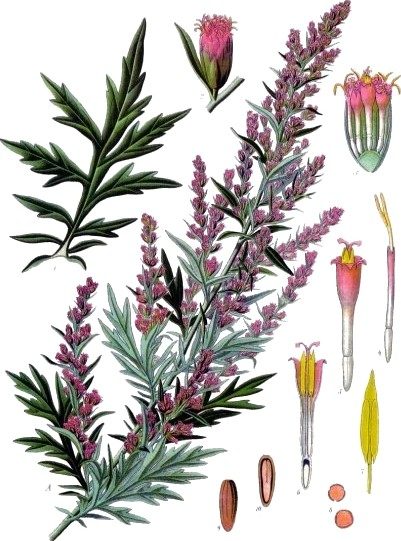
Mustard seed (The English follows the 1674 text as “mustard”) · Myrobalans (T) · Mullein (Verbascum thapsus) · Myrrh (The resin of Commiphora myrrha) · Mugwort (Artemisia vulgaris) · Nasturtium, that is, garden cress (Lepidium sativum) · Motherwort (of the mint family, a tall, prickly-calyxed herb of waste ground)
Historical description, not medical advice.