
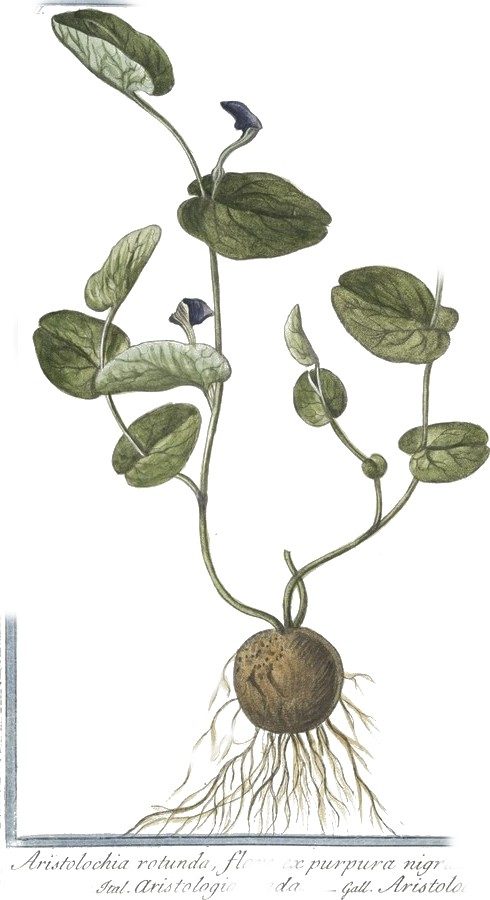
Round birthwort
Aristolochia rotonda
- Known today as
- Aristolochia rotunda.
- Kind
- Plant, in 1 older authority
- Constituents
- aristolochic acid I, aristolochic acid II
- Poisoning
- Aristolochic acid nephropathy
- Earliest authority here
- The name
- In other databases
- Plants of the World Online search · GBIF search · Wikidata search
- In the Canale glossary
- On the Manner of Discerning and Healing the Bewitched, Appendix A: Part Three, Chapter 6: Remedies Given by Mouth After the Purge
Revised October 1, 2026: Lore added from texts read in full. Version 1, first published September 25, 2026.
Caution. Hazardous in some form or dose; see the modern assessment below.
Round birthwort: what did Canale use it for?
In the cockerel, the bath, the oil; as an amulet (chs. 6–7, 9–10).
Round birthwort: what does modern science say?
Named for its use in childbirth. It contains aristolochic acid, which causes kidney failure and cancer, and is banned or restricted in herbal medicines in many countries.
Round birthwort: is it poisonous?
Yes, in some form or dose. Its poisoning is aristolochic acid nephropathy: Months to years of exposure; the kidney damage is cumulative and silent. Historical description, not medical advice; in a poisoning, call a poison centre.
Pharmacognosy & Toxicology
- Constituents
- Mechanism
- The aristolochic acids are activated in the kidney to compounds that bind DNA; the adducts cause a characteristic mutation and kill the tubule cells.
- Toxic dose
- Cumulative; the Belgian patients took about 200 g of the herb over a year.
- Syndrome
- Aristolochic acid nephropathy
- Standing
- Banned in the European Union, the United States (2001), and most of Asia; the FDA warns against every product containing Aristolochia.
- Vanherweghem, J.-L., et al. (1993). Lancet 341. Verified against its record · doi:10.1016/0140-6736(93)91209-5
- Hoang, M. L., et al. (2013). “Mutational signature of aristolochic acid exposure as revealed by whole-exome sequencing.” Science Translational Medicine 5. Verified against its record · doi:10.1126/scitranslmed.3006200
Constituent names open the compound’s record at PubChem, and “ChEMBL” beside a name opens its record at ChEMBL, the European Bioinformatics Institute’s database of bioactive molecules. Where a mechanism line was checked against ChEMBL (ChEMBL 37, read 1 October 2026), the check is shown with the measured value and its source paper, or says plainly that nothing has been measured. Doses are as the references give them, for description only; this is not medical advice. Each source carries the result of its check against Crossref, PubMed, or the authority’s page: see Verification.
Round birthwort: what lore surrounds it?
Folkard derives the old English name “from its reputed remedial powers in parturition—probably first suggested by the shape of the corolla—whence also its Greek name, from aristos, best, and locheia, delivery,” and adds from Pliny that “if the expectant mother desired to have a son, she employed Aristolochia, with the flesh of an ox.” Certain species are “renowned, in some European countries, for having a wonderful influence over fishes and serpents”; the snake jugglers of Egypt “are believed to stupefy these reptiles by means of a decoction distilled from the plant,” and “Apuleius recommends the use of Aristolochia against the Evil Eye.”
Grieve adds that Aristolochia sempervirens “is said to be used by the Arabians as a remedy against the poisonous effects of snake-bite,” and the serpentary of North America “as an alexiteric and for the bites of mad dogs.”
Round birthwort: what did the older authorities say?
- The name
- Greek aristolochia, “best for childbirth”: its curved flower was read as a sign of the womb, and it was given to hasten labor.
Sources
- [38] Encyclopaedia Britannica, online edition, britannica.com. Articles: Ambergris; Aristolochiaceae; Asafetida; Azurite; Castor-oil plant; Civet; Dragon’s blood; Garden cress; Jet; Kermes; Laudanum; Lye; Monemvasía; Musk; Precious coral; Saltpetre; Sulfur dioxide; Tartar emetic; Tropaeolum. Book, seen in reviews
- [46] U.S. Food and Drug Administration (2020). Import Alert 54-10: Detention without physical examination of bulk/finished dietary supplement products containing aristolochic acid. Book, not indexed
- [65] International Agency for Research on Cancer (2002). Aristolochia species and aristolochic acids. IARC Monographs 82, Summary and Evaluation. inchem.org. Standard reference work
- [126] Zhou, Q., Jiang, L., Su, T., Liu, G., & Yang, L. (2023). Overview of aristolochic acid nephropathy: an update. Kidney Research and Clinical Practice 42(5): 579–590. doi:10.23876/j.krcp.22.211 Verified against its record · doi:10.23876/j.krcp.22.211
- Folkard, R. (1884). Plant Lore, Legends, and Lyrics, “Aristolochia.” Project Gutenberg #44638. Primary text
- Grieve, M. (1931). A Modern Herbal, “Birthwort.” botanical.com/botanical/mgmh/b/birthw44.html Standard reference work
Verification
- Checked
- October 1, 2026
- Passes
- Every sentence read against its sources, in the pass over the remaining 343 entries
- The Standing line checked against the authority it names (EMA, WHO, FDA, CITES, Commission E)
- Every dated or regulatory claim checked by category across the database
- Each quotation from the older authorities checked word for word against the text, read in full
- Sources
- 8 cited: 3 verified against its record, 1 primary text, 2 standard reference work, 1 book, seen in reviews, 1 book, not indexed.
- Corrections
- None were needed.
What was checked, how, and what was found is set out on the Verification page. A checked source is one whose record was found; it does not make the entry medical advice.
Cite This Entry
Version 1 · first published September 25, 2026 · last revised October 1, 2026
- Chicago
“Round birthwort.” In Materia Medica, edited by B. C. P. Statema. Version 1. The Thinking Press, 2026–. Last modified October 1, 2026. https://thethinkingpress.org/materia-medica/round-birthwort.
- MLA
“Round birthwort.” Materia Medica, edited by B. C. P. Statema, version 1, The Thinking Press, 1 Oct. 2026, thethinkingpress.org/materia-medica/round-birthwort. Accessed 8 Oct. 2026.
- APA
Round birthwort. (2026, October 1). In B. C. P. Statema (Ed.), Materia medica (Version 1). The Thinking Press. Retrieved October 8, 2026, from https://thethinkingpress.org/materia-medica/round-birthwort
Club members keep entries on a shelf with private notes, print the plates as cards, and receive an entry by email each week. Create a free account before January 1, 2027 and all of it is yours for good. About the Club
See Also
Poisoned alike: aristolochic acid nephropathy
Drawing on the same sources: Folkard, Grieve
Savin · Radish · Spikenard · Rowan · Rosemary rice water · Rue · the bibliography →
Nearby in the alphabet
Rosemary (Salvia rosmarinus (formerly Rosmarinus officinalis)) · Saffron (The stigmas of Crocus sativus) · Rose · Saffron milk cap (An orange mushroom of pine woods that weeps carrot-colored milk) · Rosary (Strings of prayer beads)
Historical description, not medical advice.