
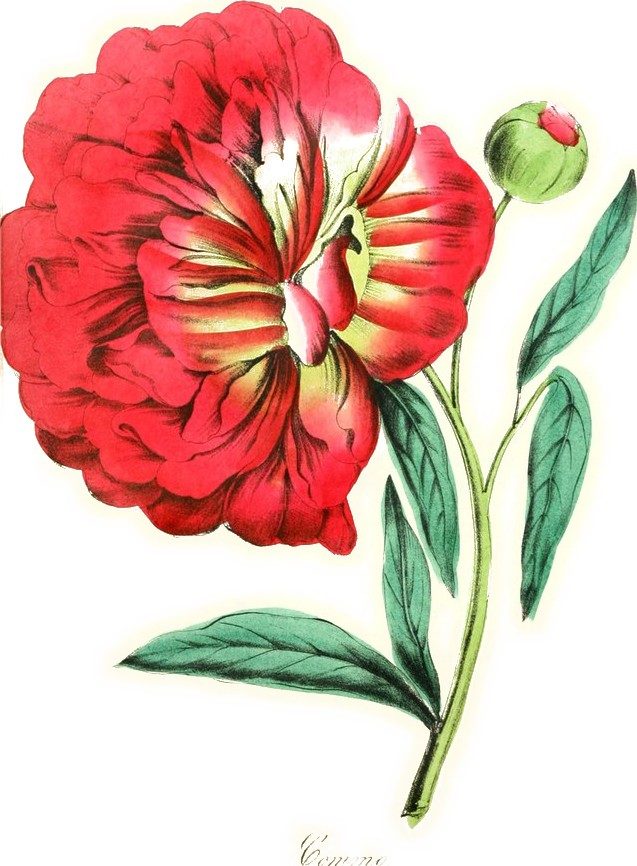
Peony
Peonia
- Known today as
- Paeonia officinalis and the “male” peony, the kind formerly grown for its medicinal root.
- Kind
- Plant, in 3 older authorities
- Constituents
- paeoniflorin, paeonol
- Earliest authority here
- Homer (fl. c. 8th century BC)
- In other databases
- Plants of the World Online search · GBIF search · Wikidata search
- In the Canale glossary
- On the Manner of Discerning and Healing the Bewitched, Appendix A: Part Three, Chapter 6: Remedies Given by Mouth After the Purge
Peony: what did Canale use it for?
Seed, root, and water throughout the powders and waters; its root in the oil; among the amulets (chs. 5–6, 9–10).
Peony: what does modern science say?
Peony root was the ancient specific against epilepsy, hung round children’s necks since Galen, and was still reckoned antispasmodic in the nineteenth century. Its use against epilepsy has not been established by controlled trials, though an open-label pilot study of thirty children with intractable epilepsy (Zangooei Pourfard et al., 2021) reported fewer seizures on a root extract.
Pharmacognosy & Toxicology
- Constituents
- paeoniflorin ChEMBL
- paeonol ChEMBLin the bark of the tree peony
- Mechanism
- Paeoniflorin relaxes smooth muscle and modulates the immune system in animals; the Chinese total glucosides of peony are a licensed drug for rheumatoid arthritis there.
- Toxic dose
- No toxicity reported.
- Standing
- No approval in the West; the root is in the Chinese pharmacopoeia.
- He, D.-Y., and Dai, S.-M. (2011). “Anti-inflammatory and immunomodulatory effects of Paeonia lactiflora Pall.” Frontiers in Pharmacology 2. Verified against its record · doi:10.3389/fphar.2011.00010
- Zangooei Pourfard, M., et al. (2021). “Efficacy and tolerability of hydroalcoholic extract of Paeonia officinalis in children with intractable epilepsy: an open-label pilot study.” Epilepsy Research 176. Verified against its record · doi:10.1016/j.eplepsyres.2021.106735
The abstract of each source, beneath its citation. For Club members. About the Club or sign in.
Constituent names open the compound’s record at PubChem, and “ChEMBL” beside a name opens its record at ChEMBL, the European Bioinformatics Institute’s database of bioactive molecules. Where a mechanism line was checked against ChEMBL (ChEMBL 37, read 1 October 2026), the check is shown with the measured value and its source paper, or says plainly that nothing has been measured. Doses are as the references give them, for description only; this is not medical advice. Each source carries the result of its check against Crossref, PubMed, or the authority’s page: see Verification.
What Medicine Makes of It
- The Nightmare and the HagThe incubus that sits on the chest, and sleep paralysis.
- The IncubusThe demon lover of the night, and the sleep that cannot move.
- The Falling SicknessEpilepsy, the demon that throws the child into the fire.
Peony: what lore surrounds it?
Worn by children against epilepsy and night terrors into the modern period; the seeds were strung as teething beads.
Peony: what did the older authorities say?
- Homer
- Named for Paeon, physician of the gods, who in the Iliad heals the wounds of Hades and of Ares.
- Theophrastus
- Records the lore that the root must be dug by night, lest a woodpecker see the gatherer and peck out his eyes.
- Galen
- Tells of a boy kept free of fits while a piece of peony root hung at his neck, a report that made the root the classic amulet against the falling sickness.
Sources
- [17] Buchanan, A. (2020). Plant of the Month: Peony. JSTOR Daily, 29 July 2020. Book, seen in reviews
- [43] Felter, H. W., & Lloyd, J. U. (1898). King’s American Dispensatory. Monographs as transcribed at Henriette’s Herbal Homepage, henriettes-herb.com, cited under the drug concerned. Read in full · the text read
- [54] Grieve, M. (1931). A Modern Herbal. Online edition, botanical.com, cited under the plant concerned. Read in part · the text read
- [125] Zangooei Pourfard, M., et al. (2021). Efficacy and tolerability of hydroalcoholic extract of Paeonia officinalis in children with intractable epilepsy: an open-label pilot study. Epilepsy Research 176: 106735. doi:10.1016/j.eplepsyres.2021.106735 Verified against its record · doi:10.1016/j.eplepsyres.2021.106735
Verification
- Checked
- October 1, 2026
- Passes
- Every sentence read against its sources, in the fifty-entry sample
- The Standing line checked against the authority it names (EMA, WHO, FDA, CITES, Commission E)
- Every dated or regulatory claim checked by category across the database
- Sources
- 6 cited: 1 read in full, 1 read in part, 3 verified against its record, 1 book, seen in reviews. 1 with the abstract on file.
- Corrections
- the "small uncontrolled study (2021)" is now named (Zangooei Pourfard et al., Epilepsy Research 176) and cited.
What was checked, how, and what was found is set out on the Verification page. A checked source is one whose record was found; it does not make the entry medical advice.
Cite This Entry
Version 1 · first published September 25, 2026
- Chicago
“Peony.” In Materia Medica, edited by B. C. P. Statema. Version 1. The Thinking Press, 2026–. Last modified September 25, 2026. https://thethinkingpress.org/materia-medica/peony.
- MLA
“Peony.” Materia Medica, edited by B. C. P. Statema, version 1, The Thinking Press, 25 Sept. 2026, thethinkingpress.org/materia-medica/peony. Accessed 8 Oct. 2026.
- APA
Peony. (2026, September 25). In B. C. P. Statema (Ed.), Materia medica (Version 1). The Thinking Press. Retrieved October 8, 2026, from https://thethinkingpress.org/materia-medica/peony
Club members keep entries on a shelf with private notes, print the plates as cards, and receive an entry by email each week. Create a free account before January 1, 2027 and all of it is yours for good. About the Club
See Also
Also in Homer
Sulfur in Homer · Nepenthe in Homer · Moly in Homer · everything Homer names →
Also in Theophrastus
White lead in Theophrastus · Opopanax in Theophrastus · Cinnabar in Theophrastus · Mandrake in Theophrastus · everything Theophrastus names →
Also in Galen
Purslane in Galen · Hiera picra in Galen · Terra sigillata in Galen · Garlic in Galen · everything Galen names →
Drawing on the same sources: He
Nearby in the alphabet
Periwinkle (the lesser periwinkle, a trailing evergreen with blue flowers) · Pennyroyal (Mentha pulegium) · Pilewort · Penicillin mould (fruit, and damp) · Pilgrim badges and ampullae · Pearls, prepared (Pearls ground to a fine powder) · Plantain (Plantago major) · Pawpaw (the one temperate tree of the custard-apple family)
Historical description, not medical advice.