
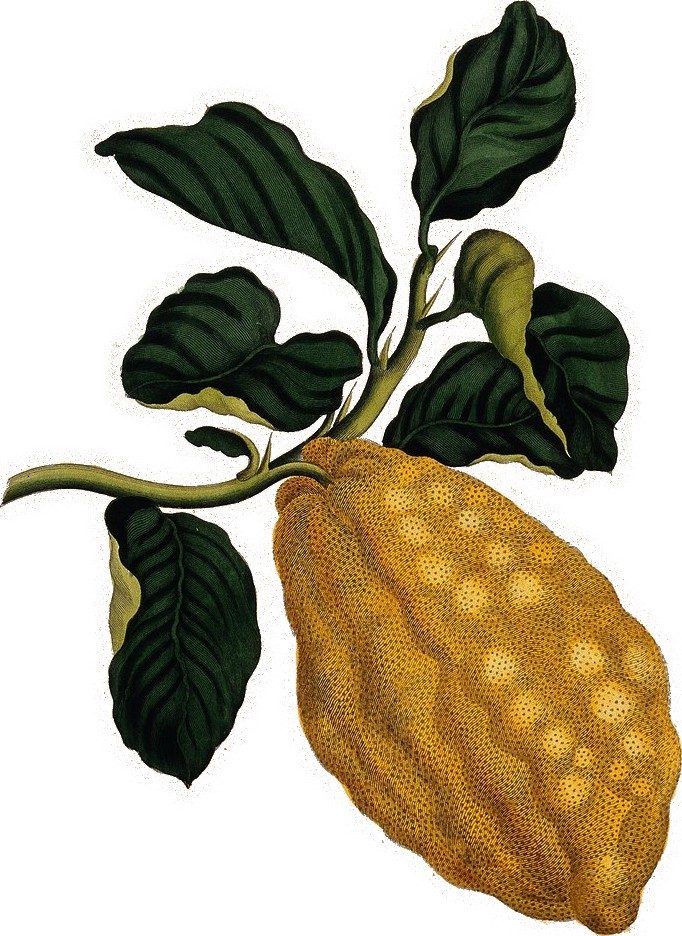
Citron
Cedro
- Known today as
- Citrus medica, the large thick-rinded ancestor of the lemon.
- Kind
- Plant, in 1 older authority
- Constituents
- limonene, citral, bergapten, and 1 more
- Poisoning
- Phytophotodermatitis
- Earliest authority here
- Pliny (AD 23/24–79)
- In other databases
- Plants of the World Online search · GBIF search · Wikidata search
- In the Canale glossary
- On the Manner of Discerning and Healing the Bewitched, Appendix A: Treatise One, Part Three, Chapters 2–3: Purgative and Preparative Medicines
Revised October 1, 2026: An older authority added from a text read in full. Version 1, first published September 25, 2026.
Citron: what did Canale use it for?
The seed in purges; the peel in decoctions, pills, and syrup (chs. 4, 6).
Citron: what does modern science say?
Flavor and aroma. No purgative action.
Pharmacognosy & Toxicology
- Constituents
- Mechanism
- The peel oil is carminative and the pith’s pectin is a bulk laxative; the furanocoumarins make the skin burn in sunlight after handling the peel, which is why citrus pickers blister.
- Toxic dose
- Safe as food; the oil on the skin before sun gives phototoxic burns.
- Syndrome
- Phytophotodermatitis
- Standing
- A food; no monograph. The related bitter orange peel has an EMA monograph for dyspepsia.
- Wagner, A. M., et al. (2002). “Bullous phytophotodermatitis associated with high natural concentrations of furanocoumarins in limes.” American Journal of Contact Dermatitis 13. Verified against its record · doi:10.1053/ajcd.2002.29948
- Lv, X., et al. (2015). “Citrus fruits as a treasure trove of active natural metabolites.” Chemistry Central Journal 9. Verified against its record · doi:10.1186/s13065-015-0145-9
The abstract of each source, beneath its citation. For Club members. About the Club or sign in.
Constituent names open the compound’s record at PubChem, and “ChEMBL” beside a name opens its record at ChEMBL, the European Bioinformatics Institute’s database of bioactive molecules. Where a mechanism line was checked against ChEMBL (ChEMBL 37, read 1 October 2026), the check is shown with the measured value and its source paper, or says plainly that nothing has been measured. Doses are as the references give them, for description only; this is not medical advice. Each source carries the result of its check against Crossref, PubMed, or the authority’s page: see Verification.
Citron: what lore surrounds it?
Beyond the apothecary, the citron holds a place in Jewish practice of its own: it is the etrog, one of the Four Species held and blessed during Sukkot, a use continuously attested for more than two thousand years.
Citron: what did the older authorities say?
- Pliny
- Calls the citron tree “the Assyrian, and by some the Median apple,” an antidote against poisons, whose fruit “is never eaten” but whose smell is so strong that it penetrates clothes; and later gives citrons, “either the pulp of them or the pips,” taken in wine as an antidote, the juice as a gargle to sweeten the breath, the pips for pregnant women to chew against qualmishness, and the fruit for a weak stomach, “but it is not easy to eat them except with vinegar.”
Sources
- [124] Wu, G. A., et al. (2018). Genomics of the origin and evolution of Citrus. Nature 554: 311–316. doi:10.1038/nature25447 Verified against its record · doi:10.1038/nature25447
- Pliny the Elder, Natural History 12.7, 23.56, trans. J. Bostock & H. T. Riley (1855), Perseus Digital Library. Primary text
Verification
- Checked
- October 1, 2026
- Passes
- Every sentence read against its sources, in the pass over the remaining 343 entries
- The Standing line checked against the authority it names (EMA, WHO, FDA, CITES, Commission E)
- Every dated or regulatory claim checked by category across the database
- Each quotation from the older authorities checked word for word against the text, read in full
- Sources
- 4 cited: 3 verified against its record, 1 primary text. 3 with the abstract on file.
- Corrections
- None were needed.
What was checked, how, and what was found is set out on the Verification page. A checked source is one whose record was found; it does not make the entry medical advice.
Cite This Entry
Version 1 · first published September 25, 2026 · last revised October 1, 2026
- Chicago
“Citron.” In Materia Medica, edited by B. C. P. Statema. Version 1. The Thinking Press, 2026–. Last modified October 1, 2026. https://thethinkingpress.org/materia-medica/citron.
- MLA
“Citron.” Materia Medica, edited by B. C. P. Statema, version 1, The Thinking Press, 1 Oct. 2026, thethinkingpress.org/materia-medica/citron. Accessed 8 Oct. 2026.
- APA
Citron. (2026, October 1). In B. C. P. Statema (Ed.), Materia medica (Version 1). The Thinking Press. Retrieved October 8, 2026, from https://thethinkingpress.org/materia-medica/citron
Club members keep entries on a shelf with private notes, print the plates as cards, and receive an entry by email each week. Create a free account before January 1, 2027 and all of it is yours for good. About the Club
See Also
Poisoned alike: phytophotodermatitis
Dittany · Masterwort and angelica · Fig · Lovage · the syndrome, with all of them →
Sharing limonene, citral, bergapten
Anethum graveolens · Elettaria cardamomum · Carum carvi · Origanum vulgare · Melissa officinalis · Verbena officinalis · Ruta graveolens
Also in Pliny the Elder
Clary, garden in Pliny the Elder · Cinquefoil in Pliny the Elder · Clove in Pliny the Elder · Cinnamon in Pliny the Elder · everything Pliny the Elder names →
Drawing on the same sources: Lv
Nearby in the alphabet
Civet (The glandular secretion of the civet cat) · Cinnabar (Mercury sulfide) · Cochia pills · Cinchona (The bark of Cinchona trees of the Andes)
Historical description, not medical advice.