
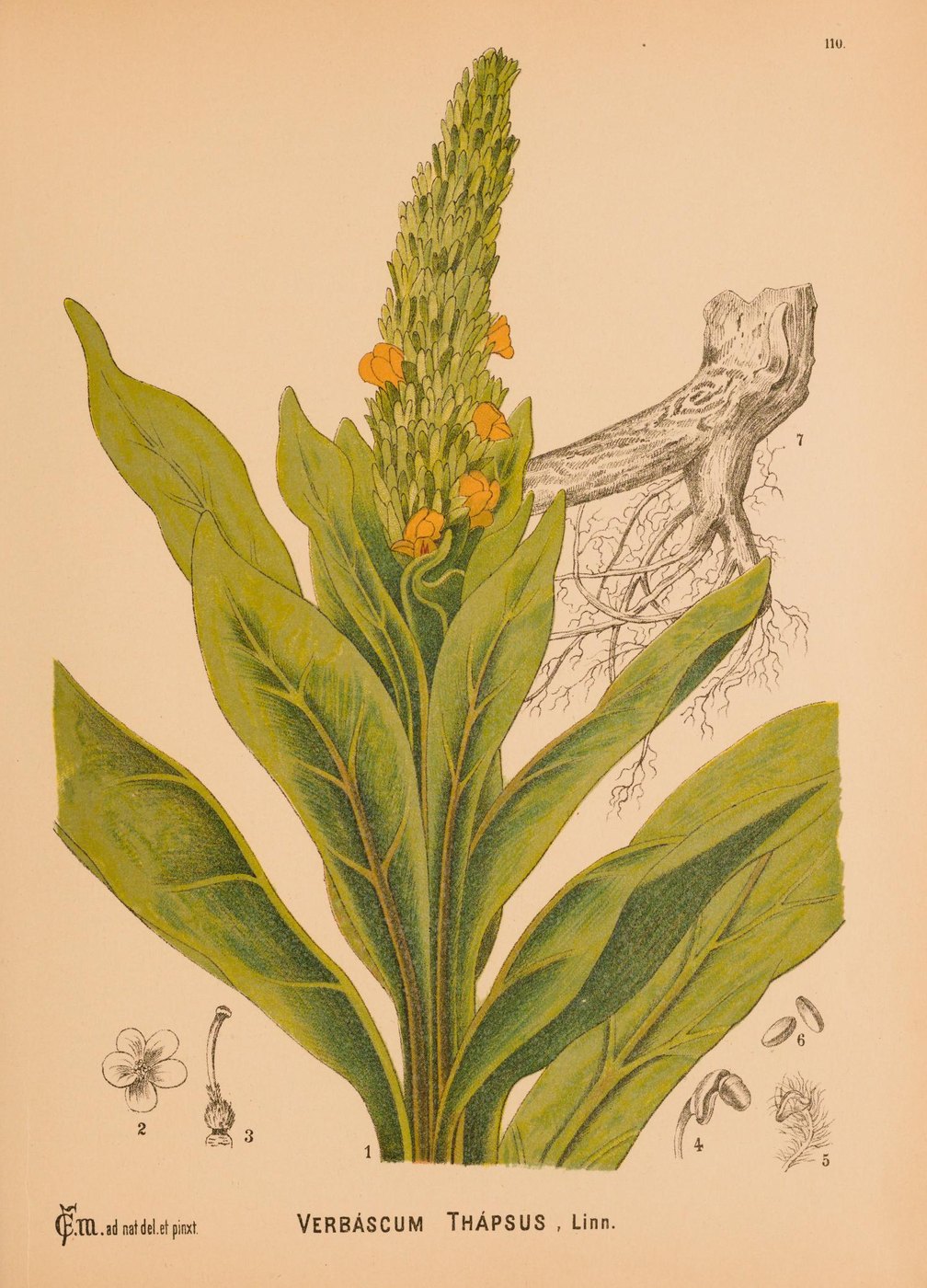
Mullein
Verbascum; hag’s taper
- Known today as
- Verbascum thapsus.
- Kind
- Plant, in 2 older authorities
- Constituents
- mucilage, verbascoside, aucubin, and 1 more
- Earliest authority here
- Dioscorides (c. AD 40–90)
- In other databases
- Plants of the World Online search · GBIF search · Wikidata search
Revised October 1, 2026: Tradition, lore, modern assessment, and sources extended. Version 1, first published September 25, 2026.
Mullein: what was it used for?
For coughs and the lungs; the leaves as lamp-wicks, the dried stalks dipped in tallow as torches.
Mullein: foraging it in the Midwest
- Part
- Leaves
- When
- Summer
The Flambeau Ojibwe had no name for it, since it came into their territory from the south, and did not use it; Smith gathered it for his grandmother, who smoked the leaves for asthma and bronchitis.
After Smith. All the foragables of the Midwest. Historical record, not a field guide: identify before you gather, and read the whole entry.
Mullein: how is it taken as a tea?
An ounce of the flowers or leaves to a pint of boiling water, in wineglassful doses, always strained through fine muslin to catch the hairs, which otherwise itch the mouth intolerably: a remedy of the greatest antiquity for coughs and colds.
All the herbal teas of the database. Historical directions, not medical advice.
Mullein: what does modern science say?
A mild demulcent for coughs. The flowers are rich in mucilage and saponins, which account for its soothing of a cough, and extracts kill some bacteria in the dish; no drug has been made from it. Mullein oil, the flowers steeped in olive oil, is still dropped in the ear for earache in folk and herbal practice.
Pharmacognosy & Toxicology
- Constituents
- Mechanism
- The mucilage soothes the throat and the saponins thin the phlegm: a demulcent expectorant. The flower oil in the ear, a folk remedy, was tested in children with ear pain in a herbal mixture (Sarrell, 2001) and matched the anaesthetic drops.
- Toxic dose
- Safe; the leaf hairs irritate the throat if the tea is not strained.
- Standing
- EMA monograph (2018) for the flower for sore throat and dry cough, on tradition.
- EMA/HMPC (2018). European Union herbal monograph on Verbascum thapsus L., V. densiflorum Bertol. and V. phlomoides L., flos (EMA/HMPC/611537/2016). Verified against its record
- Sarrell, E. M., et al. (2001). “Efficacy of naturopathic extracts in the management of ear pain associated with acute otitis media.” Archives of Pediatrics and Adolescent Medicine 155. Verified against its record · doi:10.1001/archpedi.155.7.796
The abstract of each source, beneath its citation. For Club members. About the Club or sign in.
Constituent names open the compound’s record at PubChem, and “ChEMBL” beside a name opens its record at ChEMBL, the European Bioinformatics Institute’s database of bioactive molecules. Where a mechanism line was checked against ChEMBL (ChEMBL 37, read 1 October 2026), the check is shown with the measured value and its source paper, or says plainly that nothing has been measured. Doses are as the references give them, for description only; this is not medical advice. Each source carries the result of its check against Crossref, PubMed, or the authority’s page: see Verification.
Mullein: what lore surrounds it?
“Hag’s taper”: its torches were said to light the witches’ gatherings, and to drive away evil spirits.
Settlers carried it to America, where native peoples took up the smoking of the dried leaf for the lungs and lined their moccasins with the soft leaves against the cold; the seeds, thrown in water, stunned fish. Its other names run to Adam’s flannel, Aaron’s rod, and candlewick plant, the down of the leaves having served as wicks.
Mullein: what did the older authorities say?
- Dioscorides
- Gives phlomos for coughs and the chest, and the leaves for burns and old sores.
- Pliny
- Describes two kinds of verbascum, and the stalks dipped in tallow and burned as torches at funerals, whence the Roman candela regia, the king’s candle.
Sources
- Dioscorides, De materia medica. Read in part · the text read
- Grieve, M. A Modern Herbal, “Mullein, Great.” As published on botanical.com.
- Pliny, Natural History XXV. Primary text
- Turker, A. U., and Gurel, E. (2005). “Common mullein: recent advances in research.” Phytotherapy Research 19. Verified against its record · doi:10.1002/ptr.1653
Verification
- Checked
- October 1, 2026
- Passes
- Every sentence read against its sources, in the pass over the remaining 343 entries
- The Standing line checked against the authority it names (EMA, WHO, FDA, CITES, Commission E)
- Every dated or regulatory claim checked by category across the database
- Sources
- 6 cited: 1 read in part, 3 verified against its record, 1 primary text, 1 not yet checked. 2 with the abstract on file.
- Corrections
- None were needed.
What was checked, how, and what was found is set out on the Verification page. A checked source is one whose record was found; it does not make the entry medical advice.
Cite This Entry
Version 1 · first published September 25, 2026 · last revised October 1, 2026
- Chicago
“Mullein.” In Materia Medica, edited by B. C. P. Statema. Version 1. The Thinking Press, 2026–. Last modified October 1, 2026. https://thethinkingpress.org/materia-medica/mullein.
- MLA
“Mullein.” Materia Medica, edited by B. C. P. Statema, version 1, The Thinking Press, 1 Oct. 2026, thethinkingpress.org/materia-medica/mullein. Accessed 8 Oct. 2026.
- APA
Mullein. (2026, October 1). In B. C. P. Statema (Ed.), Materia medica (Version 1). The Thinking Press. Retrieved October 8, 2026, from https://thethinkingpress.org/materia-medica/mullein
Club members keep entries on a shelf with private notes, print the plates as cards, and receive an entry by email each week. Create a free account before January 1, 2027 and all of it is yours for good. About the Club
See Also
Sharing mucilage, verbascoside, aucubin
Plantago major · Pulmonaria officinalis · Cydonia oblonga · Sempervivum tectorum · Verbena officinalis · Euphrasia officinalis · Atriplex hortensis · Impatiens capensis
Also in Dioscorides
Opium poppy in Dioscorides · Melon root in Dioscorides · Meadow saffron in Dioscorides · everything Dioscorides names →
Also in Pliny the Elder
Nasturtium, that is, garden cress in Pliny the Elder · Mugwort in Pliny the Elder · Nettle seed in Pliny the Elder · Mithridate in Pliny the Elder · everything Pliny the Elder names →
Drawing on the same sources: Dioscorides, Grieve, Pliny
Oak galls · Mustard seed · Olive oil and holy water · Niter, pills of · Mistletoe · the bibliography →
Nearby in the alphabet
Mummy (sold by the apothecaries) · Musk (The secretion of the musk deer’s gland) · Motherwort (of the mint family, a tall, prickly-calyxed herb of waste ground) · Morel (hollow spring mushroom) · Myrobalans (T) · Moonwort (The small fern Botrychium lunaria)
Historical description, not medical advice.