
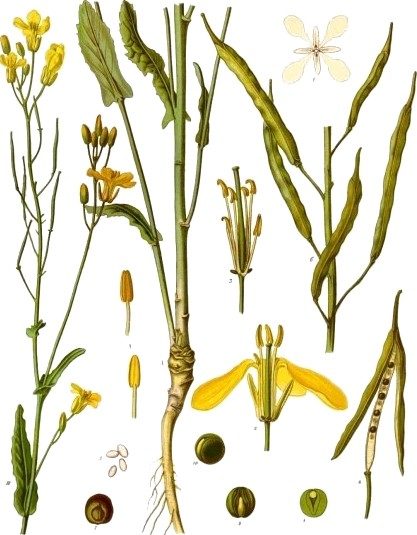
Mustard seed
Seme di napo, 1660
- Known today as
- The English follows the 1674 text as “mustard”; the 1660 printing, whose Italian is given in the heading, reads sem. napi, the seed of rape (Brassica napus), a close relative.
- Kind
- Plant, in 1 older authority
- Constituents
- sinigrin, allyl isothiocyanate
- Earliest authority here
- Matthew 13:31 (the Hebrew Bible and the New Testament)
- In other databases
- Plants of the World Online search · GBIF search · Wikidata search
- In the Canale glossary
- On the Manner of Discerning and Healing the Bewitched, Appendix A: Part Three, Chapter 5: Vomitory Medicines
Revised October 1, 2026: Lore added from texts read in full. Version 1, first published September 25, 2026.
Mustard seed: what did Canale use it for?
Powdered, with squill oxymel and radish, as a vomit (ch. 5).
Mustard seed: what does modern science say?
Mustard in warm water is a genuine emetic and was long used in first aid for poisoning, a practice poison centers now advise against.
Pharmacognosy & Toxicology
- Constituents
- sinigrina glucosinolate
- allyl isothiocyanate ChEMBLthe pungent oil, freed by the seed’s own enzyme
- Mechanism
- Allyl isothiocyanate activates TRPA1 and inflames the skin: the mustard plaster.
- Checked against ChEMBL
- allyl isothiocyanate: Measured, as the entry says (“activates TRPA1”): Transient receptor potential cation channel subfamily A member 1 (human), EC50 398 nM, CHEMBL1255565; Transient receptor potential cation channel subfamily A member 1 (rat), EC50 1.4 µM, CHEMBL5338786.
- Toxic dose
- Blisters from a plaster left too long; the oil is a lachrymator.
- Standing
- A food.
- Grieve, M. (1931). A Modern Herbal. Read in part · the text read
Constituent names open the compound’s record at PubChem, and “ChEMBL” beside a name opens its record at ChEMBL, the European Bioinformatics Institute’s database of bioactive molecules. Where a mechanism line was checked against ChEMBL (ChEMBL 37, read 1 October 2026), the check is shown with the measured value and its source paper, or says plainly that nothing has been measured. Doses are as the references give them, for description only; this is not medical advice. Each source carries the result of its check against Crossref, PubMed, or the authority’s page: see Verification.
Mustard seed: what lore surrounds it?
Folkard notes that “Small as a grain of Mustard-seed” was a common Jewish comparison and that the mustard-tree of the parable “is not, however, the English Mustard (Sinapis nigra), but a tree called by the Arabs Khardal (Salvadora Persica).” In India “by means of the seed the Hindus discover witches”: lamps are lit at night, mustard-seed oil is dropped on water “pronouncing the while the name of every woman in the village,” and a female shadow in the water “is a sure sign that such woman is a witch.” The seed “symbolises generation” in the Hindu tale of the Rose of Bakawali, where a childless wife tastes the pressed oil and conceives.
Thiselton-Dyer adds the Gloucestershire phrase for a sad and severe countenance, “He looks as if he lived on Tewkesbury mustard,” the town “having been long noted for its ‘mustard-balls made there, and sent to other parts,’” and Falstaff's “wit as thick as Tewkesbury mustard.”
Grieve: the Greek physicians “attributed its discovery to Æsculapius”; the name comes “from mustum (the must), or newly-fermented grape juice, and ardens (burning),” the Romans having pounded the seed in new wine. Coles in 1657 says “about Teuxbury they grind Mustard seed and make it up into balls which are brought to London and other remote places as being the best that the world affords,” and all mustard was sold in balls “till Mrs. Clements, of Durham, at the close of the eighteenth century, invented the method of preparing mustard flour.”
Mustard seed: what did the older authorities say?
- Matthew 13:31
- The kingdom of heaven is like a grain of mustard seed, the least of all seeds, that becomes a tree.
Sources
- [16] The British Pharmaceutical Codex (1911). London: Pharmaceutical Society of Great Britain. Monographs as transcribed at Henriette’s Herbal Homepage, henriettes-herb.com. Read in full · the text read
- [32] Dock, L. L. Text-Book of Materia Medica for Nurses, chapter “Emetics.” Online at chestofbooks.com. Verified against its record · doi:10.1097/00000446-191602000-00018
- [119] Weber, J. (2019). Ill advised antidotes. Missouri Poison Center, 10 October 2019. missouripoisoncenter.org. Verified against its record · doi:10.1211/pj.2020.20208251
- Folkard, R. (1884). Plant Lore, Legends, and Lyrics, “Mustard.” Project Gutenberg #44638. Primary text
- Thiselton-Dyer, T. F. (1889). The Folk-lore of Plants. Project Gutenberg #10118. Read in part · the text read
- Grieve, M. (1931). A Modern Herbal, “Mustards.” botanical.com/botanical/mgmh/m/mustar65.html Standard reference work
Verification
- Checked
- October 1, 2026
- Passes
- Every sentence read against its sources, in the pass over the remaining 343 entries
- The Standing line checked against the authority it names (EMA, WHO, FDA, CITES, Commission E)
- Every dated or regulatory claim checked by category across the database
- The mechanism read against ChEMBL (ChEMBL 37): curated mechanisms and measured activity
- Each quotation from the older authorities checked word for word against the text, read in full
- Sources
- 7 cited: 1 read in full, 2 read in part, 2 verified against its record, 1 primary text, 1 standard reference work.
- Corrections
- None were needed.
What was checked, how, and what was found is set out on the Verification page. A checked source is one whose record was found; it does not make the entry medical advice.
Cite This Entry
Version 1 · first published September 25, 2026 · last revised October 1, 2026
- Chicago
“Mustard seed.” In Materia Medica, edited by B. C. P. Statema. Version 1. The Thinking Press, 2026–. Last modified October 1, 2026. https://thethinkingpress.org/materia-medica/mustard-seed.
- MLA
“Mustard seed.” Materia Medica, edited by B. C. P. Statema, version 1, The Thinking Press, 1 Oct. 2026, thethinkingpress.org/materia-medica/mustard-seed. Accessed 8 Oct. 2026.
- APA
Mustard seed. (2026, October 1). In B. C. P. Statema (Ed.), Materia medica (Version 1). The Thinking Press. Retrieved October 8, 2026, from https://thethinkingpress.org/materia-medica/mustard-seed
Club members keep entries on a shelf with private notes, print the plates as cards, and receive an entry by email each week. Create a free account before January 1, 2027 and all of it is yours for good. About the Club
See Also
Sharing sinigrin
Also in Scripture
Myrrh in Scripture · Mint, oil of in Scripture · Spikenard in Scripture · Mandrake in Scripture · everything Scripture names →
Drawing on the same sources: Folkard, Thiselton-Dyer, Grieve
Myrobalans · Motherwort · Nasturtium, that is, garden cress · Olive oil and holy water · Moonwort · Purslane · Mullein · Orache · the bibliography →
Historical description, not medical advice.