
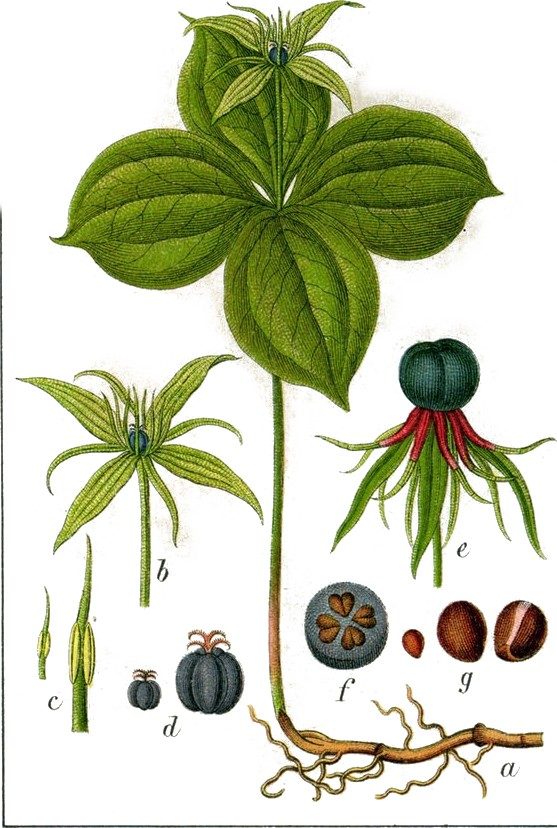
Herb Paris
Herba Paris
- Known today as
- Paris quadrifolia, true-lover’s knot, a woodland plant with a single black berry.
- Kind
- Plant, in 1 older authority
- Constituents
- paridin and paristyphnin, pennogenin glycosides, diosgenin glycosides
- Poisoning
- Saponin irritation
- Earliest authority here
- Culpeper (1616–1654)
- In other databases
- Plants of the World Online search · GBIF search · Wikidata search
- In the Canale glossary
- On the Manner of Discerning and Healing the Bewitched, Appendix A: Part Three, Chapter 6: Remedies Given by Mouth After the Purge
Revised October 1, 2026: An older authority added from a text read in full. Version 1, first published September 25, 2026.
Caution. Hazardous in some form or dose; see the modern assessment below.
Herb Paris: what did Canale use it for?
The seeds, a dram a day for twenty days, “heal the bewitched”; in an electuary (ch. 6).
Herb Paris: what does modern science say?
Herb Paris was long believed an antidote to poisons and to witchcraft. The plant is poisonous in large doses, causing vomiting, vertigo, delirium, and convulsions; it has no place in modern medicine.
Herb Paris: is it poisonous?
Yes, in some form or dose. Its poisoning is saponin irritation: Half an hour to a few hours. Historical description, not medical advice; in a poisoning, call a poison centre.
Pharmacognosy & Toxicology
- Constituents
- paridin and paristyphninsteroidal saponins
- pennogenin glycosides
- diosgenin glycosides
- Mechanism
- The whole plant, and most the berry and seed, carries steroidal saponins that irritate the gut and in quantity slow the heart and cause headache and narrowed pupils; Canale’s dram a day for twenty days is a dose that would make the patient ill. The Chinese relative Paris polyphylla (chonglou) is a pharmacopoeial haemostatic.
- Toxic dose
- A few berries give vomiting, colic, and headache; fatal poisoning is not recorded in adults.
- Syndrome
- Saponin irritation
- Standing
- No approved use in Europe; Paris polyphylla is in the Chinese Pharmacopoeia.
- Frohne, D., and Pfänder, H. J. (2005). Poisonous Plants, 2nd ed., “Paris quadrifolia.” Book, seen in reviews
- Ding, Y.-G., et al. (2021). “The traditional uses, phytochemistry, and pharmacological properties of Paris L.” Journal of Ethnopharmacology 278. Verified against its record · doi:10.1016/j.jep.2021.114293
The abstract of each source, beneath its citation. For Club members. About the Club or sign in.
Constituent names open the compound’s record at PubChem, and “ChEMBL” beside a name opens its record at ChEMBL, the European Bioinformatics Institute’s database of bioactive molecules. Where a mechanism line was checked against ChEMBL (ChEMBL 37, read 1 October 2026), the check is shown with the measured value and its source paper, or says plainly that nothing has been measured. Doses are as the references give them, for description only; this is not medical advice. Each source carries the result of its check against Crossref, PubMed, or the authority’s page: see Verification.
Herb Paris: what lore surrounds it?
Its folk name, true-love’s-knot, comes from the four leaves, which form a shape read as a lover’s knot or a Burgundian cross; “Paris” is neither the Trojan prince nor the city but the Latin par, “equal,” for those four matching leaves. By the doctrine of signatures its single black berry was read as an eye, giving oil distilled from it the folk name “the soul of the eye” and a reputation against eye disease.
Herb Paris: what did the older authorities say?
- Culpeper
- Describes the four leaves “set directly one against another, in manner of a cross or ribband tied (as it is called in a true-loves knot),” the star-like flower with its “round dark purplish button or head,” and the single “blackish purple berry, full of juice, of the bigness of a reasonable grape.” “Venus owns it; the leaves or berries hereof are effectual to expel poison of all sorts, especially that of the aconites; as also, the plague.” He cites Matthiolus “that some that have lain long in a lingering sickness, and others that by witchcraft (as it was thought) were become half foolish, by taking a dram of the seeds or berries hereof in powder every day for 20 days together, were restored to their former health.”
Sources
- [54] Grieve, M. (1931). A Modern Herbal. Online edition, botanical.com, cited under the plant concerned. Read in part · the text read
- [76] Larkin, D. The Medieval Garden Enclosed (blog), The Metropolitan Museum of Art, The Cloisters: Herb Paris (23 June 2010); Salvia, Save Us (7 September 2010); Beneficent Betony (24 June 2011). Book, seen in reviews
- Wellcome Collection, on herb Paris. Book, not indexed
- Culpeper, N. (1653). The Complete Herbal, “Herb True-Love, Or One-Berry.” Project Gutenberg #49513. Primary text
Verification
- Checked
- October 1, 2026
- Passes
- Every sentence read against its sources, in the pass over the remaining 343 entries
- The Standing line checked against the authority it names (EMA, WHO, FDA, CITES, Commission E)
- Every dated or regulatory claim checked by category across the database
- Each quotation from the older authorities checked word for word against the text, read in full
- Sources
- 6 cited: 1 read in part, 1 verified against its record, 1 primary text, 2 book, seen in reviews, 1 book, not indexed. 1 with the abstract on file.
- Corrections
- None were needed.
What was checked, how, and what was found is set out on the Verification page. A checked source is one whose record was found; it does not make the entry medical advice.
Cite This Entry
Version 1 · first published September 25, 2026 · last revised October 1, 2026
- Chicago
“Herb Paris.” In Materia Medica, edited by B. C. P. Statema. Version 1. The Thinking Press, 2026–. Last modified October 1, 2026. https://thethinkingpress.org/materia-medica/herb-paris.
- MLA
“Herb Paris.” Materia Medica, edited by B. C. P. Statema, version 1, The Thinking Press, 1 Oct. 2026, thethinkingpress.org/materia-medica/herb-paris. Accessed 8 Oct. 2026.
- APA
Herb Paris. (2026, October 1). In B. C. P. Statema (Ed.), Materia medica (Version 1). The Thinking Press. Retrieved October 8, 2026, from https://thethinkingpress.org/materia-medica/herb-paris
Club members keep entries on a shelf with private notes, print the plates as cards, and receive an entry by email each week. Create a free account before January 1, 2027 and all of it is yours for good. About the Club
See Also
Poisoned alike: saponin irritation
Sarsaparilla · Eryngo · Solomon’s seal · Cowslip · the syndrome, with all of them →
Also in Nicholas Culpeper
Juniper in Nicholas Culpeper · Hawthorn in Nicholas Culpeper · Madder in Nicholas Culpeper · Ground pine in Nicholas Culpeper · everything Nicholas Culpeper names →
Drawing on the same sources: Wellcome Collection, Culpeper, Frohne
Houndstongue · Hiera picra · Hiera with agaric · Lesser bean-trefoil · Gorse · Liverwort, or hepatica · the bibliography →
Nearby in the alphabet
Hiera of Pacchius · Herb bennet (of the rose family, with a root that smells of cloves) · Henbane (of the nightshade family) · Hemp (Cannabis sativa) · The Holy Name, IHS (the first three letters of Jesus in Greek, often within a sunburst) · Hemlock (Conium maculatum, of the carrot family)
Historical description, not medical advice.