
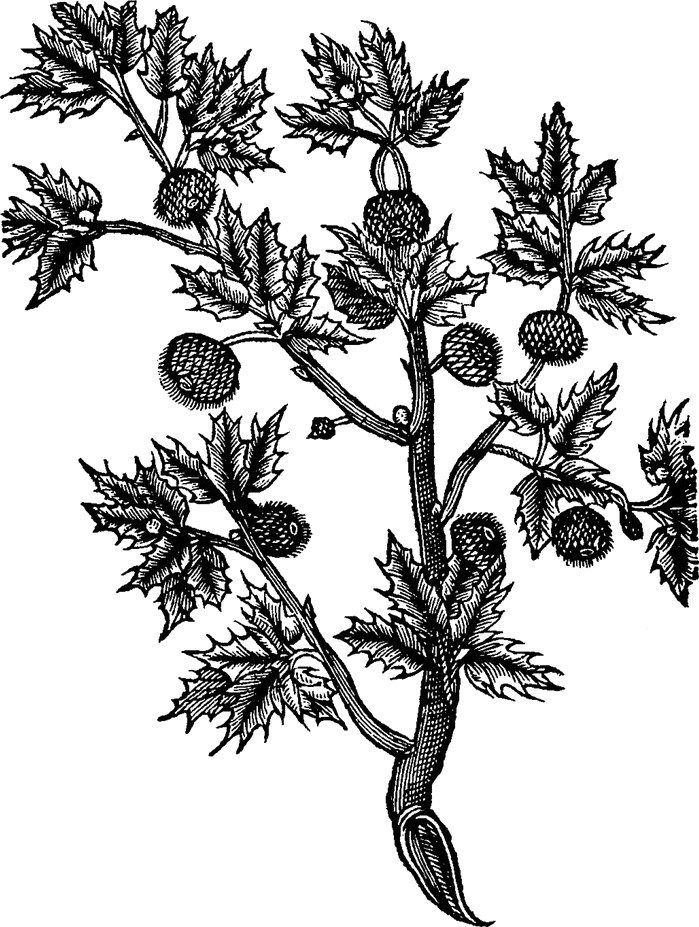
Kermes
Grana di chermes
- Known today as
- The dried bodies of female kermes scale insects, which yield a red dye used since antiquity.
- Kind
- Animal, in 1 older authority
- Constituents
- kermesic acid, flavokermesic acid
- Earliest authority here
- Pliny (AD 23/24–79)
- In the Canale glossary
- On the Manner of Discerning and Healing the Bewitched, Appendix A: Part Three, Chapter 6: Remedies Given by Mouth After the Purge
Revised October 3, 2026: An older authority added from a text read in full. Checked against its sources, each read in full, in part, or in its abstract. Version 1, first published September 25, 2026.
Kermes: what did Canale use it for?
In the electuary (ch. 6).
Kermes: what does modern science say?
In medicine it was the base of the confection alkermes, compounded with ambergris, musk, pearls, and gold leaf.
Pharmacognosy & Toxicology
- Constituents
- kermesic acidan anthraquinone, the red
- flavokermesic acid ChEMBL
- Mechanism
- The dried females of the kermes scale insect, a parasite of the kermes oak; its only coloured component is kermesic acid, an anthraquinone. The Italian liqueur alchermes, which descends from the Confectio Alkermes, takes its scarlet and its name from it.
- Toxic dose
- Inert.
- Standing
- Replaced in general use in Europe by Mexican cochineal, whose carmine is the food colour E120, after the Spanish conquest of the Aztec Empire.
Constituent names open the compound’s record at PubChem, and “ChEMBL” beside a name opens its record at ChEMBL, the European Bioinformatics Institute’s database of bioactive molecules. Where a mechanism line was checked against ChEMBL (ChEMBL 37, read 1 October 2026), the check is shown with the measured value and its source paper, or says plainly that nothing has been measured. Doses are as the references give them, for description only; this is not medical advice. Each source carries the result of its check against Crossref, PubMed, or the authority’s page: see Verification.
Kermes: what lore surrounds it?
Its scarlet reaches back to Neolithic burials near Aix-en-Provence and forward into Scripture, where the Hebrew tola’at shani, “scarlet worm,” names this insect dye,. Medieval Italian and Sicilian scarlets dyed with it were prized above Tyrian purple, and the dried insects, like grains of wheat, gave English the phrase “dyed in the grain.” It was replaced in general use in Europe only after the Spanish conquest of the Aztec Empire brought Mexican cochineal, a stronger dye, into European trade.
Used in These Compounds
Kermes is an ingredient of 1 compound medicine in the database. For Club members. Create a free account or sign in.
Kermes: what did the older authorities say?
- Pliny
- Names the red of the kermes first among the three principal colours of dyed cloth, which “beginning in the tints of the rose, reflects, when viewed sideways and held up to the light, the shades that are found in the Tyrian purple”; the berries of Galatia, Africa, and Lusitania furnish the coccus, “a dye reserved for the military costume of our generals.”
Sources
- [28] Culpeper, N. (1653). Pharmacopœia Londinensis, or, The London Dispensatory [the Royal College of Physicians’ pharmacopoeia in English, with Culpeper’s commentary]. London: Peter Cole. Text Creation Partnership edition A35381. Read in part · the text read
- Wikipedia, “Kermes (dye).” Read in full · the text read
- Pliny the Elder, Natural History 21.22, 22.3, trans. J. Bostock & H. T. Riley (1855), Perseus Digital Library. Read in part · the text read
- Wikipedia, “Alchermes.” Read in full · the text read
- Wikipedia, “Kermesic acid.” Read in full · the text read
- Wikipedia, “Cochineal.” Read in full · the text read
Verification
- Checked
- October 1, 2026, and October 3, 2026
- Passes
- Every sentence read against its sources, in the pass over the remaining 343 entries
- The Standing line checked against the authority it names (EMA, WHO, FDA, CITES, Commission E)
- Every dated or regulatory claim checked by category across the database
- Each quotation from the older authorities checked word for word against the text, read in full
- Every source read, in full, in part, or in its abstract, and every sentence checked against what was read (October 3, 2026)
- Sources
- 6 cited: 4 read in full, 2 read in part.
- Corrections
- None were needed.
What was checked, how, and what was found is set out on the Verification page. A checked source is one whose record was found; it does not make the entry medical advice.
Cite This Entry
Version 1 · first published September 25, 2026 · last revised October 3, 2026
- Chicago
“Kermes.” In Materia Medica, edited by B. C. P. Statema. Version 1. The Thinking Press, 2026–. Last modified October 3, 2026. https://thethinkingpress.org/materia-medica/kermes.
- MLA
“Kermes.” Materia Medica, edited by B. C. P. Statema, version 1, The Thinking Press, 3 Oct. 2026, thethinkingpress.org/materia-medica/kermes. Accessed 8 Oct. 2026.
- APA
Kermes. (2026, October 3). In B. C. P. Statema (Ed.), Materia medica (Version 1). The Thinking Press. Retrieved October 8, 2026, from https://thethinkingpress.org/materia-medica/kermes
Club members keep entries on a shelf with private notes, print the plates as cards, and receive an entry by email each week. Create a free account before January 1, 2027 and all of it is yours for good. About the Club
See Also
Sharing kermesic acid
Also in Pliny the Elder
Lesser bean-trefoil in Pliny the Elder · Juniper in Pliny the Elder · Long pepper in Pliny the Elder · Jet, oil of in Pliny the Elder · everything Pliny the Elder names →
Drawing on the same sources: Wikipedia
Nearby in the alphabet
Koji mould (The mould grown on steamed rice or soybeans) · Labdanum (Cistus ladanifer and C) · Juneberry · Lady’s mantle · Jewelweed · Lapis lazuli, pills of
Historical description, not medical advice.