
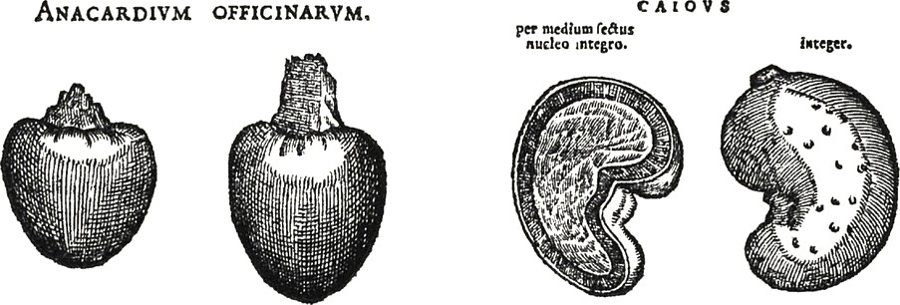
Marking-nut electuary
Mel anacardinum
- Known today as
- An electuary of the marking nut, Semecarpus anacardium (note XLIV).
- Kind
- Compound, in 2 older authorities
- Constituents
- anacardic acids, bhilawanol, honey
- Earliest authority here
- The Arab physicians
- In other databases
- GBIF search · Wikidata search
- In the Canale glossary
- On the Manner of Discerning and Healing the Bewitched, Appendix A: Part Three, Chapter 6: Remedies Given by Mouth After the Purge
Revised October 3, 2026: Tradition, lore, modern assessment, and sources extended. Checked against its sources, each read in full, in part, or in its abstract. Version 1, first published September 25, 2026.
Caution. Hazardous in some form or dose; see the modern assessment below.
Marking-nut electuary: what did Canale use it for?
In the cockerel distillate (ch. 6).
Marking-nut electuary: what does modern science say?
The nut yields a strongly vesicant oil that raises blisters. The oil of the pericarp holds bhilawanols, which are urushiols, and anacardic acid, and raises blisters on contact; the kernel within has no acrid properties, and the nut’s extracts have been tried for the nerves only in the laboratory and in animals.
Marking-nut electuary: is it poisonous?
Yes, in some form or dose. Historical description, not medical advice; in a poisoning, call a poison centre.
Pharmacognosy & Toxicology
- Constituents
- anacardic acidsthe phenolic resin of Semecarpus anacardium
- bhilawanola urushiol-like catechol, the blistering agent
- honey ChEMBL
- Mechanism
- The marking nut of India, whose juice stains linen and blisters skin by its urushiols, the bhilawanols: in Ayurveda (bhallataka) it is purified before internal use and given for nervous debility, rheumatism, epilepsy, and asthma, with laboratory and animal data for anti-inflammatory and memory-sparing actions, and human reports of contact dermatitis and of an idiosyncratic reaction to an oral formulation. Mel anacardinum, the honey of it, was Mesue’s medicine for the memory; the modern evidence for the nerves is still preclinical.
- Toxic dose
- The raw nut blisters; Ayurveda gives it internally only after purification, whose aim is to reduce its toxicity, and the Muslim physicians held two dirhems a poisonous dose.
- Standing
- Used in Ayurveda after purification, and listed as a poisonous medicinal plant under India’s Drugs and Cosmetics Act of 1940; contact dermatitis and an idiosyncratic drug reaction have been reported.
- Semalty, M., et al. (2010). “Semecarpus anacardium Linn.: a review.” Pharmacognosy Reviews 4. Verified against its record · doi:10.4103/0973-7847.65328
The abstract of each source, beneath its citation. For Club members. About the Club or sign in.
Constituent names open the compound’s record at PubChem, and “ChEMBL” beside a name opens its record at ChEMBL, the European Bioinformatics Institute’s database of bioactive molecules. Where a mechanism line was checked against ChEMBL (ChEMBL 37, read 1 October 2026), the check is shown with the measured value and its source paper, or says plainly that nothing has been measured. Doses are as the references give them, for description only; this is not medical advice. Each source carries the result of its check against Crossref, PubMed, or the authority’s page: see Verification.
Marking-nut electuary: what lore surrounds it?
Mesue’s anacardine electuary was good for those who wished to be learned, for it sharpened the intellect and made a good memory. In India the blistering juice was used to fake a bruise in support of a false charge, and by malingerers to raise eruptions of the skin.
Marking-nut electuary: what did the older authorities say?
- The Arab physicians
- Mesue gives an anacardine electuary for those who wish to become learned, since it sharpens the intellect and makes a good memory. The Muslim physicians, Dymock reports, held the nut hot and dry and gave its juice, always mixed with oil or butter, in diseases of the skin, palsy, epilepsy, and other affections of the nerves; it is the anacardia of Serapion.
- The Indian tradition
- The nut, bhallātaka, is in the Ayurvedic texts for the nerves and the skin, and its juice, mixed with a little quicklime, is used all over India to mark linen.
Sources
- [43] Felter, H. W., & Lloyd, J. U. (1898). King’s American Dispensatory. Monographs as transcribed at Henriette’s Herbal Homepage, henriettes-herb.com, cited under the drug concerned. Read in full · the text read
- Mesue, Grabadin. Read in part · the text read
- Dymock, W., et al. (1890). Pharmacographia Indica. Read in part · the text read
- Ilanchezhian, R., Joseph, C. R., & Acharya, R. (2012). Urushiol-induced contact dermatitis caused during Shodhana (purificatory measures) of Bhallataka (Semecarpus anacardium Linn.) fruit. Ayu 33: 270–273. Read in full · the text read
- Ilanchezhian, R., Joseph, C. R., & Acharya, R. (2010). Importance of media in Shodhana (purification/processing) of poisonous herbal drugs. Ancient Science of Life 30: 54–57. Read in full · the text read
- Rastogi, S., & Pandey, P. (2022). Idiosyncratic adversity reported after oral consumption of an ayurvedic formulation containing bhallataka (Semecarpus anacardium): a case report. Journal of Ayurveda and Integrative Medicine 13: 100635. Read in full · the text read
- Ram Kumar Pandian, S., et al. (2026). Unlocking the neuroprotective potential of Semecarpus anacardium L.: an updated review. Antioxidants 15: 660. doi:10.3390/antiox15060660 Read in full · the text read
Verification
- Checked
- October 1, 2026, and October 3, 2026
- Passes
- Every sentence read against its sources, in the pass over the remaining 343 entries
- The Standing line checked against the authority it names (EMA, WHO, FDA, CITES, Commission E)
- Every dated or regulatory claim checked by category across the database
- Every source read, in full, in part, or in its abstract, and every sentence checked against what was read (October 3, 2026)
- Sources
- 8 cited: 5 read in full, 2 read in part, 1 verified against its record. 1 with the abstract on file.
- Corrections
- None were needed.
What was checked, how, and what was found is set out on the Verification page. A checked source is one whose record was found; it does not make the entry medical advice.
Cite This Entry
Version 1 · first published September 25, 2026 · last revised October 3, 2026
- Chicago
“Marking-nut electuary.” In Materia Medica, edited by B. C. P. Statema. Version 1. The Thinking Press, 2026–. Last modified October 3, 2026. https://thethinkingpress.org/materia-medica/marking-nut-electuary.
- MLA
“Marking-nut electuary.” Materia Medica, edited by B. C. P. Statema, version 1, The Thinking Press, 3 Oct. 2026, thethinkingpress.org/materia-medica/marking-nut-electuary. Accessed 8 Oct. 2026.
- APA
Marking-nut electuary. (2026, October 3). In B. C. P. Statema (Ed.), Materia medica (Version 1). The Thinking Press. Retrieved October 8, 2026, from https://thethinkingpress.org/materia-medica/marking-nut-electuary
Club members keep entries on a shelf with private notes, print the plates as cards, and receive an entry by email each week. Create a free account before January 1, 2027 and all of it is yours for good. About the Club
See Also
Sharing honey
Drawing on the same sources: Mesue
Nearby in the alphabet
Masterwort and angelica (Peucedanum ostruthium and Angelica archangelica) · Marjoram and jasmine (Origanum majorana) · Mastic · Marigold (the pot marigold) · Mayapple · Manna (Fraxinus ornus, of Calabria and Sicily) · Meadow saffron (Colchicum autumnale) · Mandrake (of the nightshade family)
Historical description, not medical advice.