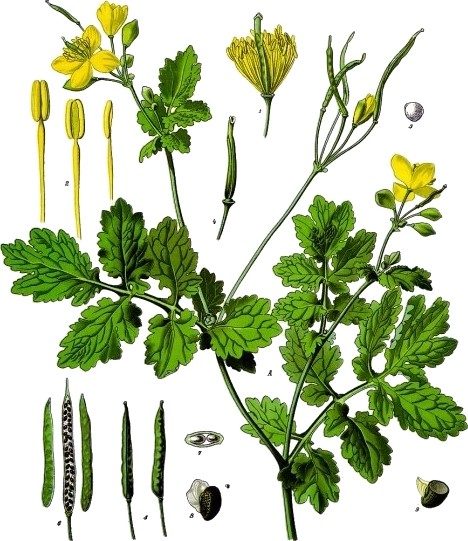
Greater celandine
Chelidonia maggiore
- Known today as
- Chelidonium majus.
- Kind
- Plant, in 1 older authority
- Constituents
- chelidonine, sanguinarine, coptisine
- Earliest authority quoted here
- Pliny (AD 23/24–79)
- In other databases
- Plants of the World Online · GBIF · Wikidata
- In the Canale glossary
- On the Manner of Discerning and Healing the Bewitched, Appendix A: Part Three, Chapter 6: Remedies Given by Mouth After the Purge
Revised October 17, 2026: Checked against its sources, each read in full, in part, or in its abstract. Version 1, first published September 25, 2026.
Caution. Hazardous in some form or dose; see Safety, below.
Greater celandine: what did Canale use it for?
Its water in a julep (ch. 6).
Greater celandine: what does modern science say?
Its orange sap was used in folk medicine against warts, and internal use has caused liver damage.
Greater celandine: is it poisonous?
Yes, in some form or dose. Historical description, not medical advice; in a poisoning, call a poison centre.
The toxic dose and the poisoning
- Toxic dose
- Its preparations have caused hepatitis: by 2011 the WHO database held 124 liver and biliary reactions from 56 case reports, most of them from Germany.
The references for these lines are listed under Pharmacognosy, in Science. Doses are as the references give them, for description only; this is not medical advice. In a poisoning, call a poison centre.
Greater celandine: what did the older authorities say?
- PlinyAD 23/24–79
- Says the swallow (chelidon) restores the sight of its nestlings with this plant, whence its name.
Greater celandine: what lore surrounds it?
Folkard has it called Swallow-wort and Tetter-wort, “thought to be efficacious in the cure of warts and cutaneous disorders,” and traces the belief that swallows restore their young ones’ sight with it from Aristotle through Pliny and “most of the old botanical writers.” Pliny already has its juice boiled gently “in a copper vessel on hot ashes, with Attic honey” as a sovereign remedy for films upon the eyes. Against jaundice, Thiselton-Dyer notes, “celandine, with its yellow juice, was once equally in repute,” and the old alchemists, says Grieve, held it good to “superstifle the jaundice” because of its intense yellow colour.
Pharmacognosy
- Constituents
- Mechanism
- Several of the benzylisoquinoline alkaloids are cytotoxic in the laboratory, and the whole extract doubled the flow of bile in the rat liver; the fresh latex, dabbed on warts, was their old remedy.
- Standing
- In Germany, oral products giving more than 2.5 mg of its alkaloids a day were withdrawn in 2008 after the liver cases; in 2011 the European Medicines Agency judged the balance of benefit and risk for oral use negative.
- Stickel, F., et al. (2003). “Acute hepatitis induced by Greater Celandine (Chelidonium majus).” Scandinavian Journal of Gastroenterology 38. Abstract read · the text read
The abstract of each source, beneath its citation. For Club members. About the Club or sign in.
Constituent names open the compound’s record at PubChem, and “ChEMBL” beside a name opens its record at ChEMBL, the European Bioinformatics Institute’s database of bioactive molecules. Where a mechanism line was checked against ChEMBL (ChEMBL 37, read 1 October 2026), the check is shown with the measured value and its source paper, or says plainly that nothing has been measured. Doses are as the references give them, for description only; this is not medical advice. Each source carries the result of its check against Crossref, PubMed, or the authority’s page: see Verification.
What Medicine Makes of It
- Charming the WartThe toad, the bean, and the natural history of warts.
Sources
- [41] European Medicines Agency, Committee on Herbal Medicinal Products (HMPC). Herbal monographs, assessment reports and public statements, ema.europa.eu, cited under the herb concerned: aniseed (summary, EMA/305345/2016); Aristolochia (public statement, EMEA/HMPC/138381/2005); asarone (public statement, EMEA/HMPC/139215/2005); caraway (EMA/HMPC/715092/2013); centaury (EMA/HMPC/277493/2015); chicory root (assessment report, EMA/HMPC/113041/2010); cinnamon (EMA/HMPC/246774/2009); clove (assessment report, EMA/HMPC/534946/2010); ethanol in herbal products (reflection paper, EMA/HMPC/85114/2008); fennel (EMEA/HMPC/372839/2016, Rev. 1, 2024); fumitory (draft assessment report, EMA/HMPC/367013/2021); greater celandine (public statement, EMA/HMPC/743927/2010); hops (EMA/HMPC/682384/2013); horehound (EMA/HMPC/604271/2012); mallow (assessment report, EMA/HMPC/749518/2016); marshmallow root (Althaeae radix); melissa (summary, EMA/HMPC/310761/2013); myrrh (assessment report and monograph, EMA/HMPC/96910/2010 and 96911/2010); peppermint oil (assessment report, EMEA/HMPC/349465/2006); pyrrolizidine alkaloids (public statement, EMA/HMPC/893108/2011); rhubarb (EMA/HMPC/113700/2019); sage (Salviae officinalis folium); wormwood (EMA/HMPC/751490/2016). Read in full · the text read
- [78] Li, X.-L., Sun, Y.-P., Wang, M., Wang, Z.-B., & Kuang, H.-X. (2024). Alkaloids in Chelidonium majus L.: a review of its phytochemistry, pharmacology and toxicology. Frontiers in Pharmacology 15: 1440979. doi:10.3389/fphar.2024.1440979 Abstract read · the text read
- [96] Pantano, F., Mannocchi, G., Marinelli, E., Gentili, S., Graziano, S., Busardò, F. P., & di Luca, N. M. (2017). Hepatotoxicity induced by greater celandine (Chelidonium majus L.): a review of the literature. European Review for Medical and Pharmacological Sciences 21(1 Suppl.): 46–52. Abstract read · the text read
- Canale, F. (1622). Del modo di conoscer et sanare i maleficiati. Brescia: Bartolomeo Fontana. Read in part · the text read
- EMA/HMPC (2011). Public statement on Chelidonium majus L., herba (EMA/HMPC/743927/2010). European Medicines Agency. Read in full · the text read
- EMA/HMPC (2011). Assessment report on Chelidonium majus L., herba (EMA/HMPC/369801/2009). European Medicines Agency. Read in part · the text read
- Grieve, M. (1931). A Modern Herbal, “Celandine, Greater.” botanical.com/botanical/mgmh/c/celgre43.html Read in full · the text read
- Folkard, R. (1884). Plant Lore, Legends, and Lyrics. London: Sampson Low. Project Gutenberg #44638. Read in part · the text read
- Pliny the Elder, Natural History 25.50, trans. J. Bostock & H. T. Riley (1855), Perseus Digital Library. Read in part · the text read
- Thiselton-Dyer, T. F. (1889). The Folk-lore of Plants. London: Chatto & Windus. Project Gutenberg #10118. Read in part · the text read
Verification
- Checked
- October 1, 2026, October 17, 2026
- Passes
- Read against its sources in the pass over the remaining 343 entries
- The Standing line checked against the EMA, among the sources below
- Every dated or regulatory claim checked by category across the database
- Every source read, in full, in part, or in its abstract, and every sentence checked against what was read (October 17, 2026)
- Sources
- 11 cited: 3 read in full, 5 read in part, 3 abstract read. 3 with the abstract on file.
- Corrections
- None recorded.
What was checked, how, and what was found is set out on the Verification page. A checked source is one whose record was found; it does not make the entry medical advice.
Club members can point at a technical term in this entry, such as a constituent, an action, or a word of Jung’s, to read its definition from the source. The Club.
Cite This Entry
Version 1 · first published September 25, 2026 · last revised October 17, 2026
- Chicago
“Greater celandine.” In Materia Medica, edited by B. C. P. Statema. Version 1. The Thinking Press, 2026–. Last modified October 17, 2026. https://thethinkingpress.org/materia-medica/greater-celandine.
- MLA
“Greater celandine.” Materia Medica, edited by B. C. P. Statema, version 1, The Thinking Press, 17 Oct. 2026, thethinkingpress.org/materia-medica/greater-celandine. Accessed 22 Nov. 2026.
- APA
Greater celandine. (2026, October 17). In B. C. P. Statema (Ed.), Materia medica (Version 1). The Thinking Press. Retrieved November 22, 2026, from https://thethinkingpress.org/materia-medica/greater-celandine
See Also
Sharing chelidonine, sanguinarine
Also in Pliny the Elder
Ground ivy in Pliny the Elder · Gorse in Pliny the Elder · Ground pine in Pliny the Elder · Gold leaf in Pliny the Elder · everything Pliny the Elder names →
Drawing on the same sources: Canale, Grieve, Folkard, Thiselton-Dyer
Honey · Honeyed wine and honeyed water · Grindelia · Ground cherry · Guelder rose · Gentian · the bibliography →
Nearby in the alphabet
Greek sage · Goldenseal · Goldenrod · Golden pills (a standard compound of aloes, scammony, and colocynth)
Historical description, not medical advice.
