
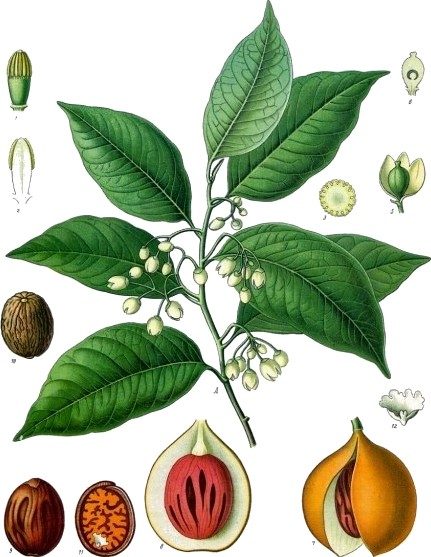
Nutmeg and clove
Noce moscata; garofoli
- Known today as
- Myristica fragrans and Syzygium aromaticum.
- Kind
- Plant, in 1 older authority
- Constituents
- myristicin, elemicin, eugenol
- Poisoning
- Tropane (anticholinergic) poisoning
- Earliest authority here
- Pliny (AD 23/24–79)
- In other databases
- Plants of the World Online search · GBIF search · Wikidata search
- In the Canale glossary
- On the Manner of Discerning and Healing the Bewitched, Appendix A: Part Three, Chapter 5: Vomitory Medicines
Revised October 1, 2026: An older authority added from a text read in full. Version 1, first published September 25, 2026.
Nutmeg and clove: what did Canale use it for?
Oil of nutmeg on the stomach after vomiting; both in the distilled water, the cockerel, the pills, the fumigation, and the oil for the bewitched (chs. 5–6, 8–9).
Nutmeg and clove: what does modern science say?
Clove oil is a true local anesthetic and antiseptic. Nutmeg is intoxicating in large doses.
Pharmacognosy & Toxicology
- Constituents
- myristicinin nutmeg
- elemicin
- eugenol ChEMBLin clove, 80 per cent of the oil
- Mechanism
- Myristicin is weakly psychoactive, perhaps through an amphetamine-like metabolite; eugenol is a local anaesthetic and antiseptic.
- Toxic dose
- Two or three whole nutmegs bring a day of delirium, nausea, and dread; eugenol in quantity injures the liver.
- Syndrome
- Tropane (anticholinergic) poisoning
- Standing
- Clove oil remains in dentistry; nutmeg is a spice.
- Stein, U., et al. (2001). “Nutmeg (myristicin) poisoning.” Forensic Science International 118. Verified against its record · doi:10.1016/s0379-0738(00)00369-8
Constituent names open the compound’s record at PubChem, and “ChEMBL” beside a name opens its record at ChEMBL, the European Bioinformatics Institute’s database of bioactive molecules. Where a mechanism line was checked against ChEMBL (ChEMBL 37, read 1 October 2026), the check is shown with the measured value and its source paper, or says plainly that nothing has been measured. Doses are as the references give them, for description only; this is not medical advice. Each source carries the result of its check against Crossref, PubMed, or the authority’s page: see Verification.
Nutmeg and clove: what lore surrounds it?
Cloves were among the aromatics, with lavender, camphor, myrrh, and labdanum, packed into the beak of the plague doctor’s mask, on the theory that sweet smells could filter the bad air believed to carry plague. Nutmeg’s history is darker than its scent: the Dutch East India Company seized the Banda Islands, the spice’s only source, in 1621, killing or driving off nearly all of the thirteen to fifteen thousand islanders and working the plantations with enslaved labor, a cost the old pharmacopoeias never recorded.
Used in These Compounds
Nutmeg and clove is an ingredient of 2 compound medicines in the database. For Club members. Create a free account or sign in.
Nutmeg and clove: what did the older authorities say?
- Pliny
- Of the clove: “There is, also, in India another grain which bears a considerable resemblance to pepper, but is longer and more brittle; it is known by the name of caryophyllon. It is said that this grain is produced in a sacred grove in India; with us it is imported for its aromatic perfume.”
Sources
- [41] European Medicines Agency, Committee on Herbal Medicinal Products (HMPC). Herbal monographs, assessment reports and public statements, ema.europa.eu, cited under the herb concerned: aniseed (summary, EMA/305345/2016); Aristolochia (public statement, EMEA/HMPC/138381/2005); asarone (public statement, EMEA/HMPC/139215/2005); caraway (EMA/HMPC/715092/2013); centaury (EMA/HMPC/277493/2015); chicory root (assessment report, EMA/HMPC/113041/2010); cinnamon (EMA/HMPC/246774/2009); clove (assessment report, EMA/HMPC/534946/2010); ethanol in herbal products (reflection paper, EMA/HMPC/85114/2008); fennel (EMEA/HMPC/372839/2016, Rev. 1, 2024); fumitory (draft assessment report, EMA/HMPC/367013/2021); greater celandine (public statement, EMA/HMPC/743927/2010); hops (EMA/HMPC/682384/2013); horehound (EMA/HMPC/604271/2012); mallow (assessment report, EMA/HMPC/749518/2016); marshmallow root (Althaeae radix); melissa (summary, EMA/HMPC/310761/2013); myrrh (assessment report and monograph, EMA/HMPC/96910/2010 and 96911/2010); peppermint oil (assessment report, EMEA/HMPC/349465/2006); pyrrolizidine alkaloids (public statement, EMA/HMPC/893108/2011); rhubarb (EMA/HMPC/113700/2019); sage (Salviae officinalis folium); wormwood (EMA/HMPC/751490/2016). Read in full · the text read
- [113] Tennessee Poison Center, Vanderbilt University Medical Center. Toxicology Question of the Week: N. Bowman, “Nutmeg, a potentially uninvited holiday guest?” (23 November 2020); B. Frazier, “What are the clinical manifestations of turpentine poisoning?” (21 November 2022). vumc.org. Book, not indexed
- Wikipedia, “Plague doctor costume.” Book, not indexed
- JSTOR Daily, “The Violent History Behind Nutmeg.” Book, not indexed
- Pliny the Elder, Natural History 12.15, trans. J. Bostock & H. T. Riley (1855), Perseus Digital Library. Primary text
Verification
- Checked
- October 1, 2026
- Passes
- Every sentence read against its sources, in the pass over the remaining 343 entries
- The Standing line checked against the authority it names (EMA, WHO, FDA, CITES, Commission E)
- Every dated or regulatory claim checked by category across the database
- Each quotation from the older authorities checked word for word against the text, read in full
- Sources
- 6 cited: 1 read in full, 1 verified against its record, 1 primary text, 3 book, not indexed.
- Corrections
- None were needed.
What was checked, how, and what was found is set out on the Verification page. A checked source is one whose record was found; it does not make the entry medical advice.
Cite This Entry
Version 1 · first published September 25, 2026 · last revised October 1, 2026
- Chicago
“Nutmeg and clove.” In Materia Medica, edited by B. C. P. Statema. Version 1. The Thinking Press, 2026–. Last modified October 1, 2026. https://thethinkingpress.org/materia-medica/nutmeg-and-clove.
- MLA
“Nutmeg and clove.” Materia Medica, edited by B. C. P. Statema, version 1, The Thinking Press, 1 Oct. 2026, thethinkingpress.org/materia-medica/nutmeg-and-clove. Accessed 8 Oct. 2026.
- APA
Nutmeg and clove. (2026, October 1). In B. C. P. Statema (Ed.), Materia medica (Version 1). The Thinking Press. Retrieved October 8, 2026, from https://thethinkingpress.org/materia-medica/nutmeg-and-clove
Club members keep entries on a shelf with private notes, print the plates as cards, and receive an entry by email each week. Create a free account before January 1, 2027 and all of it is yours for good. About the Club
See Also
Poisoned alike: tropane (anticholinergic) poisoning
Thorn apple · Mandrake · Woody nightshade · Henbane · Deadly nightshade · the syndrome, with all of them →
Sharing myristicin, eugenol
Petroselinum crispum · Carmelite water · Ocimum basilicum · Geum urbanum · Cinnamomum verum · Clove
Also in Pliny the Elder
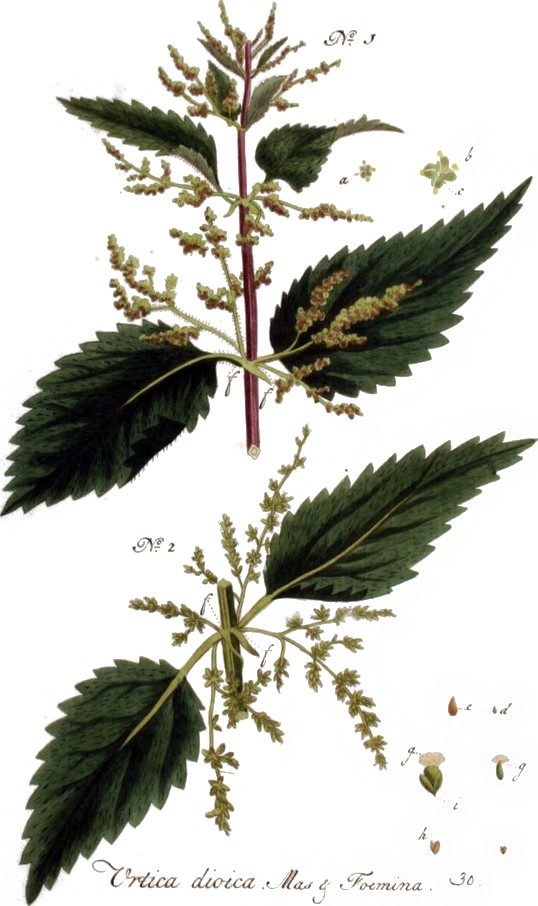
Oak galls in Pliny the Elder · Niter, pills of in Pliny the Elder · Olive oil and holy water in Pliny the Elder · Nettle seed in Pliny the Elder · everything Pliny the Elder names →
Drawing on the same sources: Wikipedia
Nearby in the alphabet
Oil of bricks · Oil of catechumens · Nepenthe (Unidentified) · Oil of the sick · Nasturtium, that is, garden cress (Lepidium sativum)
Historical description, not medical advice.