
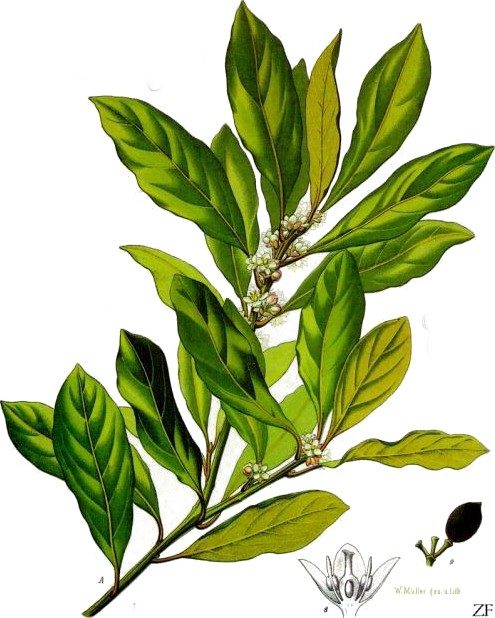
Laurel
Lauro
- Known today as
- Bay laurel, Laurus nobilis: oil, leaves, and berries.
- Kind
- Plant, in 2 older authorities
- Constituents
- 1,8-cineole, eugenol and methyleugenol, costunolide, and 1 more
- In other databases
- Plants of the World Online search · GBIF search · Wikidata search
- In the Canale glossary
- On the Manner of Discerning and Healing the Bewitched, Appendix A: Part Three, Chapter 9: Anointings
Revised October 17, 2026: Checked against its sources, each read in full, in part, or in its abstract. Version 1, first published September 25, 2026.
Laurel: what did Canale use it for?
Laurel oil for anointing; leaves and berries in the oil for the bewitched; among the amulets (chs. 9–10).
Laurel: what does modern science say?
Aromatic; the oil of bays was used externally for sprains and bruises.
The toxic dose and the poisoning
- Toxic dose
- The leaf is much used in cookery; the oil and the lactones can cause allergic contact dermatitis.
The references for these lines are listed under Pharmacognosy, in Science. Doses are as the references give them, for description only; this is not medical advice. In a poisoning, call a poison centre.
Laurel: what did the older authorities say?
- Ovid43 BC–AD 17/18
- Daphne, fleeing Apollo, becomes the laurel, which the god makes his own tree.
- Delphi
- The oldest temple of Apollo at Delphi, Pausanias was told, was made of laurel brought from Tempe; and a crown of laurel was the prize of a Pythian victory, because Apollo loved the daughter of Ladon.
Laurel: what lore surrounds it?
Suetonius records that the emperor Tiberius, though somewhat neglectful of the gods, was so afraid of thunder that he wore a laurel wreath whenever the sky was lowering, because laurel was said never to be struck by lightning.
Pharmacognosy
- Constituents
- 1,8-cineole ChEMBLthe chief compound of the leaf oil, its share varying from place to place
- eugenol and methyleugenol
- costunolide ChEMBLa sesquiterpene lactone, a contact allergen
- lauric acid ChEMBLin the berry fat
- Mechanism
- The bay of the kitchen, Laurus nobilis, not the poisonous cherry laurel: its leaf oil is antimicrobial in the laboratory, its berries went into carminative preparations, the oil of bays was rubbed on for sprains and bruises, and its lactones sensitise the skin.
- Standing
- A kitchen herb; in Grieve’s day the leaves and fruit were very rarely taken internally except in veterinary practice, and the oil of bays was used on sprains and bruises.
- Fiorini, C., et al. (1997). “Composition of the flower, leaf and stem essential oils from Laurus nobilis L.” Flavour and Fragrance Journal 12. Verified against its record · doi:10.1002/(sici)1099-1026(199703)12:2<91::aid-ffj623>3.0.co;2-3
Constituent names open the compound’s record at PubChem, and “ChEMBL” beside a name opens its record at ChEMBL, the European Bioinformatics Institute’s database of bioactive molecules. Where a mechanism line was checked against ChEMBL (ChEMBL 37, read 1 October 2026), the check is shown with the measured value and its source paper, or says plainly that nothing has been measured. Doses are as the references give them, for description only; this is not medical advice. Each source carries the result of its check against Crossref, PubMed, or the authority’s page: see Verification.
Sources
- [7] Awada, F., Hamade, K., Kassir, M., Hammoud, Z., Mesnard, F., Rammal, H., & Fliniaux, O. (2023). Laurus nobilis leaves and fruits: a review of metabolite composition and interest in human health. Applied Sciences 13(7): 4606. doi:10.3390/app13074606 Verified against its record · doi:10.3390/app13074606
- Suetonius, Life of Tiberius 69. Read in part · the text read
- Canale, F. (1622). Del modo di conoscer et sanare i maleficiati, et dell'antichissimo, et ottimo uso del benedire: trattati due. Brescia: Bartolomeo Fontana. Read in part · the text read
- Ovid. Metamorphoses, Book I, trans. H. T. Riley (1851). Project Gutenberg #21765. Read in part · the text read
- Pausanias. Description of Greece 10.5, 10.7, trans. W. H. S. Jones (1918). Perseus Digital Library. Read in part · the text read
- Pausanias. Description of Greece 10.7, trans. W. H. S. Jones (1918). Perseus Digital Library. Read in part · the text read
- Grieve, M. (1931). A Modern Herbal, “Laurel (Bay).” botanical.com/botanical/mgmh/l/larbay10.html Read in full · the text read
- Paparella, A., Nawade, B., Shaltiel-Harpaz, L., & Ibdah, M. (2022). A review of the botany, volatile composition, biochemical and molecular aspects, and traditional uses of Laurus nobilis. Plants 11(9): 1209. doi:10.3390/plants11091209 Read in full · the text read
- Paulsen, E. (2017). Systemic allergic dermatitis caused by sesquiterpene lactones. Contact Dermatitis 76(1): 1–10. doi:10.1111/cod.12671 Abstract read · the text read
- Uzuncakmak, T. K., et al. (2015). Erythema multiforme-like allergic contact dermatitis associated with laurel oil: a rare presentation. Dermatology Online Journal 21. doi:10.5070/d3214026273 Abstract read · the text read
Verification
- Checked
- October 1, 2026, October 17, 2026
- Passes
- Read against its sources in the pass over the remaining 343 entries
- Every dated or regulatory claim checked by category across the database
- Every source read, in full, in part, or in its abstract, and every sentence checked against what was read (October 17, 2026)
- Sources
- 11 cited: 2 read in full, 5 read in part, 2 abstract read, 2 verified against its record. 3 with the abstract on file.
- Corrections
- None recorded.
What was checked, how, and what was found is set out on the Verification page. A checked source is one whose record was found; it does not make the entry medical advice.
Club members can point at a technical term in this entry, such as a constituent, an action, or a word of Jung’s, to read its definition from the source. The Club.
Cite This Entry
Version 1 · first published September 25, 2026 · last revised October 17, 2026
- Chicago
“Laurel.” In Materia Medica, edited by B. C. P. Statema. Version 1. The Thinking Press, 2026–. Last modified October 17, 2026. https://thethinkingpress.org/materia-medica/laurel.
- MLA
“Laurel.” Materia Medica, edited by B. C. P. Statema, version 1, The Thinking Press, 17 Oct. 2026, thethinkingpress.org/materia-medica/laurel. Accessed 22 Nov. 2026.
- APA
Laurel. (2026, October 17). In B. C. P. Statema (Ed.), Materia medica (Version 1). The Thinking Press. Retrieved November 22, 2026, from https://thethinkingpress.org/materia-medica/laurel
See Also
Sharing 1,8-cineole
Mint, oil of · Salvia fruticosa · Salvia rosmarinus · Alpinia officinarum
Also in Ovid
Aconite in Ovid · Cypress in Ovid · Coral, red in Ovid · everything Ovid names →
Drawing on the same sources: Suetonius, Canale, Grieve, Paulsen
Caesar’s mushroom · Death cap · Lesser bean-trefoil · Jet, oil of · Mallow and marshmallow · Lavender · Lady’s mantle · Lemon verbena · the bibliography →
Nearby in the alphabet
Laudanum (with saffron, cinnamon, and cloves) · Leech (Hirudo medicinalis) · Lapis lazuli, pills of · Lenitive electuary · Laburnum
Historical description, not medical advice.
