
Mandrake
Mandragora; Greek mandragoras; Hebrew dudaim
- Known today as
- Mandragora officinarum and its relatives, of the nightshade family.
- Kind
- Plant, in 4 older authorities
- Constituents
- hyoscyamine, scopolamine, atropine
- Poisoning
- Tropane (anticholinergic) poisoning
- Earliest authority here
- Genesis 30 (the Hebrew Bible and the New Testament)
- Qualities
- Cold in the third degree (Galen); authorities differ on its moisture. What the degrees mean
- In other databases
- Plants of the World Online search · GBIF search · Wikidata search
Caution. Poisonous: tropane alkaloids cause delirium, fever, heart disturbance, and death.
Mandrake: what does modern science say?
Contains the tropane alkaloids hyoscyamine and scopolamine, which account for its sedative, anesthetic, and deliriant effects. Gravely poisonous.
Mandrake: is it poisonous?
Yes, in some form or dose. Poisonous: tropane alkaloids cause delirium, fever, heart disturbance, and death. Its poisoning is tropane (anticholinergic) poisoning: Thirty minutes to a few hours; longer from the skin. Historical description, not medical advice; in a poisoning, call a poison centre.
Pharmacognosy & Toxicology
- Constituents
- hyoscyamine ChEMBL
- scopolamine ChEMBL
- atropine ChEMBLthe racemate of hyoscyamine
- Mechanism
- The tropanes block the muscarinic acetylcholine receptors: dry, hot, dilated, delirious.
- Checked against ChEMBL
- atropine: ChEMBL’s curated mechanism: antagonist Muscarinic acetylcholine receptor M1; antagonist Muscarinic acetylcholine receptor M2; antagonist Muscarinic acetylcholine receptor M3.
- scopolamine: ChEMBL’s curated mechanism: antagonist Muscarinic acetylcholine receptor M1.
- Toxic dose
- The alkaloid content of the root varies tenfold; a few grams can cause delirium, and deaths are recorded.
- Syndrome
- Tropane (anticholinergic) poisoning
- Standing
- No medicinal use. Scopolamine itself is a licensed drug for motion sickness and the secretions of the dying.
- Nelson, L. S., et al. (2007). Handbook of Poisonous and Injurious Plants. Verified against its record · doi:10.1007/978-1-4939-8926-3
Constituent names open the compound’s record at PubChem, and “ChEMBL” beside a name opens its record at ChEMBL, the European Bioinformatics Institute’s database of bioactive molecules. Where a mechanism line was checked against ChEMBL (ChEMBL 37, read 1 October 2026), the check is shown with the measured value and its source paper, or says plainly that nothing has been measured. Doses are as the references give them, for description only; this is not medical advice. Each source carries the result of its check against Crossref, PubMed, or the authority’s page: see Verification.
What Medicine Makes of It
- The Witches’ OintmentNightshades on the skin, and what they do.
Mandrake: what lore surrounds it?
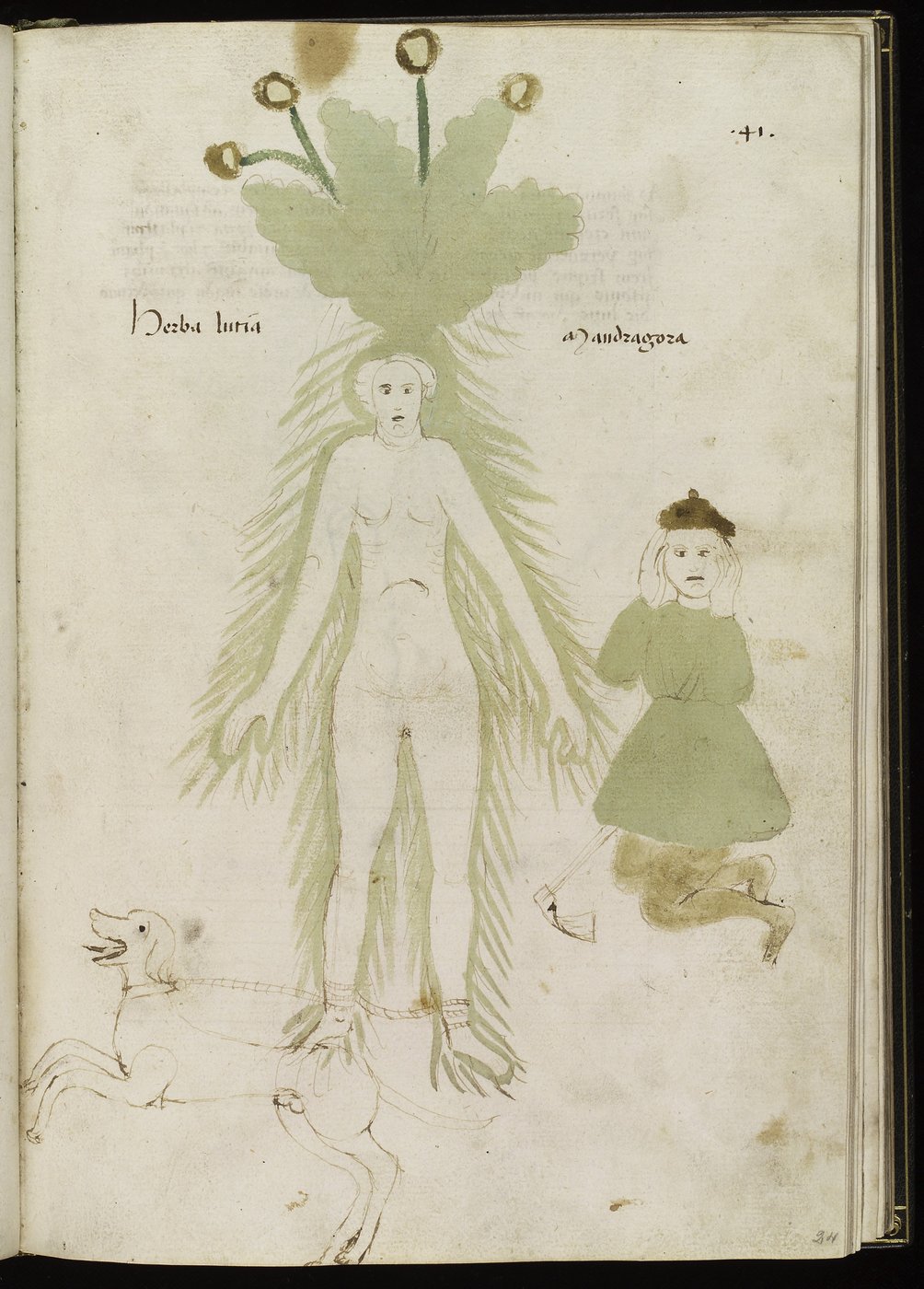
Its forked, manlike root made it the most storied plant of the Middle Ages: it was said to shriek when uprooted and to grow beneath the gallows. Roots were carved and dressed as household spirits, the German Alraune, and Machiavelli made it the title of his comedy La Mandragola (see Machiavelli).
Mandrake: what did the older authorities say?
- Genesis 30
- Rachel trades a night with Jacob to Leah for the mandrakes Reuben found in the field.
- Theophrastus
- Records the rites of gathering: draw three circles round it with a sword, and cut facing the west.
- Dioscorides
- Gives a wine of the root to bring sleep and to deaden pain before cutting or burning in surgery.
- Josephus
- Tells of a root, baaras, that kills whoever pulls it, and is drawn up by tying a dog to it.
Sources
- Dioscorides, De materia medica. Read in part · the text read
- Theophrastus, Enquiry into Plants. Verified against its record · doi:10.4159/dlcl.theophrastus-enquiry_plants.1916
- Flavius Josephus, The Jewish War. Book, not indexed
- Genesis 30:14–16. Book, seen in reviews
Verification
- Checked
- October 1, 2026
- Passes
- Every sentence read against its sources, in the pass over the remaining 343 entries
- The Standing line checked against the authority it names (EMA, WHO, FDA, CITES, Commission E)
- Every dated or regulatory claim checked by category across the database
- The mechanism read against ChEMBL (ChEMBL 37): curated mechanisms and measured activity
- Sources
- 5 cited: 1 read in part, 2 verified against its record, 1 book, seen in reviews, 1 book, not indexed.
- Corrections
- None were needed.
What was checked, how, and what was found is set out on the Verification page. A checked source is one whose record was found; it does not make the entry medical advice.
Cite This Entry
Version 1 · first published September 25, 2026
- Chicago
“Mandrake.” In Materia Medica, edited by B. C. P. Statema. Version 1. The Thinking Press, 2026–. Last modified September 25, 2026. https://thethinkingpress.org/materia-medica/mandrake.
- MLA
“Mandrake.” Materia Medica, edited by B. C. P. Statema, version 1, The Thinking Press, 25 Sept. 2026, thethinkingpress.org/materia-medica/mandrake. Accessed 8 Oct. 2026.
- APA
Mandrake. (2026, September 25). In B. C. P. Statema (Ed.), Materia medica (Version 1). The Thinking Press. Retrieved October 8, 2026, from https://thethinkingpress.org/materia-medica/mandrake
Club members keep entries on a shelf with private notes, print the plates as cards, and receive an entry by email each week. Create a free account before January 1, 2027 and all of it is yours for good. About the Club
See Also
Poisoned alike: tropane (anticholinergic) poisoning
Nutmeg and clove · Henbane · Thorn apple · Deadly nightshade · Woody nightshade · the syndrome, with all of them →
Also in Scripture
Mint, oil of in Scripture · Hyssop in Scripture · Mustard seed in Scripture · Galbanum in Scripture · everything Scripture names →
Also in Theophrastus
Opopanax in Theophrastus · Licorice in Theophrastus · Peony in Theophrastus · Hemlock in Theophrastus · everything Theophrastus names →
Also in Dioscorides
Marjoram and jasmine in Dioscorides · Mastic in Dioscorides · Lavender in Dioscorides · everything Dioscorides names →
Drawing on the same sources: Dioscorides, Theophrastus, Nelson
Nearby in the alphabet
Manna (Fraxinus ornus, of Calabria and Sicily) · Man on horseback (long counted a good edible) · Marigold (the pot marigold) · Malmsey · Mallow and marshmallow (Malva sylvestris and Althaea officinalis) · Marking-nut electuary (Semecarpus anacardium (note XLIV))

Historical description, not medical advice.