
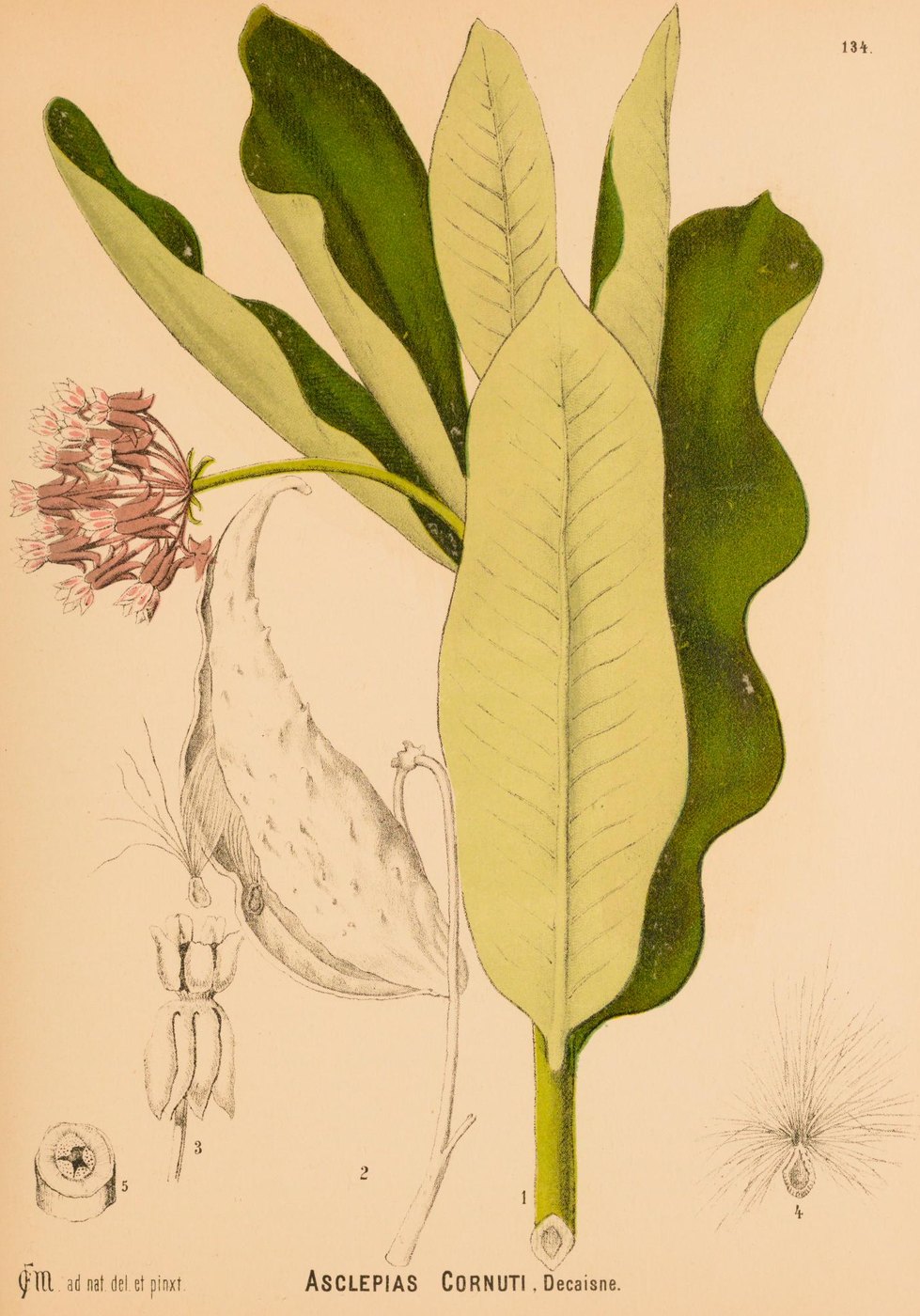
Milkweed
Common milkweed, silkweed, wild cotton, Virginian swallow-wort; Asclepias syriaca of Linnaeus, a wholly American plant misnamed for Syria, Asclepias cornuti of Decaisne; the Ojibwe cabo’sîkûn, milk, and înîni’wûnj, Indian plant; the Potawatomi anêniwîc, man weed
- Known today as
- Asclepias syriaca, the stout milkweed of roadsides, fields, and waste places everywhere in Canada and the United States: four or five feet high, leafy to the top, with oval leaves downy beneath, drooping umbels of dusky rose flowers in summer, a white juice that congeals where the stem is cut, and warty pods that split to loose seeds on silk. The food plant of the monarch butterfly across its whole eastern range.
- Kind
- Plant, in 3 older authorities
- Constituents
- cardenolides, asclepione
- Earliest authority here
- Frances Densmore
- In other databases
- Plants of the World Online search · GBIF search · Wikidata search
Caution. A cardenolide plant: the heart poisons that make the monarch inedible are in the leaves and juice. The shoots, buds, and flowers were cooked, not eaten raw, by every people recorded here, and the root was a purge and an emetic in the dispensatories.
Milkweed: what was it used for?
A vegetable of the Lake tribes. Densmore’s Chippewa cut up the flowers and stewed them, “being eaten like preserves,” and said the plant was sometimes eaten before a feast so that a man could hold more food; the Pillager Ojibwe, Smith says, “eat the fresh flowers and tips of the shoots in soups,” cooked with meat until mucilaginous like okra, and dried the flowers for winter soup; the Forest Potawatomi thickened their meat soups with the buds and flowers, and a riot of milkweed stood by every wigwam as if cultivated. Millspaugh knew the young sprouts, “just as they appear above the ground in spring,” cooked like asparagus by housewives. The root was medicine: a female remedy among the Ojibwe, a medicine of unrecorded purpose among the Potawatomi, and, by Densmore’s summary of the dispensatories, tonic, diuretic, alterative, emmenagogue, purgative, and emetic; the juice was laid on warts, and formed a pellicle over ulcers and wounds. The silk stuffed beds and hats and was tried for paper, and the stem gave thread; the Ojibwe put the milk on a deer call.
Milkweed: foraging it in the Midwest
- Part
- Young shoots, buds, and flowers
- When
- Shoots in spring, buds and flowers in early summer
Roadsides and fields everywhere, and by every wigwam; the shoots were cooked like asparagus, the buds and flowers stewed or dropped into meat soups until they thickened it like okra, and the flowers dried for winter. Always cooked; the plant holds heart glycosides.
After Smith; Densmore; Millspaugh. All the foragables of the Midwest. Historical record, not a field guide: identify before you gather, and read the whole entry.
Milkweed: what does modern science say?
The plant is a cardenolide plant, and the monarch is its proof: in 158 samples from twenty-seven sites across the eastern range the cardenolide content ran from 4 to 229 micrograms in a tenth of a gram of dry weight, and the butterflies reared on it stored on average nearly five times the plant’s concentration, twenty-eight distinct cardenolides being recognised in plants and insects together. Younger plants and plants at the edges of their patches held more. The old chemistry found asclepione, caoutchouc, and a bitter principle in root and juice; the modern finds the heart poisons the butterfly borrows.
Milkweed: is it poisonous?
Yes, in some form or dose. A cardenolide plant: the heart poisons that make the monarch inedible are in the leaves and juice. The shoots, buds, and flowers were cooked, not eaten raw, by every people recorded here, and the root was a purge and an emetic in the dispensatories. Historical description, not medical advice; in a poisoning, call a poison centre.
Pharmacognosy & Toxicology
- Constituents
- cardenolidestwenty-seven recognised in the plant, aspecioside the most concentrated and diagnostic; 4 to 229 micrograms in a tenth of a gram of dry plant across the eastern range
- asclepionethe crystalline resinoid of juice and root, with caoutchouc, fixed oil, tannin, and a bitter principle, by Millspaugh
- Mechanism
- Cardenolides are heart glycosides; the monarch stores them against its predators at nearly five times the plant’s concentration. The old provings found the root diuretic and diaphoretic by lowering the heart’s action.
- Toxic dose
- Ten drops to a fluid drachm of the fluid extract, by the Eclectic Dispensatory; the shoots, buds, and flowers cooked, by every people that ate them.
- Standing
- A wild vegetable of the Lake tribes and the butterfly’s pharmacy; no trial in people.
- Malcolm, S. B., Cockrell, B. J., & Brower, L. P. (1989). Cardenolide fingerprint of monarch butterflies reared on common milkweed, Asclepias syriaca L. Journal of Chemical Ecology 15: 819–853. doi:10.1007/bf01015180 Verified against its record · PMID 24271887
The abstract of each source, beneath its citation. For Club members. About the Club or sign in.
Constituent names open the compound’s record at PubChem, and “ChEMBL” beside a name opens its record at ChEMBL, the European Bioinformatics Institute’s database of bioactive molecules. Where a mechanism line was checked against ChEMBL (ChEMBL 37, read 1 October 2026), the check is shown with the measured value and its source paper, or says plainly that nothing has been measured. Doses are as the references give them, for description only; this is not medical advice. Each source carries the result of its check against Crossref, PubMed, or the authority’s page: see Verification.
Milkweed: what lore surrounds it?
Linnaeus named an American weed for Syria, Millspaugh grumbles, and Decaisne’s name was never taken up. The Potawatomi called it man weed and the Ojibwe Indian plant, and planted it, or let it plant itself, at every door. Its silk was going to be the cotton of the North; its milk went on the deer call to make the fawn’s cry more piteous; and the monarch, which eats nothing else, carries its poison south every autumn.
Milkweed: what did the older authorities say?
- Frances Densmore
- “The flowers were cut up and stewed, being eaten like preserves. It is said that this plant was sometimes eaten before a feast, so that a man could consume more food.” Of the root: tonic, diuretic, alterative, emmenagogue, purgative, and emetic.
- Huron H. Smith
- “The Pillager Ojibwe eat the fresh flowers and tips of the shoots in soups. They are usually cooked with some kind of meat and become somewhat mucilaginous like okra, when cooked. They also gather and dry the flowers for refreshening in the winter time, to make into soup.” Among the Forest Potawatomi “one always finds a riot of milkweed close to the wigwam or house of the Indian, suggesting that they have been cultivated.”
- Charles F. Millspaugh
- The young sprouts in spring “are highly esteemed among housewives as a pot-herb, being cooked similarly to asparagus, for which they are an excellent substitute.” The juice on the skin “forms a tough, adhesive pellicle,” used by the laity to cover ulcers and wounds; and from Moller’s memoir, eight or nine pounds of the seed-silk made a bed, coverlet, and pillows, the stalks a paper like that from rags.
Sources
- Densmore, F. (1928). Uses of Plants by the Chippewa Indians, Forty-fourth Annual Report of the Bureau of American Ethnology, “Asclepias syriaca,” under foods and medicinal properties. Internet Archive, usesofplantsbych00dens. Primary text
- Smith, H. H. (1932). Ethnobotany of the Ojibwe Indians, Bulletin of the Public Museum of the City of Milwaukee 4(3), “Common Milkweed,” under medicines, foods, and hunting. Project Gutenberg, 49527. Primary text
- Smith, H. H. (1933). Ethnobotany of the Forest Potawatomi Indians, Bulletin of the Public Museum of the City of Milwaukee 7(1), “Common Milkweed,” under medicines, foods, and fibres. Internet Archive, ethnobotany-of-the-forest-potawatomi-indians-by-huron-h.-smith-1933. Primary text
- Millspaugh, C. F. (1887). American Medicinal Plants, vol. 2, no. 134, “Asclepias cornuti,” and Plate 134. Internet Archive, americanmedicina02mill_0. Primary text
Verification
- Checked
- October 1, 2026
- Passes
- Every sentence read against its sources, in the pass over the remaining 343 entries
- The Standing line checked against the authority it names (EMA, WHO, FDA, CITES, Commission E)
- Every dated or regulatory claim checked by category across the database
- Sources
- 5 cited: 1 verified against its record, 4 primary text. 1 with the abstract on file.
- Corrections
- None were needed.
What was checked, how, and what was found is set out on the Verification page. A checked source is one whose record was found; it does not make the entry medical advice.
Cite This Entry
Version 1 · first published October 4, 2026
- Chicago
“Milkweed.” In Materia Medica, edited by B. C. P. Statema. Version 1. The Thinking Press, 2026–. Last modified October 4, 2026. https://thethinkingpress.org/materia-medica/milkweed.
- MLA
“Milkweed.” Materia Medica, edited by B. C. P. Statema, version 1, The Thinking Press, 4 Oct. 2026, thethinkingpress.org/materia-medica/milkweed. Accessed 8 Oct. 2026.
- APA
Milkweed. (2026, October 4). In B. C. P. Statema (Ed.), Materia medica (Version 1). The Thinking Press. Retrieved October 8, 2026, from https://thethinkingpress.org/materia-medica/milkweed
Club members keep entries on a shelf with private notes, print the plates as cards, and receive an entry by email each week. Create a free account before January 1, 2027 and all of it is yours for good. About the Club
See Also
Drawing on the same sources: Densmore, Smith, Millspaugh
Ramps · Juneberry · Sumac · Pawpaw · Mayapple · Pokeweed · the bibliography →
Nearby in the alphabet
Mint, oil of (Oil of garden or spear mint) · Melon root (Cucumis melo) · The Miraculous Medal · Meadowsweet · Mistletoe (especially when found on oak) · Meadow saffron (Colchicum autumnale) · Mithridate (the forerunner of theriac)
Historical description, not medical advice.