
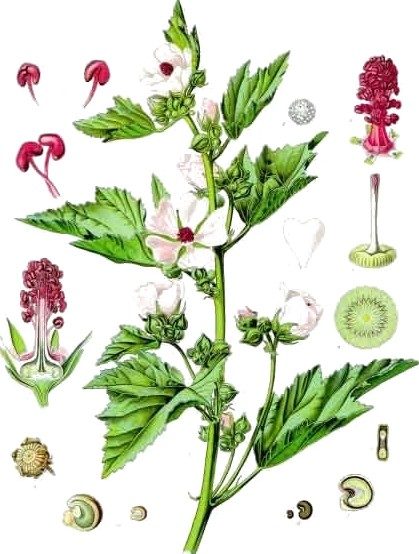
Mallow and marshmallow
Malva; altea
- Known today as
- Malva sylvestris and Althaea officinalis.
- Kind
- Plant, in 1 older authority
- Constituents
- mucilage polysaccharides, anthocyanins, starch
- Earliest authority here
- Hesiod (fl. c. 700 BC)
- In other databases
- Plants of the World Online search · GBIF search · Wikidata search
- In the Canale glossary
- On the Manner of Discerning and Healing the Bewitched, Appendix A: Part Three, Chapter 5: Vomitory Medicines
Revised October 1, 2026: Lore added from texts read in full. Version 1, first published September 25, 2026.
Mallow and marshmallow: what did Canale use it for?
In relaxing broths before hellebore; mallow in baths for hot complexions (chs. 5, 7).
Mallow and marshmallow: what does modern science say?
Soothing. Their mucilage coats and calms irritated membranes, and they are still used for sore throats and dry cough.
Pharmacognosy & Toxicology
- Constituents
- mucilage polysaccharides5–10 per cent in the marshmallow root, rhamnogalacturonans
- anthocyaninsmalvin, in the mallow flower
- starch ChEMBLin the root
- Mechanism
- The mucilage coats the mouth, throat, and stomach, which calms the cough reflex from the pharynx and the irritation of the gut: the classic demulcent, and the “relaxing broth” before hellebore.
- Toxic dose
- Safe; mucilage slows the absorption of drugs taken with it.
- Standing
- EMA monographs (2016) for marshmallow root for irritation of the mouth and throat and dry cough, and for mild gastrointestinal discomfort; the mallow leaf and flower likewise (2019).
- EMA/HMPC (2016). European Union herbal monograph on Althaea officinalis L., radix (EMA/HMPC/436679/2015). Verified against its record
- EMA/HMPC (2019). European Union herbal monograph on Malva sylvestris L. and/or Malva neglecta Wallr., folium (EMA/HMPC/749510/2016). Verified against its record
Constituent names open the compound’s record at PubChem, and “ChEMBL” beside a name opens its record at ChEMBL, the European Bioinformatics Institute’s database of bioactive molecules. Where a mechanism line was checked against ChEMBL (ChEMBL 37, read 1 October 2026), the check is shown with the measured value and its source paper, or says plainly that nothing has been measured. Doses are as the references give them, for description only; this is not medical advice. Each source carries the result of its check against Crossref, PubMed, or the authority’s page: see Verification.
Mallow and marshmallow: what lore surrounds it?
Folkard has the mallow served as a vegetable by the Romans and eaten in Job's day by those who “cut up Mallows by the bushes, and Juniper-roots for their meat”; it was “one of the funeral flowers of the ancients,” planted round graves, and country children call its seeds cheeses. He quotes Pliny's charm, “Whosoever shall take a spoonful of any of the Mallows shall that day be free from all the diseases that may come unto him.” The marsh mallow, Althæa, “from a Greek root meaning to cure,” was “sometimes called Bismalva, being held to be twice as good in medicinal properties as the ordinary Mallow,” and its sap went into the paste Albertus Magnus describes for those who had to hold red-hot iron in the ordeal, “and the hands covered with it were perfectly safe.” A German tradition used an ointment of its leaves “to anoint the body of anyone affected by witchcraft.”
Thiselton-Dyer notes that the “cheeses,” or fruit of the mallow, “are known in the North of England as ‘fairy-cheeses,’” that “a German antidote against the hurtful effects of any malicious influence was an ointment made of the leaves of the marsh-mallow,” and that Our Lady's bedstraw and the mallow “were supposed to have the reverse effect” to an antidote for love, inclining the heart rather than curbing it.
Grieve adds that “a dish of Marsh Mallow was one of their delicacies” among the Romans, that Syrian Fellahs, Greeks and Armenians “subsist for weeks on herbs, of which Marsh Mallow is one of the most common,” that in ancient days the mallow “was used, especially the Musk Mallow, to decorate the graves of friends,” and that the confectioner's marsh mallows “are a mixture of flour, gum, egg-albumin, etc., and contain no mallow.”
Mallow and marshmallow: what did the older authorities say?
- Hesiod
- “How much good there is in mallow and asphodel,” the fare of the poor, in the Works and Days.
Sources
- [41] European Medicines Agency, Committee on Herbal Medicinal Products (HMPC). Herbal monographs, assessment reports and public statements, ema.europa.eu, cited under the herb concerned: aniseed (summary, EMA/305345/2016); Aristolochia (public statement, EMEA/HMPC/138381/2005); asarone (public statement, EMEA/HMPC/139215/2005); caraway (EMA/HMPC/715092/2013); centaury (EMA/HMPC/277493/2015); chicory root (assessment report, EMA/HMPC/113041/2010); cinnamon (EMA/HMPC/246774/2009); clove (assessment report, EMA/HMPC/534946/2010); ethanol in herbal products (reflection paper, EMA/HMPC/85114/2008); fennel (EMEA/HMPC/372839/2016, Rev. 1, 2024); fumitory (draft assessment report, EMA/HMPC/367013/2021); greater celandine (public statement, EMA/HMPC/743927/2010); hops (EMA/HMPC/682384/2013); horehound (EMA/HMPC/604271/2012); mallow (assessment report, EMA/HMPC/749518/2016); marshmallow root (Althaeae radix); melissa (summary, EMA/HMPC/310761/2013); myrrh (assessment report and monograph, EMA/HMPC/96910/2010 and 96911/2010); peppermint oil (assessment report, EMEA/HMPC/349465/2006); pyrrolizidine alkaloids (public statement, EMA/HMPC/893108/2011); rhubarb (EMA/HMPC/113700/2019); sage (Salviae officinalis folium); wormwood (EMA/HMPC/751490/2016). Read in full · the text read
- Folkard, R. (1884). Plant Lore, Legends, and Lyrics, “Mallow.” Project Gutenberg #44638. Primary text
- Folkard, R. (1884). Plant Lore, Legends, and Lyrics, “Marsh Mallow.” Project Gutenberg #44638. Primary text
- Thiselton-Dyer, T. F. (1889). The Folk-lore of Plants. Project Gutenberg #10118. Read in part · the text read
- Grieve, M. (1931). A Modern Herbal, “Mallows.” botanical.com/botanical/mgmh/m/mallow07.html Standard reference work
Verification
- Checked
- October 1, 2026
- Passes
- Every sentence read against its sources, in the pass over the remaining 343 entries
- The Standing line checked against the authority it names (EMA, WHO, FDA, CITES, Commission E)
- Every dated or regulatory claim checked by category across the database
- Each quotation from the older authorities checked word for word against the text, read in full
- Sources
- 7 cited: 1 read in full, 1 read in part, 2 verified against its record, 2 primary text, 1 standard reference work.
- Corrections
- None were needed.
What was checked, how, and what was found is set out on the Verification page. A checked source is one whose record was found; it does not make the entry medical advice.
Cite This Entry
Version 1 · first published September 25, 2026 · last revised October 1, 2026
- Chicago
“Mallow and marshmallow.” In Materia Medica, edited by B. C. P. Statema. Version 1. The Thinking Press, 2026–. Last modified October 1, 2026. https://thethinkingpress.org/materia-medica/mallow-and-marshmallow.
- MLA
“Mallow and marshmallow.” Materia Medica, edited by B. C. P. Statema, version 1, The Thinking Press, 1 Oct. 2026, thethinkingpress.org/materia-medica/mallow-and-marshmallow. Accessed 8 Oct. 2026.
- APA
Mallow and marshmallow. (2026, October 1). In B. C. P. Statema (Ed.), Materia medica (Version 1). The Thinking Press. Retrieved October 8, 2026, from https://thethinkingpress.org/materia-medica/mallow-and-marshmallow
Club members keep entries on a shelf with private notes, print the plates as cards, and receive an entry by email each week. Create a free account before January 1, 2027 and all of it is yours for good. About the Club
See Also
Sharing anthocyanins, starch
Rosa gallica · Amelanchier canadensis · Sambucus nigra · Curcuma zedoaria · Barley water
Drawing on the same sources: Folkard, Thiselton-Dyer, Grieve
Masterwort and angelica · Lesser bean-trefoil · Mint, oil of · Hop · Meadow saffron · Manna · Madonna lily · Marigold · the bibliography →
Historical description, not medical advice.