
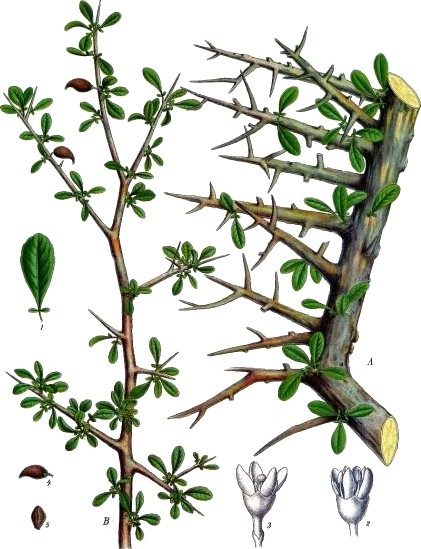
Myrrh
Mirra
- Known today as
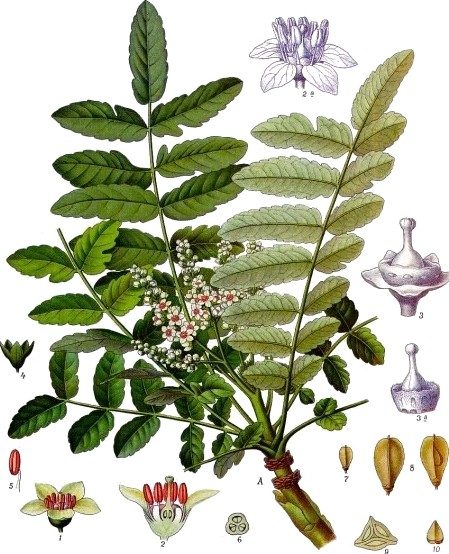
- The resin of Commiphora myrrha.
- Kind
- Resin & Wood, in 2 older authorities
- Constituents
- furanoeudesma-1,3-diene, curzerene, commiphoric acids
- Earliest authority here
- Herodotus (c. 484–c. 425 BC)
- Qualities
- Hot and dry in the second degree (Galenic tradition). What the degrees mean
- In other databases
- Plants of the World Online search · GBIF search · Wikidata search
- In the Canale glossary
- On the Manner of Discerning and Healing the Bewitched, Appendix A: Part Three, Chapters 7–8: The Bath and Fumigations
Myrrh: what did Canale use it for?
In fumigations and the oil; blessed at Epiphany (chs. 8–9; Treatise Two).
Myrrh: what does modern science say?
Astringent and antibacterial; still used in mouthwashes.
Pharmacognosy & Toxicology
- Constituents
- Mechanism
- The sesquiterpenes are antiseptic and, in mice, analgesic through the opioid receptors; the resin tightens the gums, which is the surviving use.
- Toxic dose
- No toxicity in use.
- Standing
- Tincture of myrrh is in the European monographs for the mouth and small wounds.
- Dolara, P., et al. (1996). “Analgesic effects of myrrh.” Nature 379. Verified against its record · doi:10.1038/379029a0
Constituent names open the compound’s record at PubChem, and “ChEMBL” beside a name opens its record at ChEMBL, the European Bioinformatics Institute’s database of bioactive molecules. Where a mechanism line was checked against ChEMBL (ChEMBL 37, read 1 October 2026), the check is shown with the measured value and its source paper, or says plainly that nothing has been measured. Doses are as the references give them, for description only; this is not medical advice. Each source carries the result of its check against Crossref, PubMed, or the authority’s page: see Verification.
Myrrh: what lore surrounds it?
Bitterness and preservation together: the resin of death and of incorruption.
The word preserves the resin’s bitterness: “myrrh” descends through Greek and Latin from a Semitic root meaning simply “was bitter,” the root of the Hebrew mor and the Arabic murr, so that the Magi’s gift names the taste before the substance.
Used in These Compounds
Myrrh is an ingredient of 1 compound medicine in the database. For Club members. Create a free account or sign in.
Myrrh: what did the older authorities say?
- Herodotus
- Describes the Egyptian embalmers filling the body with pure myrrh and cassia.
- The Gospels
- A gift of the Magi (Matthew 2:11); offered to Christ in wine at the Crucifixion (Mark 15:23); brought with aloes by Nicodemus for his burial (John 19:39).
Sources
- [41] European Medicines Agency, Committee on Herbal Medicinal Products (HMPC). Herbal monographs, assessment reports and public statements, ema.europa.eu, cited under the herb concerned: aniseed (summary, EMA/305345/2016); Aristolochia (public statement, EMEA/HMPC/138381/2005); asarone (public statement, EMEA/HMPC/139215/2005); caraway (EMA/HMPC/715092/2013); centaury (EMA/HMPC/277493/2015); chicory root (assessment report, EMA/HMPC/113041/2010); cinnamon (EMA/HMPC/246774/2009); clove (assessment report, EMA/HMPC/534946/2010); ethanol in herbal products (reflection paper, EMA/HMPC/85114/2008); fennel (EMEA/HMPC/372839/2016, Rev. 1, 2024); fumitory (draft assessment report, EMA/HMPC/367013/2021); greater celandine (public statement, EMA/HMPC/743927/2010); hops (EMA/HMPC/682384/2013); horehound (EMA/HMPC/604271/2012); mallow (assessment report, EMA/HMPC/749518/2016); marshmallow root (Althaeae radix); melissa (summary, EMA/HMPC/310761/2013); myrrh (assessment report and monograph, EMA/HMPC/96910/2010 and 96911/2010); peppermint oil (assessment report, EMEA/HMPC/349465/2006); pyrrolizidine alkaloids (public statement, EMA/HMPC/893108/2011); rhubarb (EMA/HMPC/113700/2019); sage (Salviae officinalis folium); wormwood (EMA/HMPC/751490/2016). Read in full · the text read
- Online Etymology Dictionary, “myrrh.” Book, seen in reviews
Verification
- Checked
- October 1, 2026
- Passes
- Every sentence read against its sources, in the fifty-entry sample
- The Standing line checked against the authority it names (EMA, WHO, FDA, CITES, Commission E)
- Every dated or regulatory claim checked by category across the database
- Sources
- 3 cited: 1 read in full, 1 verified against its record, 1 book, seen in reviews.
- Corrections
- None were needed.
What was checked, how, and what was found is set out on the Verification page. A checked source is one whose record was found; it does not make the entry medical advice.
Cite This Entry
Version 1 · first published September 25, 2026
- Chicago
“Myrrh.” In Materia Medica, edited by B. C. P. Statema. Version 1. The Thinking Press, 2026–. Last modified September 25, 2026. https://thethinkingpress.org/materia-medica/myrrh.
- MLA
“Myrrh.” Materia Medica, edited by B. C. P. Statema, version 1, The Thinking Press, 25 Sept. 2026, thethinkingpress.org/materia-medica/myrrh. Accessed 8 Oct. 2026.
- APA
Myrrh. (2026, September 25). In B. C. P. Statema (Ed.), Materia medica (Version 1). The Thinking Press. Retrieved October 8, 2026, from https://thethinkingpress.org/materia-medica/myrrh
Club members keep entries on a shelf with private notes, print the plates as cards, and receive an entry by email each week. Create a free account before January 1, 2027 and all of it is yours for good. About the Club
See Also
Also in Herodotus
Onion in Herodotus · Labdanum in Herodotus · Radish in Herodotus · Hemp in Herodotus · everything Herodotus names →
Also in Scripture
Spikenard in Scripture · Mustard seed in Scripture · Mint, oil of in Scripture · Wormwood, oil of in Scripture · everything Scripture names →
Of the same qualities: hot and dry
Long pepper · Parsley · Lavender · Rosemary · Juniper · what the degrees mean →
Nearby in the alphabet
Nasturtium, that is, garden cress (Lepidium sativum) · Myrobalans (T) · Nepenthe (Unidentified) · Nettle seed (Urtica dioica) · Musk (The secretion of the musk deer’s gland) · Niter, pills of (potassium nitrate) · Mummy (sold by the apothecaries)
Historical description, not medical advice.