
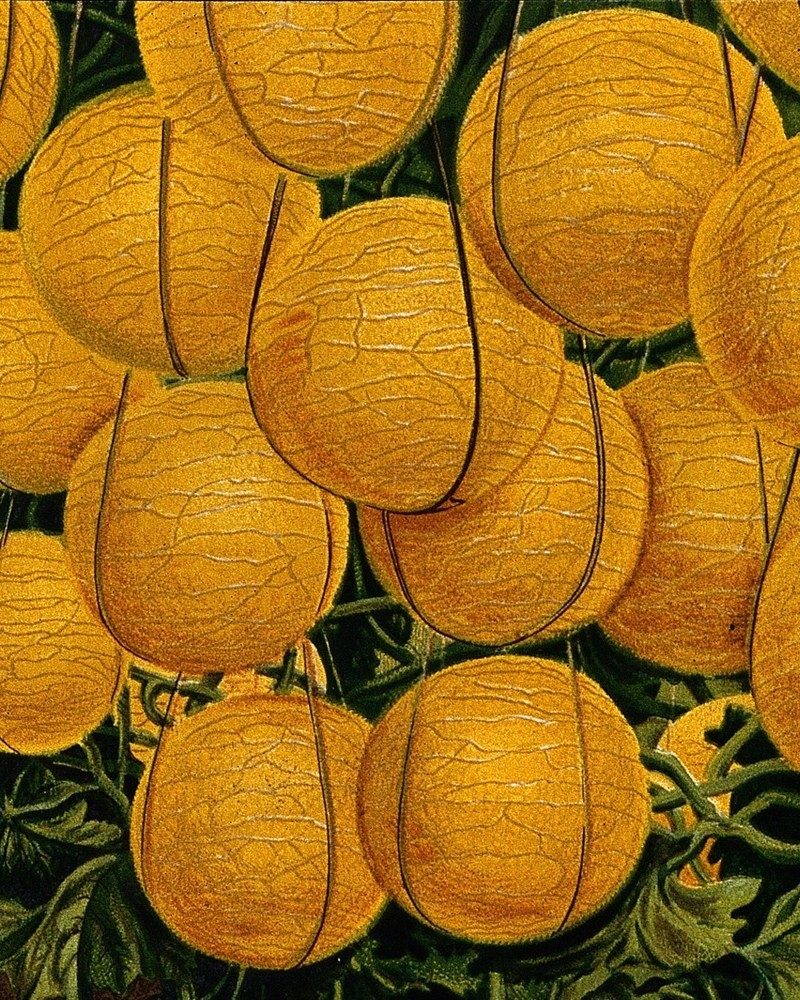
Melon root
Radice di pepone
- Known today as
- Root of the melon plant, Cucumis melo.
- Kind
- Plant, in 1 older authority
- Constituents
- cucurbitacins B and E, cucurbitacin D
- Poisoning
- Gastrointestinal irritants
- Earliest authority quoted here
- Dioscorides (c. AD 40–90)
- In other databases
- Plants of the World Online · GBIF · Wikidata
- In the Canale glossary
- On the Manner of Discerning and Healing the Bewitched, Appendix A: Part Three, Chapter 5: Vomitory Medicines
Revised October 17, 2026: Tradition, lore, modern assessment, and sources extended. Checked against its sources, each read in full, in part, or in its abstract. Version 1, first published September 25, 2026.
Melon root: what did Canale use it for?
Powdered, with honeyed wine, as a vomit (ch. 5).
Melon root: what does modern science say?
Melon root is purgative, and in large doses was held a certain emetic. Its genus holds the cucurbitacins, cytotoxic bitter compounds and its chief poisons; in the melon these are mostly cucurbitacin B, found above all in the roots, fruits, and stalks, and the bitter melon stalks are used in Chinese medicine for their strong emetic power.
The toxic dose and the poisoning
- Syndrome
- Gastrointestinal irritants
Doses are as the references give them, for description only; this is not medical advice. In a poisoning, call a poison centre.
Melon root: what did the older authorities say?
- Dioscoridesc. AD 40–90
- Says the root of the melon, dried and given in honeyed water, provokes vomiting, two drams of it, and that it is milder than the white hellebore; Pliny repeats him.
Melon root: what lore surrounds it?
The melon of the ancients was the pepon, our melon when ripe and a cucumber when green; the root, like the wild cucumber’s, held the bitterness that the sweet flesh lost in cultivation.
Pharmacognosy
- Constituents
- cucurbitacins B and Ethe chief cucurbitacins of the melon, in root, fruit, and stalk
- cucurbitacin D
- Mechanism
- The cucurbitacins are studied as anticancer agents: in cancer cells in the laboratory they act on the JAK/STAT3 and other signalling pathways, by cell death, arrest of the cell cycle, and disruption of the cytoskeleton.
Constituent names open the compound’s record at PubChem, and “ChEMBL” beside a name opens its record at ChEMBL, the European Bioinformatics Institute’s database of bioactive molecules. Where a mechanism line was checked against ChEMBL (ChEMBL 37, read 1 October 2026), the check is shown with the measured value and its source paper, or says plainly that nothing has been measured. Doses are as the references give them, for description only; this is not medical advice. Each source carries the result of its check against Crossref, PubMed, or the authority’s page: see Verification.
Sources
- [54] Grieve, M. (1931). A Modern Herbal. Online edition, botanical.com, cited under the plant concerned. Read in full · the text read
- Dioscorides, De materia medica II. Read in part · the text read
- Pliny, Natural History XX. Read in part · the text read
- El-Sayed, H. M., et al. (2026). Genus Cucumis: traditional uses, phytochemistry, pharmacology, clinical application, and toxicology. Chinese Herbal Medicines. Read in part · the text read
- Sravya, K., et al. (2026). Unravelling the intricate mechanism of cucurbitacin-mediated anti-cancer therapy. Cancers. Read in part · the text read
Verification
- Checked
- October 1, 2026, October 17, 2026
- Passes
- Read against its sources in the pass over the remaining 343 entries
- Every dated or regulatory claim checked by category across the database
- Every source read, in full, in part, or in its abstract, and every sentence checked against what was read (October 17, 2026)
- Sources
- 5 cited: 1 read in full, 4 read in part.
- Corrections
- None recorded.
What was checked, how, and what was found is set out on the Verification page. A checked source is one whose record was found; it does not make the entry medical advice.
Club members can point at a technical term in this entry, such as a constituent, an action, or a word of Jung’s, to read its definition from the source. The Club.
Cite This Entry
Version 1 · first published September 25, 2026 · last revised October 17, 2026
- Chicago
“Melon root.” In Materia Medica, edited by B. C. P. Statema. Version 1. The Thinking Press, 2026–. Last modified October 17, 2026. https://thethinkingpress.org/materia-medica/melon-root.
- MLA
“Melon root.” Materia Medica, edited by B. C. P. Statema, version 1, The Thinking Press, 17 Oct. 2026, thethinkingpress.org/materia-medica/melon-root. Accessed 22 Nov. 2026.
- APA
Melon root. (2026, October 17). In B. C. P. Statema (Ed.), Materia medica (Version 1). The Thinking Press. Retrieved November 22, 2026, from https://thethinkingpress.org/materia-medica/melon-root
See Also
Poisoned alike: gastrointestinal irritants
Mistletoe · Meadow saffron · Morel · Livid pinkgill · Pokeweed · Jalap · Scammony · Jack-o’-lantern · the syndrome, with all of them →
Also in Dioscorides
Milk thistle in Dioscorides · Mullein in Dioscorides · Mastic in Dioscorides · everything Dioscorides names →
Drawing on the same sources: Dioscorides, Pliny
Nearby in the alphabet
Melilot · Milkweed · Meadowsweet · Mint, oil of (Oil of garden or spear mint) · The Miraculous Medal · Mayapple
Historical description, not medical advice.
