
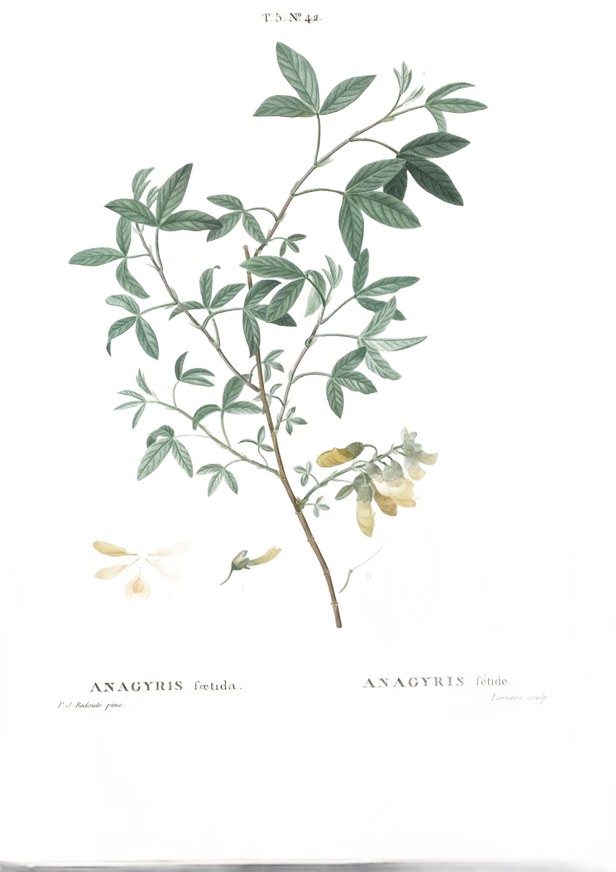
Lesser bean-trefoil
Anagiride minore
- Known today as
- Stinking bean trefoil, Anagyris foetida, a Mediterranean shrub. “Female bean trefoil” in the oil of ch. 9 is the same plant.
- Kind
- Plant, in 1 older authority
- Constituents
- cytisine, anagyrine, N-methylcytisine
- Earliest authority here
- Pliny (AD 23/24–79)
- In other databases
- Plants of the World Online search · GBIF search · Wikidata search
- In the Canale glossary
- On the Manner of Discerning and Healing the Bewitched, Appendix A: Part Three, Chapter 5: Vomitory Medicines
Revised October 1, 2026: An older authority added from a text read in full. Lore added from texts read in full. Version 1, first published September 25, 2026.
Caution. Hazardous in some form or dose; see the modern assessment below.
Lesser bean-trefoil: what did Canale use it for?
Seeds and inner bark as a powerful vomit (chs. 5, 9).
Lesser bean-trefoil: what does modern science say?
A genuine emetic and purgative, and poisonous; the plant contains cytisine, anagyrine, and related alkaloids.
Lesser bean-trefoil: is it poisonous?
Yes, in some form or dose. Its poisoning is nicotinic poisoning (coniine, nicotine, cytisine): Minutes to an hour. Historical description, not medical advice; in a poisoning, call a poison centre.
Pharmacognosy & Toxicology
- Constituents
- Mechanism
- Anagyris foetida, the stinking bean trefoil: its seeds and bark carry cytisine and anagyrine, nicotinic agonists that vomit violently and then, in quantity, paralyse breathing; Canale’s “powerful vomit” was a laburnum-class poisoning stopped at the vomiting. Anagyrine causes crooked-calf disease in cattle that graze lupins.
- Checked against ChEMBL
- cytisine: ChEMBL’s curated mechanism: partial agonist Neuronal acetylcholine receptor; alpha4/beta2.
- Toxic dose
- A few seeds vomit; more has killed; there is no therapeutic margin.
- Syndrome
- Nicotinic poisoning (coniine, nicotine, cytisine)
- Standing
- No use; a plant of the Mediterranean scrub avoided by goats.
- Frohne, D., and Pfänder, H. J. (2005). Poisonous Plants, 2nd ed., “Fabaceae.” Book, not indexed
- Keeler, R. F. (1989). “Piperidine alkaloid composition and relation to crooked calf disease-inducing potential of Lupinus formosus.” Teratology 40. Verified against its record · doi:10.1002/tera.1420400503
The abstract of each source, beneath its citation. For Club members. About the Club or sign in.
Constituent names open the compound’s record at PubChem, and “ChEMBL” beside a name opens its record at ChEMBL, the European Bioinformatics Institute’s database of bioactive molecules. Where a mechanism line was checked against ChEMBL (ChEMBL 37, read 1 October 2026), the check is shown with the measured value and its source paper, or says plainly that nothing has been measured. Doses are as the references give them, for description only; this is not medical advice. Each source carries the result of its check against Crossref, PubMed, or the authority’s page: see Verification.
Lesser bean-trefoil: what lore surrounds it?
Folkard records the ancient aversion to beans “arising from the resemblance of the fruit to a portion of the human body”: Pythagoras “recognised blood, and consequently an animal,” and was killed “because, having in his flight reached a field of Beans, he would not cross it for fear of trampling upon living beings, the souls of the dead.” The Roman Lemures went by night “throwing Beans against” houses, and in May the people threw black beans on graves. Of the trefoil, “among the Romans, the Grass crown made of Trefoil-leaves was esteemed a mark of very high honour.”
Lesser bean-trefoil: what did the older authorities say?
- Pliny
- Describes the anagyros, “known to some by the name of acopon,” as a shrub-like plant “with an offensive smell,” a blossom like the cabbage, and a kidney-shaped seed in long horn-like pods that hardens at harvest; its leaves are applied to gatherings and “attached to the person in cases of difficult parturition, care being taken to remove them the moment after delivery.”
Sources
- [4] Aliboudhar, H., Tigrine-Kordjani, N., & Lakache, Z. (2022). Identification and evaluation of free radical scavenging activity of quinolizidine alkaloids isolated from various parts of Anagyris foetida plant. Pharmaceutical Chemistry Journal 56: 966–973. doi:10.1007/s11094-022-02734-8 Verified against its record · doi:10.1007/s11094-022-02734-8
- [64] Innocenti, G., Dall’Acqua, S., Viola, G., & Loi, M. C. (2006). Cytotoxic constituents from Anagyris foetida leaves. Fitoterapia 77(7–8): 595–597. doi:10.1016/j.fitote.2006.06.012 Verified against its record · doi:10.1016/j.fitote.2006.06.012
- Pliny the Elder, Natural History 27.13, trans. J. Bostock & H. T. Riley (1855), Perseus Digital Library. Primary text
- Folkard, R. (1884). Plant Lore, Legends, and Lyrics, “Beans.” Project Gutenberg #44638. Primary text
- Folkard, R. (1884). Plant Lore, Legends, and Lyrics, “Trefoil.” Project Gutenberg #44638. Primary text
Verification
- Checked
- October 1, 2026
- Passes
- Every sentence read against its sources, in the pass over the remaining 343 entries
- The Standing line checked against the authority it names (EMA, WHO, FDA, CITES, Commission E)
- Every dated or regulatory claim checked by category across the database
- The mechanism read against ChEMBL (ChEMBL 37): curated mechanisms and measured activity
- Each quotation from the older authorities checked word for word against the text, read in full
- Sources
- 7 cited: 3 verified against its record, 3 primary text, 1 book, not indexed. 1 with the abstract on file.
- Corrections
- None were needed.
What was checked, how, and what was found is set out on the Verification page. A checked source is one whose record was found; it does not make the entry medical advice.
Cite This Entry
Version 1 · first published September 25, 2026 · last revised October 1, 2026
- Chicago
“Lesser bean-trefoil.” In Materia Medica, edited by B. C. P. Statema. Version 1. The Thinking Press, 2026–. Last modified October 1, 2026. https://thethinkingpress.org/materia-medica/lesser-bean-trefoil.
- MLA
“Lesser bean-trefoil.” Materia Medica, edited by B. C. P. Statema, version 1, The Thinking Press, 1 Oct. 2026, thethinkingpress.org/materia-medica/lesser-bean-trefoil. Accessed 8 Oct. 2026.
- APA
Lesser bean-trefoil. (2026, October 1). In B. C. P. Statema (Ed.), Materia medica (Version 1). The Thinking Press. Retrieved October 8, 2026, from https://thethinkingpress.org/materia-medica/lesser-bean-trefoil
Club members keep entries on a shelf with private notes, print the plates as cards, and receive an entry by email each week. Create a free account before January 1, 2027 and all of it is yours for good. About the Club
See Also
Poisoned alike: nicotinic poisoning (coniine, nicotine, cytisine)
Tobacco · Hemlock · Broom · Gorse · the syndrome, with all of them →
Also in Pliny the Elder
Long pepper in Pliny the Elder · Kermes in Pliny the Elder · Madder in Pliny the Elder · Juniper in Pliny the Elder · everything Pliny the Elder names →
Drawing on the same sources: Folkard, Frohne
Mallow and marshmallow · Labdanum · Masterwort and angelica · Liverwort, or hepatica · Herb Paris · Rowan · the bibliography →
Nearby in the alphabet
Letters from Heaven · Lenitive electuary · Licorice (The root of Glycyrrhiza glabra) · Leech (Hirudo medicinalis) · Lion’s mane (A single clump of hanging spines on hardwood trees) · Lavender (L) · Litharge (a byproduct of refining silver) · Laurel (Laurus nobilis)
Historical description, not medical advice.