
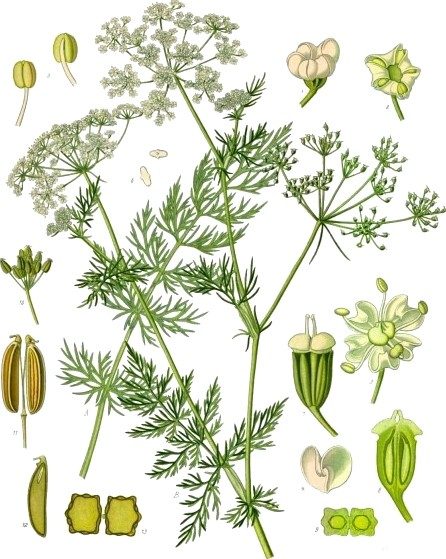
Caraway broth
Brodo di carvi
- Known today as
- A broth of caraway seed, Carum carvi.
- Kind
- Compound, in 1 older authority
- Constituents
- carvone, limonene
- Earliest authority here
- Dioscorides (c. AD 40–90)
- In other databases
- GBIF search · Wikidata search
- In the Canale glossary
- On the Manner of Discerning and Healing the Bewitched, Appendix A: Part Three, Chapter 6: Remedies Given by Mouth After the Purge
Revised October 3, 2026: Tradition, lore, modern assessment, and sources extended. Checked against its sources, each read in full, in part, or in its abstract. Version 1, first published September 25, 2026.
Caraway broth: what did Canale use it for?
As a vehicle for the powder (ch. 6).
Caraway broth: what does modern science say?
Carminative. The EMA accepts caraway only as a traditional remedy for bloating and wind, finding no clinical trials of adequate quality for the fruit; its extracts relax the guinea-pig gut in the laboratory, and a capsule of peppermint and caraway oils eased functional dyspepsia better than placebo in one controlled trial. The British Pharmaceutical Codex of 1911 still combined caraway with purgatives, so the broth was a fitting vehicle for a purging powder.
Pharmacognosy & Toxicology
- Constituents
- Mechanism
- Caraway extracts relax the isolated gut of the guinea pig, and caraway oil is in the peppermint-and-caraway capsule (Enteroplant) that eased functional dyspepsia in a controlled trial; a broth of it was a palatable vehicle for the powder, as distilled caraway water was still “an excellent vehicle for children’s medicines” in 1911.
- Toxic dose
- A food.
- Standing
- Caraway fruit has an EMA monograph (2015) for digestive disorders such as bloating and wind.
- EMA/HMPC (2015). European Union herbal monograph on Carum carvi L., fructus (EMA/HMPC/715092/2013). Read in full · the text read
- May, B., et al. (2000). “Efficacy and tolerability of a fixed combination of peppermint oil and caraway oil in patients suffering from functional dyspepsia.” Alimentary Pharmacology and Therapeutics 14. Abstract read · the text read
The abstract of each source, beneath its citation. For Club members. About the Club or sign in.
Constituent names open the compound’s record at PubChem, and “ChEMBL” beside a name opens its record at ChEMBL, the European Bioinformatics Institute’s database of bioactive molecules. Where a mechanism line was checked against ChEMBL (ChEMBL 37, read 1 October 2026), the check is shown with the measured value and its source paper, or says plainly that nothing has been measured. Doses are as the references give them, for description only; this is not medical advice. Each source carries the result of its check against Crossref, PubMed, or the authority’s page: see Verification.
Caraway broth: what lore surrounds it?
Caraway comfits, the seeds crusted in white sugar, were served to the table with fruit, as Parkinson says in Grieve’s quotation of him, and Justice Shallow offers Falstaff “a last year’s pippin of mine own graffing, with a dish of caraways”; the seed was held to keep lovers from proving fickle and fowls and pigeons from straying, and tame pigeons were given baked caraway dough in their cote.
Caraway broth: what did the older authorities say?
- Dioscorides
- Gives karos, the caraway seed, as urinary, warming, good for the stomach, pleasant to the mouth, and digestive, mixed usefully in antidotes; its root, boiled, is eaten like parsnip.
Sources
- [41] European Medicines Agency, Committee on Herbal Medicinal Products (HMPC). Herbal monographs, assessment reports and public statements, ema.europa.eu, cited under the herb concerned: aniseed (summary, EMA/305345/2016); Aristolochia (public statement, EMEA/HMPC/138381/2005); asarone (public statement, EMEA/HMPC/139215/2005); caraway (EMA/HMPC/715092/2013); centaury (EMA/HMPC/277493/2015); chicory root (assessment report, EMA/HMPC/113041/2010); cinnamon (EMA/HMPC/246774/2009); clove (assessment report, EMA/HMPC/534946/2010); ethanol in herbal products (reflection paper, EMA/HMPC/85114/2008); fennel (EMEA/HMPC/372839/2016, Rev. 1, 2024); fumitory (draft assessment report, EMA/HMPC/367013/2021); greater celandine (public statement, EMA/HMPC/743927/2010); hops (EMA/HMPC/682384/2013); horehound (EMA/HMPC/604271/2012); mallow (assessment report, EMA/HMPC/749518/2016); marshmallow root (Althaeae radix); melissa (summary, EMA/HMPC/310761/2013); myrrh (assessment report and monograph, EMA/HMPC/96910/2010 and 96911/2010); peppermint oil (assessment report, EMEA/HMPC/349465/2006); pyrrolizidine alkaloids (public statement, EMA/HMPC/893108/2011); rhubarb (EMA/HMPC/113700/2019); sage (Salviae officinalis folium); wormwood (EMA/HMPC/751490/2016). Read in full · the text read
- Shakespeare, Henry IV, Part 2 V.iii. Read in part · the text read
- Dioscorides, De materia medica III. Read in part · the text read
- EMA/HMPC (2015). Assessment report on Carum carvi L., fructus and Carum carvi L., aetheroleum (EMA/HMPC/715093/2013). Read in full · the text read
- Grieve, M. (1931). A Modern Herbal, “Caraway.” London: Jonathan Cape. Read in part · the text read
Verification
- Checked
- October 1, 2026, and October 3, 2026
- Passes
- Every sentence read against its sources, in the pass over the remaining 343 entries
- The Standing line checked against the authority it names (EMA, WHO, FDA, CITES, Commission E)
- Every dated or regulatory claim checked by category across the database
- Every source read, in full, in part, or in its abstract, and every sentence checked against what was read (October 3, 2026)
- Sources
- 7 cited: 3 read in full, 3 read in part, 1 abstract read. 1 with the abstract on file.
- Corrections
- None were needed.
What was checked, how, and what was found is set out on the Verification page. A checked source is one whose record was found; it does not make the entry medical advice.
Cite This Entry
Version 1 · first published September 25, 2026 · last revised October 3, 2026
- Chicago
“Caraway broth.” In Materia Medica, edited by B. C. P. Statema. Version 1. The Thinking Press, 2026–. Last modified October 3, 2026. https://thethinkingpress.org/materia-medica/caraway-broth.
- MLA
“Caraway broth.” Materia Medica, edited by B. C. P. Statema, version 1, The Thinking Press, 3 Oct. 2026, thethinkingpress.org/materia-medica/caraway-broth. Accessed 8 Oct. 2026.
- APA
Caraway broth. (2026, October 3). In B. C. P. Statema (Ed.), Materia medica (Version 1). The Thinking Press. Retrieved October 8, 2026, from https://thethinkingpress.org/materia-medica/caraway-broth
Club members keep entries on a shelf with private notes, print the plates as cards, and receive an entry by email each week. Create a free account before January 1, 2027 and all of it is yours for good. About the Club
See Also
Sharing carvone, limonene
Anethum graveolens · Blessed herbs · Elettaria cardamomum · Citrus medica
Also in Dioscorides
Cantharides in Dioscorides · Caterpillar fungus in Dioscorides · Calamine in Dioscorides · everything Dioscorides names →
Drawing on the same sources: Shakespeare, Dioscorides, Grieve
Chamomile · Toadstone · Eryngo · Chaste tree · Butterbur · Carmelite water · the bibliography →
Nearby in the alphabet
The Caravaca cross · Caper spurge (Euphorbia lathyris) · Cassia wood (Cinnamomum aromaticum (long known as Cinnamomum cassia)) · Cassia, flower of (the Indian laburnum) · Camphor (The crystalline gum of Cinnamomum camphora)
Historical description, not medical advice.