
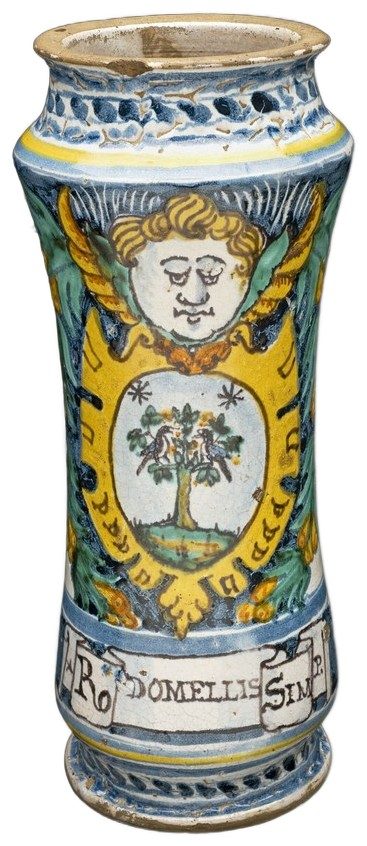
Honeyed wine and honeyed water
Mulsa
- Known today as
- Wine or water sweetened with honey.
- Kind
- Food & Drink, in 2 older authorities
- Constituents
- fructose and glucose, ethanol, hydrogen peroxide and methylglyoxal
- Earliest authority here
- Pliny (AD 23/24–79)
- In the Canale glossary
- On the Manner of Discerning and Healing the Bewitched, Appendix A: Part Three, Chapter 5: Vomitory Medicines
Revised October 3, 2026: Tradition, lore, modern assessment, and sources extended. Checked against its sources, each read in full, in part, or in its abstract. Version 1, first published September 25, 2026.
Honeyed wine and honeyed water: what did Canale use it for?
The vehicle for powdered seeds and roots in the vomits (ch. 5).
Honeyed wine and honeyed water: what does modern science say?
A vehicle only; honey’s own antibacterial action is documented in wound dressings.
Pharmacognosy & Toxicology
- Constituents
- fructose and glucosethe honey
- ethanol ChEMBLin the mulsum
- hydrogen peroxide and methylglyoxalthe antibacterial of honey
- Mechanism
- Mulsum and hydromel, the vehicles for powdered roots and seeds: honey makes the dose palatable and the wine adds alcohol, and Pliny says hydromel taken warm promotes vomiting, which suited the vomits. Honey’s antibacterial action is documented on wounds.
- Toxic dose
- A food.
- Standing
- A vehicle; several medical-grade honey dressings are approved by the US Food and Drug Administration for minor wounds and burns.
- Molan, P. C. (1992). “The antibacterial activity of honey.” Bee World 73. Abstract read · the text read
The abstract of each source, beneath its citation. For Club members. About the Club or sign in.
Constituent names open the compound’s record at PubChem, and “ChEMBL” beside a name opens its record at ChEMBL, the European Bioinformatics Institute’s database of bioactive molecules. Where a mechanism line was checked against ChEMBL (ChEMBL 37, read 1 October 2026), the check is shown with the measured value and its source paper, or says plainly that nothing has been measured. Doses are as the references give them, for description only; this is not medical advice. Each source carries the result of its check against Crossref, PubMed, or the authority’s page: see Verification.
What Medicine Makes of It
- Fasting, Vigil, and VisionWhat hunger and sleeplessness do to the senses.
Honeyed wine and honeyed water: what lore surrounds it?
Mulsum, wine and honey, was the aperitif of the Roman dinner, offered with the gustus; hydromel, from the Greek for “water-honey,” is also a name for mead, made by fermenting honey with water.
Honeyed wine and honeyed water: what did the older authorities say?
- Pliny
- Says honied wine, mulsum, is best made with old wine, and that Pollio Romilius, past a hundred, told Augustus he kept his vigour with “honied wine within, oil without”; hydromel, he adds, “taken warm, it promotes vomiting.”
- Hippocrates
- Gives hydromel in acute diseases as moderately expectorant and diuretic, and would have it boiled when the honey is bad.
Sources
- Pliny, Natural History XXII. Read in part · the text read
- Pliny the Elder. Natural History 22.52, trans. J. Bostock & H. T. Riley (1855). Perseus Digital Library. Read in part · the text read
- “Mulsum.” Wikipedia (read 2 October 2026). Read in full · the text read
- “Mead.” Wikipedia (read 2 October 2026). Read in part · the text read
- Hippocrates. On Regimen in Acute Diseases, trans. F. Adams (1849). Wikisource. Read in full · the text read
- Canale, F. (1622). Del modo di conoscer et sanare i maleficiati. Brescia. Read in part · the text read
- “Honey.” Wikipedia (read 2 October 2026). Read in part · the text read
Verification
- Checked
- October 1, 2026, and October 3, 2026
- Passes
- Every sentence read against its sources, in the fifty-entry sample
- The Standing line checked against the authority it names (EMA, WHO, FDA, CITES, Commission E)
- Every dated or regulatory claim checked by category across the database
- Every source read, in full, in part, or in its abstract, and every sentence checked against what was read (October 3, 2026)
- Sources
- 8 cited: 2 read in full, 5 read in part, 1 abstract read. 1 with the abstract on file.
- Corrections
- None were needed.
What was checked, how, and what was found is set out on the Verification page. A checked source is one whose record was found; it does not make the entry medical advice.
Cite This Entry
Version 1 · first published September 25, 2026 · last revised October 3, 2026
- Chicago
“Honeyed wine and honeyed water.” In Materia Medica, edited by B. C. P. Statema. Version 1. The Thinking Press, 2026–. Last modified October 3, 2026. https://thethinkingpress.org/materia-medica/honeyed-wine-and-honeyed-water.
- MLA
“Honeyed wine and honeyed water.” Materia Medica, edited by B. C. P. Statema, version 1, The Thinking Press, 3 Oct. 2026, thethinkingpress.org/materia-medica/honeyed-wine-and-honeyed-water. Accessed 8 Oct. 2026.
- APA
Honeyed wine and honeyed water. (2026, October 3). In B. C. P. Statema (Ed.), Materia medica (Version 1). The Thinking Press. Retrieved October 8, 2026, from https://thethinkingpress.org/materia-medica/honeyed-wine-and-honeyed-water
Club members keep entries on a shelf with private notes, print the plates as cards, and receive an entry by email each week. Create a free account before January 1, 2027 and all of it is yours for good. About the Club
See Also
Sharing ethanol
Also in Pliny the Elder
Houndstongue in Pliny the Elder · Hawthorn in Pliny the Elder · Jet, oil of in Pliny the Elder · Gum arabic in Pliny the Elder · everything Pliny the Elder names →
Also in Hippocrates and the Hippocratic Writers
Hyssop in Hippocrates and the Hippocratic Writers · Honey in Hippocrates and the Hippocratic Writers · Valerian in Hippocrates and the Hippocratic Writers · Black hellebore in Hippocrates and the Hippocratic Writers · everything Hippocrates and the Hippocratic Writers names →
Drawing on the same sources: Pliny, Canale
Long pepper · Hagstone · Melon root · Malmsey · Passarino’s white powder · the bibliography →
Nearby in the alphabet
Hop (Humulus lupulus) · Honey fungus (from black cords, the “shoestrings,” that spread beneath the bark) · Horehound (Marrubium vulgare) · Holy wells (many of them sacred long before Christianity, visited for cures) · Houseleek (Sempervivum tectorum) · The holy water stoup (and the small stoups kept in homes)
Historical description, not medical advice.