
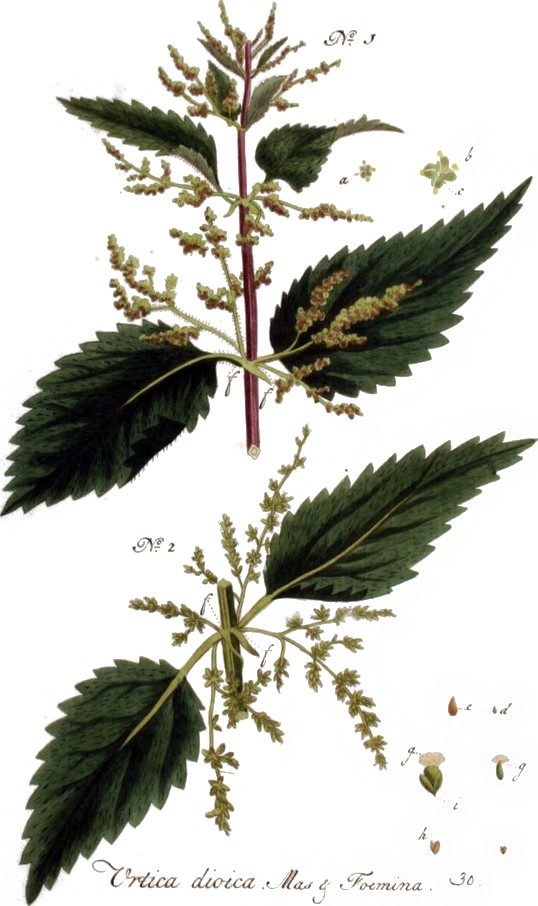
Nettle seed
Seme d’urtica
- Known today as
- Seed of the stinging nettle, Urtica dioica.
- Kind
- Plant, in 1 older authority
- Constituents
- linoleic acid, tocopherols, secoisolariciresinol, and 1 more
- Earliest authority here
- Pliny (AD 23/24–79)
- In other databases
- Plants of the World Online search · GBIF search · Wikidata search
- In the Canale glossary
- On the Manner of Discerning and Healing the Bewitched, Appendix A: Part Three, Chapter 5: Vomitory Medicines
Revised October 1, 2026: An older authority added from a text read in full. Version 1, first published September 25, 2026.
Nettle seed: what did Canale use it for?
Powdered, with honeyed water, as a vomit (ch. 5).
Nettle seed: foraging it in the Midwest
- Part
- Leaves; stalk fibre
- When
- Leaves in summer, stalks in autumn
The Flambeau Ojibwe soaked the leaves of their nettle in warm water for a poultice on heat rashes, something like fighting fire with fire, and in aboriginal times took a fine stout sewing fibre from the rind of the stalk.
After Smith. All the foragables of the Midwest. Historical record, not a field guide: identify before you gather, and read the whole entry.
Nettle seed: what does modern science say?
Pliny says the seed, taken in honeyed water, gives a gentle vomit, and acts as a laxative.
Pharmacognosy & Toxicology
- Constituents
- linoleic acid ChEMBLthe seed oil
- tocopherols
- secoisolariciresinol ChEMBLa lignan, in the root
- histamine and formic acidin the stinging hairs of the leaf
- Mechanism
- The seed is an oily food with nothing emetic in it, and Canale’s vomit was the honeyed water and the quantity; the leaf’s sting is histamine, acetylcholine, and serotonin injected by the hair, and the leaf extract is anti-inflammatory in arthritis trials; the root’s lignans and sterols ease the symptoms of an enlarged prostate.
- Toxic dose
- Safe; the sting is self-limiting.
- Standing
- EMA monographs (2008, 2012) for the leaf in minor joint pain and as a diuretic, and for the root in benign prostatic hyperplasia, with a controlled trial of 620 men (Safarinejad, 2005).
- EMA/HMPC (2012). Community herbal monograph on Urtica dioica L., Urtica urens L., radix (EMA/HMPC/461160/2008). Verified against its record
- Safarinejad, M. R. (2005). “Urtica dioica for treatment of benign prostatic hyperplasia: a prospective, randomized, double-blind, placebo-controlled, crossover study.” Journal of Herbal Pharmacotherapy 5. Verified against its record · doi:10.1080/j157v05n04_01
The abstract of each source, beneath its citation. For Club members. About the Club or sign in.
Constituent names open the compound’s record at PubChem, and “ChEMBL” beside a name opens its record at ChEMBL, the European Bioinformatics Institute’s database of bioactive molecules. Where a mechanism line was checked against ChEMBL (ChEMBL 37, read 1 October 2026), the check is shown with the measured value and its source paper, or says plainly that nothing has been measured. Doses are as the references give them, for description only; this is not medical advice. Each source carries the result of its check against Crossref, PubMed, or the authority’s page: see Verification.
Nettle seed: what lore surrounds it?
The plant’s sting had a folk use of its own: Roman soldiers in cold Britain are said to have flogged their limbs with nettles to warm them, a practice called urtication that survived as a folk remedy for arthritis and sciatica for some two thousand years.
Nettle seed: what did the older authorities say?
- Pliny
- “What plant can there possibly be that is more an object of our aversion than the nettle?” Yet its seed, according to Nicander, is an antidote to the poison of hemlock, of fungi, and of quicksilver, and Apollodorus gives it in the broth of a boiled tortoise for the bite of the salamander; the sting itself braces the uvula and wakes the lethargic when their legs and forehead are touched with it; the root arrests bleeding at the nostrils; “nettle-seed should be gathered at harvest-time: that of Alexandria is the most highly esteemed”; and in Egypt an oil, cnidinum, was pressed from it.
Sources
- [98] Pliny the Elder. The Natural History. Trans. J. Bostock and H. T. Riley. London, 1855. Perseus Digital Library, Tufts University. Cited by book and chapter. Primary text
- World Wide Words, “Urtication.” Book, not indexed
- Pliny the Elder, Natural History 22.15, 15.7, trans. J. Bostock & H. T. Riley (1855), Perseus Digital Library. Primary text
Verification
- Checked
- October 1, 2026
- Passes
- Every sentence read against its sources, in the pass over the remaining 343 entries
- The Standing line checked against the authority it names (EMA, WHO, FDA, CITES, Commission E)
- Every dated or regulatory claim checked by category across the database
- Each quotation from the older authorities checked word for word against the text, read in full
- Sources
- 5 cited: 2 verified against its record, 2 primary text, 1 book, not indexed. 1 with the abstract on file.
- Corrections
- None were needed.
What was checked, how, and what was found is set out on the Verification page. A checked source is one whose record was found; it does not make the entry medical advice.
Cite This Entry
Version 1 · first published September 25, 2026 · last revised October 1, 2026
- Chicago
“Nettle seed.” In Materia Medica, edited by B. C. P. Statema. Version 1. The Thinking Press, 2026–. Last modified October 1, 2026. https://thethinkingpress.org/materia-medica/nettle-seed.
- MLA
“Nettle seed.” Materia Medica, edited by B. C. P. Statema, version 1, The Thinking Press, 1 Oct. 2026, thethinkingpress.org/materia-medica/nettle-seed. Accessed 8 Oct. 2026.
- APA
Nettle seed. (2026, October 1). In B. C. P. Statema (Ed.), Materia medica (Version 1). The Thinking Press. Retrieved October 8, 2026, from https://thethinkingpress.org/materia-medica/nettle-seed
Club members keep entries on a shelf with private notes, print the plates as cards, and receive an entry by email each week. Create a free account before January 1, 2027 and all of it is yours for good. About the Club
See Also
Sharing linoleic acid
Also in Pliny the Elder
Niter, pills of in Pliny the Elder · Nasturtium, that is, garden cress in Pliny the Elder · Nutmeg and clove in Pliny the Elder · Mullein in Pliny the Elder · everything Pliny the Elder names →
Nearby in the alphabet
Nepenthe (Unidentified) · Oak galls (Round growths raised on oaks by gall wasps) · Myrrh (The resin of Commiphora myrrha) · Oil of bricks · Myrobalans (T)
Historical description, not medical advice.