
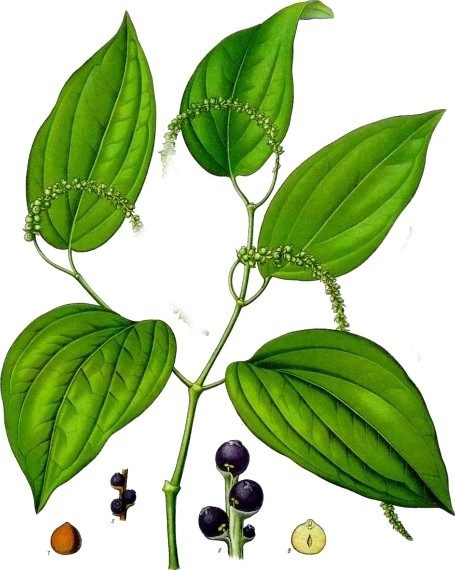
Diatrion piperion
Diatrion pipereon
- Known today as
- A warming powder of the three peppers, with aniseed and ginger.
- Kind
- Compound, in 2 older authorities
- Constituents
- piperine, thymol, gingerols, and 2 more
- Earliest authority here
- Galen (AD 129–c. 216)
- In the Canale glossary
- On the Manner of Discerning and Healing the Bewitched, Appendix A: Part Three, Chapter 6: Remedies Given by Mouth After the Purge
Revised October 3, 2026: Tradition, lore, modern assessment, and sources extended. Checked against its sources, each read in full, in part, or in its abstract. Version 1, first published September 25, 2026.
Diatrion piperion: what did Canale use it for?
In morsels (ch. 6).
Diatrion piperion: what does modern science say?
Pepper acts on the gut: black pepper raises the secretion of gastric juice and relieves colic, as the British Pharmaceutical Codex of 1911 has it, dietary piperine stimulates the digestive enzymes of the pancreas, and anise is a carminative; so the powder did what it claimed in a small way.
Pharmacognosy & Toxicology
- Constituents
- Mechanism
- The three peppers with thyme, ginger, and aniseed in honey: pepper raises the secretion of gastric juice, stirs the gut, and relieves colic, and dietary piperine stimulates the digestive enzymes of the pancreas and shortens the transit of food, which is a carminative for a cold stomach by any reckoning; piperine also raises the blood levels of drugs taken with it.
- Toxic dose
- A spice electuary: Culpeper gave half a dram of the powder or two drams of the electuary, and half as much if age and strength would not bear it.
- Standing
- In the London Pharmacopoeia of 1653; its pharmacology is that of pepper.
- Srinivasan, K. (2007). “Black pepper and its pungent principle, piperine: a review of diverse physiological effects.” Critical Reviews in Food Science and Nutrition 47. Abstract read · the text read
The abstract of each source, beneath its citation. For Club members. About the Club or sign in.
Constituent names open the compound’s record at PubChem, and “ChEMBL” beside a name opens its record at ChEMBL, the European Bioinformatics Institute’s database of bioactive molecules. Where a mechanism line was checked against ChEMBL (ChEMBL 37, read 1 October 2026), the check is shown with the measured value and its source paper, or says plainly that nothing has been measured. Doses are as the references give them, for description only; this is not medical advice. Each source carries the result of its check against Crossref, PubMed, or the authority’s page: see Verification.
Diatrion piperion: what lore surrounds it?
The names beginning dia- mean “made of”: Culpeper glosses diacinnamomum as “in plain English, a Composition of Cinnamon”; so diamoschu of musk and diatrion piperion of the three peppers.
The Recipe
The recipe: 5 ingredients, each linked to its entry. For Club members. Create a free account or sign in.
Diatrion piperion: what did the older authorities say?
- Galen
- According to Culpeper, Galen was the author of the diatrion pipereon, “of the three peppers,” and appointed it to be made up with clarified honey; the London College gives the three peppers with aniseed and ginger, to heat the stomach and expel wind.
- Mesue and Nicolaus
- Carry it into the antidotaries as diatrion pipereon: Mesue for pains of the stomach bred of gross, raw phlegm, to warm the stomach and aid digestion against acid belching, and the Antidotarium Nicolai for phlegm of the stomach, a weak digestion, and cold; and it stood in the London Pharmacopoeia of 1653.
Sources
- [28] Culpeper, N. (1653). Pharmacopœia Londinensis, or, The London Dispensatory [the Royal College of Physicians’ pharmacopoeia in English, with Culpeper’s commentary]. London: Peter Cole. Text Creation Partnership edition A35381. Read in part · the text read
- [85] Mehmood, M. H., & Gilani, A. H. (2010). Pharmacological basis for the medicinal use of black pepper and piperine in gastrointestinal disorders. Journal of Medicinal Food 13(5): 1086–1096. doi:10.1089/jmf.2010.1065 Abstract read · the text read
- Antidotarium Nicolai. Read in part · the text read
- Mesue (1589). I libri di Gio. Mesue de i semplici purgativi, et delle medicine composte, ed. G. Rossetto. Venice. Read in part · the text read
Verification
- Checked
- October 1, 2026, and October 3, 2026
- Passes
- Every sentence read against its sources, in the pass over the remaining 343 entries
- The Standing line checked against the authority it names (EMA, WHO, FDA, CITES, Commission E)
- Every dated or regulatory claim checked by category across the database
- Every source read, in full, in part, or in its abstract, and every sentence checked against what was read (October 3, 2026)
- Sources
- 5 cited: 3 read in part, 2 abstract read. 2 with the abstract on file.
- Corrections
- None were needed.
What was checked, how, and what was found is set out on the Verification page. A checked source is one whose record was found; it does not make the entry medical advice.
Cite This Entry
Version 1 · first published September 25, 2026 · last revised October 3, 2026
- Chicago
“Diatrion piperion.” In Materia Medica, edited by B. C. P. Statema. Version 1. The Thinking Press, 2026–. Last modified October 3, 2026. https://thethinkingpress.org/materia-medica/diatrion-piperion.
- MLA
“Diatrion piperion.” Materia Medica, edited by B. C. P. Statema, version 1, The Thinking Press, 3 Oct. 2026, thethinkingpress.org/materia-medica/diatrion-piperion. Accessed 8 Oct. 2026.
- APA
Diatrion piperion. (2026, October 3). In B. C. P. Statema (Ed.), Materia medica (Version 1). The Thinking Press. Retrieved October 8, 2026, from https://thethinkingpress.org/materia-medica/diatrion-piperion
Club members keep entries on a shelf with private notes, print the plates as cards, and receive an entry by email each week. Create a free account before January 1, 2027 and all of it is yours for good. About the Club
See Also
Sharing piperine, thymol, gingerols
Piper longum · Piper cubeba · Piper nigrum · Origanum vulgare · Nepeta cataria · Thymus vulgaris · Alpinia officinarum · Hiera picra
Also in Galen
Garlic in Galen · Caterpillar fungus in Galen · Armenian bole in Galen · everything Galen names →
Also in Mesue
Gallia moschata in Mesue · Diamoschu, sweet in Mesue · Indian electuary, greater and lesser in Mesue · Red roses in Mesue · everything Mesue names →
Nearby in the alphabet
Dill (Anethum graveolens) · Diascordium (cinnamon, bole, and other drugs) · Dittany (Origanum dictamnus, famous in antiquity for drawing out arrows) · Diaphenicon (with turpeth, scammony, and spices) · Dover’s powder (with salts, in a powder) · Dragon’s blood · Diacatholicon (based on senna, rhubarb, cassia, and tamarind with various seeds)
Historical description, not medical advice.