
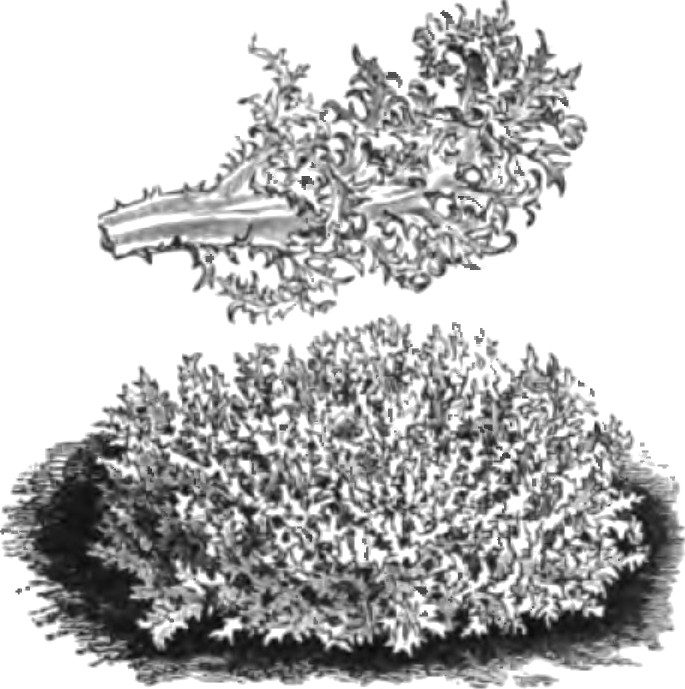
Endive
Endivia
- Known today as
- Cichorium endivia, the salad plant.
- Kind
- Plant, in 2 older authorities
- Constituents
- lactucin, inulin, potassium
- Earliest authority here
- Pliny (AD 23/24–79)
- Qualities
- Cold and dry (Galenic tradition). What the degrees mean
- In other databases
- Plants of the World Online search · GBIF search · Wikidata search
- In the Canale glossary
- On the Manner of Discerning and Healing the Bewitched, Appendix A: Treatise One, Part Three, Chapters 2–3: Purgative and Preparative Medicines
Revised October 1, 2026: An older authority added from a text read in full. Lore added from texts read in full. Version 1, first published September 25, 2026.
Endive: what did Canale use it for?
Its water and syrup as cooling preparatives for choleric patients; in baths for hot complexions (chs. 2–3, 7).
Endive: what does modern science say?
Harmless and mildly bitter. “Cooling” is a humoral category, not a pharmacological one.
Pharmacognosy & Toxicology
- Constituents
- Mechanism
- A bitter salad of the chicory family; the cooling in the Galenic sense is water and potassium, and the bitterness stimulates digestion.
- Toxic dose
- A food.
- Standing
- A food; no monograph.
- Street, R. A., et al. (2013). “Cichorium intybus: traditional uses, phytochemistry, pharmacology, and toxicology.” Evidence-Based Complementary and Alternative Medicine. Verified against its record · doi:10.1155/2013/579319
The abstract of each source, beneath its citation. For Club members. About the Club or sign in.
Constituent names open the compound’s record at PubChem, and “ChEMBL” beside a name opens its record at ChEMBL, the European Bioinformatics Institute’s database of bioactive molecules. Where a mechanism line was checked against ChEMBL (ChEMBL 37, read 1 October 2026), the check is shown with the measured value and its source paper, or says plainly that nothing has been measured. Doses are as the references give them, for description only; this is not medical advice. Each source carries the result of its check against Crossref, PubMed, or the authority’s page: see Verification.
Endive: what lore surrounds it?
Folkard records that the endive or succory is “according to the oldest Greek Alexandrian translations of the Bible, one of the ‘bitter herbs’” of the Passover, that the Egyptians called it Chicouryeh, whence Cichorium, and that the wild succory “opens its petals at 8 a.m., and closes them at 4 p.m.” The Germans, he says, hold “that once upon a time the Endives were men under a ban. The blue flowers, which are plentiful, were good men; the white flowers, much rarer, were evil-doers.” The blue blossom is their Wegewarte, “the watcher of the roads,” and a German legend makes it a maiden who waited on the road for a betrothed who never returned, until “on the spot where she breathed her last sigh sprang up a little pale flower which was the Wegewarte, the watcher of the road.”
Thiselton-Dyer adds that “in Germany now-a-days endive-seed is sold for its supposed power to influence the affections,” and quotes Gay's flowers scattered on graves, “rosemary, daisy, butter'd flower, and endive blue.”
Endive: what did the older authorities say?
- Pliny
- Counts endive among the plants that “will grow even without any cultivation,” with wild mint, catmint, and pennyroyal; it is “better able to endure the rigours of the winter than the lettuce,” of a more acrid taste, sown at the beginning of spring and transplanted at its end; and a spreading kind, known in Egypt as cichorium, he promises to treat elsewhere.
- Culpeper
- Calls it “a fine cooling, cleansing, jovial plant”: the decoction, the juice, or the distilled water cools the excessive heat of the liver and stomach and the hot fits of agues, the seeds are “of the same property, or rather more powerful,” and “you cannot use it amiss; a syrup of it is a fine cooling medicine for fevers.”
Sources
- Pliny the Elder, Natural History 19.37, 19.39, trans. J. Bostock & H. T. Riley (1855), Perseus Digital Library. Primary text
- Culpeper, N. (1653). The Complete Herbal, “Endive.” Project Gutenberg #49513. Primary text
- Folkard, R. (1884). Plant Lore, Legends, and Lyrics, “Endive.” Project Gutenberg #44638. Primary text
- Thiselton-Dyer, T. F. (1889). The Folk-lore of Plants. Project Gutenberg #10118. Read in part · the text read
Verification
- Checked
- October 1, 2026
- Passes
- Every sentence read against its sources, in the pass over the remaining 343 entries
- The Standing line checked against the authority it names (EMA, WHO, FDA, CITES, Commission E)
- Every dated or regulatory claim checked by category across the database
- Each quotation from the older authorities checked word for word against the text, read in full
- Sources
- 5 cited: 1 read in part, 1 verified against its record, 3 primary text. 1 with the abstract on file.
- Corrections
- None were needed.
What was checked, how, and what was found is set out on the Verification page. A checked source is one whose record was found; it does not make the entry medical advice.
Cite This Entry
Version 1 · first published September 25, 2026 · last revised October 1, 2026
- Chicago
“Endive.” In Materia Medica, edited by B. C. P. Statema. Version 1. The Thinking Press, 2026–. Last modified October 1, 2026. https://thethinkingpress.org/materia-medica/endive.
- MLA
“Endive.” Materia Medica, edited by B. C. P. Statema, version 1, The Thinking Press, 1 Oct. 2026, thethinkingpress.org/materia-medica/endive. Accessed 8 Oct. 2026.
- APA
Endive. (2026, October 1). In B. C. P. Statema (Ed.), Materia medica (Version 1). The Thinking Press. Retrieved October 8, 2026, from https://thethinkingpress.org/materia-medica/endive
Club members keep entries on a shelf with private notes, print the plates as cards, and receive an entry by email each week. Create a free account before January 1, 2027 and all of it is yours for good. About the Club
See Also
Sharing inulin, potassium
Burdock · Inula helenium · Cichorium intybus · Taraxacum officinale · Raisins
Also in Pliny the Elder
Epithymum in Pliny the Elder · Elf-shot in Pliny the Elder · Eryngo in Pliny the Elder · everything Pliny the Elder names →
Also in Nicholas Culpeper
Devil’s-bit scabious in Nicholas Culpeper · Feverfew in Nicholas Culpeper · Crabs’ eyes in Nicholas Culpeper · everything Nicholas Culpeper names →
Drawing on the same sources: Culpeper, Folkard, Thiselton-Dyer, Street
Diaphenicon · Eyebright · Fennel · Dittany · Fern seed · the bibliography →
Of the same qualities: cold and dry
Opium poppy · Coral, red · Quince · Rose · Camphor · what the degrees mean →
Nearby in the alphabet
Epiphany chalk · Epiphany water (in the East as the Great Blessing of the Waters at Theophany) · Elder (Sambucus nigra) · Epsom salt (first boiled from the waters of a spring on Epsom Common in Surrey) · Earthworm (washed in wine, dried, powdered, or boiled in oil)
Historical description, not medical advice.