
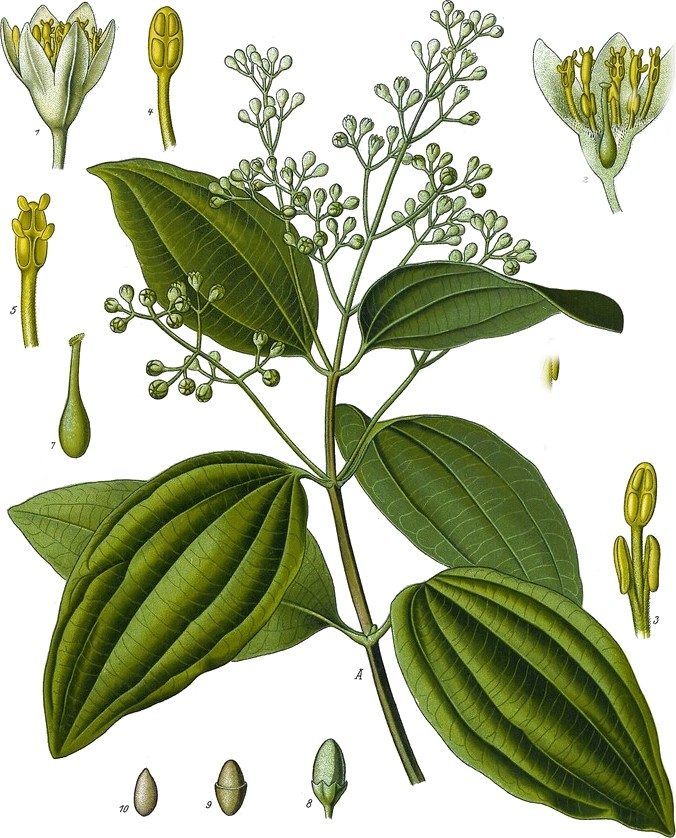
Cinnamon
Cinnamomo; canella
- Known today as
- The bark of Cinnamomum verum; “fine” cinnamon in the oil.
- Kind
- Plant, in 3 older authorities
- Constituents
- cinnamaldehyde, coumarin, eugenol
- Earliest authority here
- Herodotus (c. 484–c. 425 BC)
- Qualities
- Hot and dry (Galenic tradition). What the degrees mean
- In other databases
- Plants of the World Online search · GBIF search · Wikidata search
- In the Canale glossary
- On the Manner of Discerning and Healing the Bewitched, Appendix A: Part Three, Chapter 5: Vomitory Medicines
Revised October 1, 2026: Tradition, lore, modern assessment, and sources extended. Version 1, first published September 25, 2026.
Cinnamon: what did Canale use it for?
In the vomits, the distilled water, the cockerel, and the oil for the bewitched; in Scripture’s anointing oil (chs. 5–6, 9; Treatise Two).
Cinnamon: what does modern science say?
Aromatic and carminative; it settles the stomach, which is why it was added to harsh medicines. Trials find it lowers fasting blood sugar a little in diabetes, not enough to matter. Most “cinnamon” sold in America is cassia, whose coumarin can harm the liver at a few teaspoons a day; true Ceylon cinnamon has almost none.
Pharmacognosy & Toxicology
- Constituents
- Mechanism
- Cinnamaldehyde activates the TRPA1 receptor; coumarin injures the liver in sensitive people.
- Checked against ChEMBL
- cinnamaldehyde: Measured, as the entry says (“activates the TRPA1 receptor”): Transient receptor potential cation channel subfamily A member 1 (mouse), EC50 3.4 µM, CHEMBL5705895; Transient receptor potential cation channel subfamily A member 1 (rat), EC50 5.4 µM, CHEMBL5705895.
- Toxic dose
- Coumarin’s tolerable intake is 0.1 mg per kilogram a day, which a few teaspoons of cassia exceed.
- Standing
- A food; cassia’s coumarin is regulated in the European Union.
- Abraham, K., et al. (2010). “Toxicology and risk assessment of coumarin.” Molecular Nutrition and Food Research 54. Verified against its record · doi:10.1002/mnfr.200900281
The abstract of each source, beneath its citation. For Club members. About the Club or sign in.
Constituent names open the compound’s record at PubChem, and “ChEMBL” beside a name opens its record at ChEMBL, the European Bioinformatics Institute’s database of bioactive molecules. Where a mechanism line was checked against ChEMBL (ChEMBL 37, read 1 October 2026), the check is shown with the measured value and its source paper, or says plainly that nothing has been measured. Doses are as the references give them, for description only; this is not medical advice. Each source carries the result of its check against Crossref, PubMed, or the authority’s page: see Verification.
Cinnamon: what lore surrounds it?
The Portuguese seized the cinnamon gardens of Ceylon in 1518; the Dutch took them in 1638 and kept so strict a monopoly that they burned surplus bark in Amsterdam to hold up the price, until the British came in 1796 and the plant was carried to Java and the Seychelles.
Used in These Compounds
Cinnamon is an ingredient of 5 compound medicines in the database. For Club members. Create a free account or sign in.
Cinnamon: what did the older authorities say?
- Herodotus
- Records the Arabian tale that cinnamon was gathered from the nests of great birds, brought down with lumps of meat.
- Exodus
- Names cinnamon and cassia in the holy anointing oil (30:23), and Herodotus says the Egyptians used it in embalming.
- Pliny
- Gives prices for cinnamon and cassia that run into hundreds of denarii a pound, and for the dearest 1,500, and that Nero burned a year’s supply at the funeral of Poppaea in AD 65; the Arabian tales of its gathering, he says, were put about to raise the price.
Sources
- [16] The British Pharmaceutical Codex (1911). London: Pharmaceutical Society of Great Britain. Monographs as transcribed at Henriette’s Herbal Homepage, henriettes-herb.com. Read in full · the text read
- [41] European Medicines Agency, Committee on Herbal Medicinal Products (HMPC). Herbal monographs, assessment reports and public statements, ema.europa.eu, cited under the herb concerned: aniseed (summary, EMA/305345/2016); Aristolochia (public statement, EMEA/HMPC/138381/2005); asarone (public statement, EMEA/HMPC/139215/2005); caraway (EMA/HMPC/715092/2013); centaury (EMA/HMPC/277493/2015); chicory root (assessment report, EMA/HMPC/113041/2010); cinnamon (EMA/HMPC/246774/2009); clove (assessment report, EMA/HMPC/534946/2010); ethanol in herbal products (reflection paper, EMA/HMPC/85114/2008); fennel (EMEA/HMPC/372839/2016, Rev. 1, 2024); fumitory (draft assessment report, EMA/HMPC/367013/2021); greater celandine (public statement, EMA/HMPC/743927/2010); hops (EMA/HMPC/682384/2013); horehound (EMA/HMPC/604271/2012); mallow (assessment report, EMA/HMPC/749518/2016); marshmallow root (Althaeae radix); melissa (summary, EMA/HMPC/310761/2013); myrrh (assessment report and monograph, EMA/HMPC/96910/2010 and 96911/2010); peppermint oil (assessment report, EMEA/HMPC/349465/2006); pyrrolizidine alkaloids (public statement, EMA/HMPC/893108/2011); rhubarb (EMA/HMPC/113700/2019); sage (Salviae officinalis folium); wormwood (EMA/HMPC/751490/2016). Read in full · the text read
- Pliny, Natural History XII. Primary text
- Exodus 30:23. Book, seen in reviews
Verification
- Checked
- October 1, 2026
- Passes
- Every sentence read against its sources, in the fifty-entry sample
- The Standing line checked against the authority it names (EMA, WHO, FDA, CITES, Commission E)
- Every dated or regulatory claim checked by category across the database
- The mechanism read against ChEMBL (ChEMBL 37): curated mechanisms and measured activity
- Sources
- 5 cited: 2 read in full, 1 verified against its record, 1 primary text, 1 book, seen in reviews. 1 with the abstract on file.
- Corrections
- "Egyptians had it by 2000 BC" replaced with Herodotus's embalming report; Pliny's price given as a range rather than a single 1,500 denarii.
What was checked, how, and what was found is set out on the Verification page. A checked source is one whose record was found; it does not make the entry medical advice.
Cite This Entry
Version 1 · first published September 25, 2026 · last revised October 1, 2026
- Chicago
“Cinnamon.” In Materia Medica, edited by B. C. P. Statema. Version 1. The Thinking Press, 2026–. Last modified October 1, 2026. https://thethinkingpress.org/materia-medica/cinnamon.
- MLA
“Cinnamon.” Materia Medica, edited by B. C. P. Statema, version 1, The Thinking Press, 1 Oct. 2026, thethinkingpress.org/materia-medica/cinnamon. Accessed 8 Oct. 2026.
- APA
Cinnamon. (2026, October 1). In B. C. P. Statema (Ed.), Materia medica (Version 1). The Thinking Press. Retrieved October 8, 2026, from https://thethinkingpress.org/materia-medica/cinnamon
Club members keep entries on a shelf with private notes, print the plates as cards, and receive an entry by email each week. Create a free account before January 1, 2027 and all of it is yours for good. About the Club
See Also
Sharing cinnamaldehyde, coumarin, eugenol
Cinnamomum aromaticum · Galium odoratum · Clove · Ocimum basilicum · Geum urbanum · Myristica fragrans
Also in Herodotus
Frankincense in Herodotus · Castor-oil plant, seeds of in Herodotus · Garlic in Herodotus · Alum in Herodotus · everything Herodotus names →
Also in Pliny the Elder
Cinquefoil in Pliny the Elder · Cinnabar in Pliny the Elder · Citron in Pliny the Elder · Chicory in Pliny the Elder · everything Pliny the Elder names →
Drawing on the same sources: Pliny, Abraham
Of the same qualities: hot and dry
Coffee · Cardamom · Black pepper · Elecampane · Black hellebore · what the degrees mean →
Nearby in the alphabet
Cinchona (The bark of Cinchona trees of the Andes) · Civet (The glandular secretion of the civet cat) · Chrism (Olive oil mixed with balsam and consecrated by a bishop) · Clary, garden (Salvia sclarea) · Chokecherry (the chokecherry of North America)
Historical description, not medical advice.