
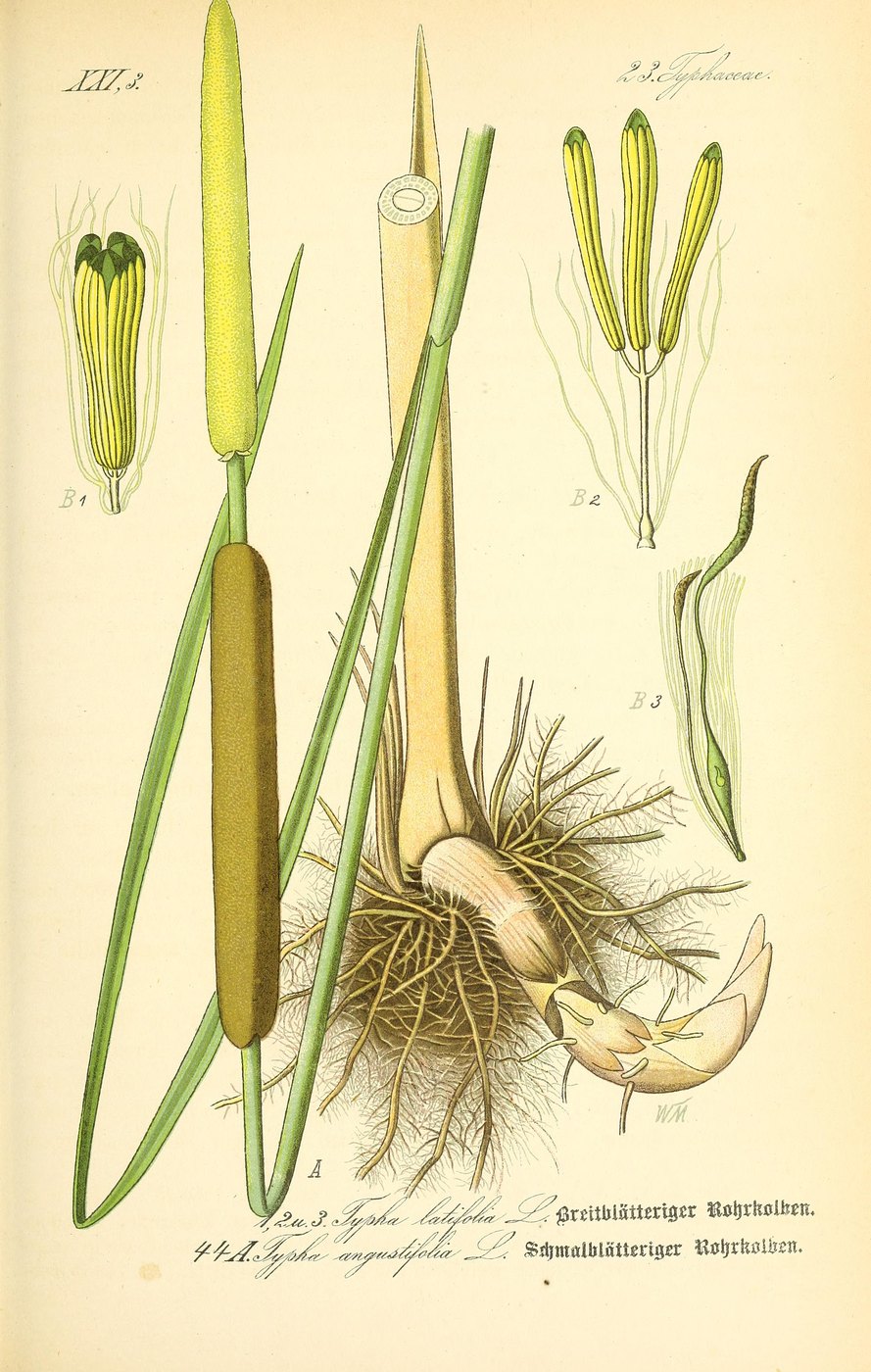
Cattail
Cat-tail, reed mace; Typha latifolia of Linnaeus; German Rohrkolben; the Ojibwe abûkweskwe, wigwam cover, and bebamasûn, it flies around; the Potawatomi aba’kweûck, shelter weed, and biwie’skwinuk, fruit for baby’s bed
- Known today as
- Typha latifolia, the broad-leaved cattail of pond margins, ditches, and marshes across the northern world: leaves half an inch to three-quarters wide that overtop a flowering stalk of one to two metres, the male spike set directly above the female, which ripens into the brown thumb-thick velvet club of the name and bursts in the end into down. It flowers in July and August.
- Kind
- Plant, in 4 older authorities
- Constituents
- a fine fecula, saponins, flavonoids, and coumarins
- Earliest authority here
- Huron H. Smith
- In other databases
- Plants of the World Online search · GBIF search · Wikidata search
Caution. Nothing read for this entry describes harm from the plant; the one feeding study was in rats.
Cattail: what was it used for?
In the Lake country the cattail was shelter, bedding, and medicine before it was food. The Flambeau Ojibwe women, Smith says, sewed the leaves with bone needles and nettle or basswood fibre into wind- and rain-proof mats for the sides of the medicine lodge, the wigwam, and the sweat lodge, rolled and carried from camp to camp; the fuzz of the fruit was a war medicine thrown into an enemy’s face to blind him. Densmore saw the down put around an infant in its cradle and the leaves made into toys; the Forest Potawatomi, by Smith, pounded the fresh root into poultices for inflammations and called the fruit the baby’s bedding. Rafinesque, for the food: “Roots subastringent febrifuge, esculent, yield one tenth of a fine fecula similar to salep, eaten by Indians of Oregon”; the seeds kill mice, and the plant “ought to be cultivated in swamps.”
Cattail: foraging it in the Midwest
- Part
- Rhizome, young shoots, leaves, down
- When
- Rhizome in autumn and winter, shoots in spring, leaves in summer
Pond margins, ditches, and marshes; the root yields a starch that Rafinesque likened to salep, the leaves made the mats of the wigwam, and the down lined the cradle. Rafinesque wanted it planted in every swamp.
After Rafinesque; Smith; Densmore. All the foragables of the Midwest. Historical record, not a field guide: identify before you gather, and read the whole entry.
Cattail: what does modern science say?
One laboratory study bears on the rhizome as food: flour of the narrow-leaved cattail’s rhizome, fed at ten percent of the diet, prevented the colonic damage of a chemical model of colitis in rats as well as prednisolone did, with less of the enzyme of inflammation in the tissue and less loss of glutathione; saponins, flavonoids, and coumarins were found in the flour. It is a rat study of the sister species, not a trial.
Pharmacognosy & Toxicology
- Constituents
- a fine feculaa tenth of the root’s weight, like salep, by Rafinesque: the starch of the rhizome
- saponins, flavonoids, and coumarinsdetected in the rhizome flour of the narrow-leaved species
- Mechanism
- In the one feeding study, rhizome flour at a tenth of the diet prevented the colonic lesions of chemically induced colitis in rats as well as prednisolone, lowering myeloperoxidase and alkaline phosphatase and sparing glutathione, without changing the lactic bacteria.
- Toxic dose
- A tenth of the diet as rhizome flour, in rats; the pounded fresh root as a poultice, by the Potawatomi.
- Standing
- A starch and a building material; the medicine rests on a rat study of the sister species.
- Fruet, A. C., Seito, L. N., Rall, V. L., & Di Stasi, L. C. (2012). Dietary intervention with narrow-leaved cattail rhizome flour (Typha angustifolia L.) prevents intestinal inflammation in the trinitrobenzenesulphonic acid model of rat colitis. BMC Complementary and Alternative Medicine 12: 62. doi:10.1186/1472-6882-12-62 Verified against its record · PMID 22559191
The abstract of each source, beneath its citation. For Club members. About the Club or sign in.
Constituent names open the compound’s record at PubChem, and “ChEMBL” beside a name opens its record at ChEMBL, the European Bioinformatics Institute’s database of bioactive molecules. Where a mechanism line was checked against ChEMBL (ChEMBL 37, read 1 October 2026), the check is shown with the measured value and its source paper, or says plainly that nothing has been measured. Doses are as the references give them, for description only; this is not medical advice. Each source carries the result of its check against Crossref, PubMed, or the authority’s page: see Verification.
Cattail: what lore surrounds it?
The Ojibwe had two names for it, one for the leaves that covered the wigwam and one for the seed that flies; the Potawatomi called the fruit the baby’s bed. The same fluff that lined a cradle was thrown in a Sioux warrior’s face. What Rafinesque called a fecula like salep, and wanted planted in every swamp, is the starch of the rhizome that every foraging book now begins with.
Cattail: what did the older authorities say?
- Huron H. Smith
- “The Flambeau Ojibwe women use the cat-tail leaves to make wind and rain-proof mats to be placed on the sides of the medicine lodge or any temporary wigwam or sweat lodge. They sew with a bone needle and nettle or basswood fiber with a hidden stitch, and bind the edges securely with their sewing cord.” Not quite rain-proof as a roof, so birchbark rolls serve for that. The fuzz was thrown into the eyes of their enemies the Sioux.
- Frances Densmore
- Among the Chippewa the cat-tail furnished mats and baskets; “the down of the cat-tail rushes was put around an infant in its cradle board,” and the outer covering of the rushes was shaped into toys.
- C. S. Rafinesque
- Four species, “all equally useful. Roots subastringent febrifuge, esculent, yield one tenth of a fine fecula similar to salep, eaten by Indians of Oregon”; the leaves serve coopers and mat-makers; with lime they make a cement as hard as marble; “Seeds kill mice. Ought to be cultivated in swamps.”
- O. W. Thomé
- The broad-leaved reed-mace: leaves twelve to eighteen millimetres wide overtopping a flowering stalk of one to two metres, the male and female spikes touching or nearly so, the fruiting spike black-brown and about as thick as a thumb; flowering July and August on pond banks and in ditches, not rare.
Sources
- Smith, H. H. (1932). Ethnobotany of the Ojibwe Indians, Bulletin of the Public Museum of the City of Milwaukee 4(3), “Cat-tail,” under medicines, fibres, and other uses. Project Gutenberg, 49527. Primary text
- Smith, H. H. (1933). Ethnobotany of the Forest Potawatomi Indians, Bulletin of the Public Museum of the City of Milwaukee 7(1), “Cat-tail.” Internet Archive, ethnobotany-of-the-forest-potawatomi-indians-by-huron-h.-smith-1933. Primary text
- Densmore, F. (1928). Uses of Plants by the Chippewa Indians, Forty-fourth Annual Report of the Bureau of American Ethnology, “Typha latifolia” and the pages on the cradle board and toys. Internet Archive, usesofplantsbych00dens. Primary text
- Rafinesque, C. S. (1830). Medical Flora, or Manual of the Medical Botany of the United States of North America, vol. 2, “Typha,” pp. 270–271. Internet Archive, b21468710_0002. Primary text
- Thomé, O. W. (1886). Flora von Deutschland, Österreich und der Schweiz, Bd. 1, “Gattung 57: Typha,” and Tafel 44. Internet Archive, profdrthomesflor11886thom. Primary text
Verification
- Checked
- October 1, 2026
- Passes
- Every sentence read against its sources, in the pass over the remaining 343 entries
- The Standing line checked against the authority it names (EMA, WHO, FDA, CITES, Commission E)
- Every dated or regulatory claim checked by category across the database
- Sources
- 6 cited: 1 verified against its record, 5 primary text. 1 with the abstract on file.
- Corrections
- None were needed.
What was checked, how, and what was found is set out on the Verification page. A checked source is one whose record was found; it does not make the entry medical advice.
Cite This Entry
Version 1 · first published October 4, 2026
- Chicago
“Cattail.” In Materia Medica, edited by B. C. P. Statema. Version 1. The Thinking Press, 2026–. Last modified October 4, 2026. https://thethinkingpress.org/materia-medica/cattail.
- MLA
“Cattail.” Materia Medica, edited by B. C. P. Statema, version 1, The Thinking Press, 4 Oct. 2026, thethinkingpress.org/materia-medica/cattail. Accessed 8 Oct. 2026.
- APA
Cattail. (2026, October 4). In B. C. P. Statema (Ed.), Materia medica (Version 1). The Thinking Press. Retrieved October 8, 2026, from https://thethinkingpress.org/materia-medica/cattail
Club members keep entries on a shelf with private notes, print the plates as cards, and receive an entry by email each week. Create a free account before January 1, 2027 and all of it is yours for good. About the Club
See Also
Drawing on the same sources: Smith, Densmore, Rafinesque
Jewelweed · Burdock · Juneberry · Milkweed · Chokecherry · Ground cherry · the bibliography →
Nearby in the alphabet
Centaury (Centaurium erythraea) · Catmint (Clinopodium nepeta) · Chaga (cracked, charcoal-like growth on living birch) · Caterpillar fungus (sending up a slender stalk) · Chamomile (Matricaria chamomilla) · Castoreum (The scent gland secretion of the beaver) · Chanterelle (apricot-scented mushroom with blunt ridges for gills) · Castor-oil plant, seeds of (Ricinus communis)
Historical description, not medical advice.