
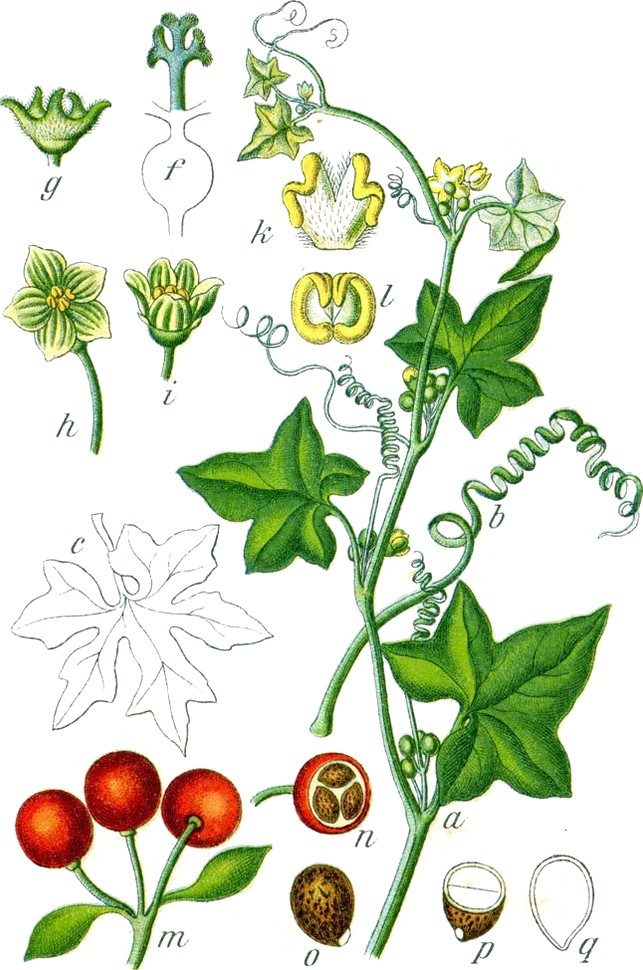
Bryony
Brionia
- Known today as
- White bryony, Bryonia dioica (now Bryonia cretica subsp. dioica), whose large root was sold as a false mandrake.
- Kind
- Plant, in 1 older authority
- Constituents
- cucurbitacin B, bryonin
- Poisoning
- Gastrointestinal irritants
- Earliest authority here
- Pliny (AD 23/24–79)
- In other databases
- Plants of the World Online search · GBIF search · Wikidata search
- In the Canale glossary
- On the Manner of Discerning and Healing the Bewitched, Appendix A: Part Three, Chapter 6: Remedies Given by Mouth After the Purge
Revised October 1, 2026: An older authority added from a text read in full. Version 1, first published September 25, 2026.
Caution. Hazardous in some form or dose; see the modern assessment below.
Bryony: what did Canale use it for?
Its root in the cockerel and the oil; dried and worn on the neck, “it hinders every hex, as Gordonius attests” (chs. 6, 9–10; note XLVIII).
Bryony: what does modern science say?
A violent purgative and poisonous; about fifteen berries are reported as lethal to a child and forty to an adult. The amulet use drew on its mandrake-like root.
Bryony: is it poisonous?
Yes, in some form or dose. Its poisoning is gastrointestinal irritants: Thirty minutes to three hours: the short latency is reassuring, since the deadly syndromes come later. Historical description, not medical advice; in a poisoning, call a poison centre.
Pharmacognosy & Toxicology
- Constituents
- Mechanism
- The cucurbitacins are violent irritants of the gut.
- Toxic dose
- Forty berries have killed a child; the root, mistaken for mandrake, purges to collapse.
- Syndrome
- Gastrointestinal irritants
- Standing
- No medicinal use.
- Nelson, L. S., et al. (2007). Handbook of Poisonous and Injurious Plants. Verified against its record · doi:10.1007/978-1-4939-8926-3
Constituent names open the compound’s record at PubChem, and “ChEMBL” beside a name opens its record at ChEMBL, the European Bioinformatics Institute’s database of bioactive molecules. Where a mechanism line was checked against ChEMBL (ChEMBL 37, read 1 October 2026), the check is shown with the measured value and its source paper, or says plainly that nothing has been measured. Doses are as the references give them, for description only; this is not medical advice. Each source carries the result of its check against Crossref, PubMed, or the authority’s page: see Verification.
Bryony: what lore surrounds it?
The “English mandrake”: its great forked root was carved into little men and sold as the true mandrake to the credulous (see Mandrake).
Used in These Compounds
Bryony is an ingredient of 1 compound medicine in the database. For Club members. Create a free account or sign in.
Bryony: what did the older authorities say?
- Pliny
- Calls it the white vine, ampeloleuce to the Greeks, with jointed climbing twigs, leaves jagged like the vine’s, and a root “large and white, and very like a radish at first”; it draws out splintered bones, disperses gatherings, works as an emmenagogue and diuretic, goes into an electuary for asthma, and taken thirty days together in doses of three oboli “has the effect of reducing the spleen”; bands of white vine were also tied round hives to keep bees from flight.
Sources
- [54] Grieve, M. (1931). A Modern Herbal. Online edition, botanical.com, cited under the plant concerned. Read in part · the text read
- [72] Kujawska, M., & Svanberg, I. (2019). From medicinal plant to noxious weed: Bryonia alba L. (Cucurbitaceae) in northern and eastern Europe. Journal of Ethnobiology and Ethnomedicine 15: 22. doi:10.1186/s13002-019-0303-6 Verified against its record · doi:10.1186/s13002-019-0303-6
- Pliny the Elder, Natural History 23.16, 21.48, trans. J. Bostock & H. T. Riley (1855), Perseus Digital Library. Primary text
Verification
- Checked
- October 1, 2026
- Passes
- Every sentence read against its sources, in the pass over the remaining 343 entries
- The Standing line checked against the authority it names (EMA, WHO, FDA, CITES, Commission E)
- Every dated or regulatory claim checked by category across the database
- Each quotation from the older authorities checked word for word against the text, read in full
- Sources
- 4 cited: 1 read in part, 2 verified against its record, 1 primary text.
- Corrections
- None were needed.
What was checked, how, and what was found is set out on the Verification page. A checked source is one whose record was found; it does not make the entry medical advice.
Cite This Entry
Version 1 · first published September 25, 2026 · last revised October 1, 2026
- Chicago
“Bryony.” In Materia Medica, edited by B. C. P. Statema. Version 1. The Thinking Press, 2026–. Last modified October 1, 2026. https://thethinkingpress.org/materia-medica/bryony.
- MLA
“Bryony.” Materia Medica, edited by B. C. P. Statema, version 1, The Thinking Press, 1 Oct. 2026, thethinkingpress.org/materia-medica/bryony. Accessed 8 Oct. 2026.
- APA
Bryony. (2026, October 1). In B. C. P. Statema (Ed.), Materia medica (Version 1). The Thinking Press. Retrieved October 8, 2026, from https://thethinkingpress.org/materia-medica/bryony
Club members keep entries on a shelf with private notes, print the plates as cards, and receive an entry by email each week. Create a free account before January 1, 2027 and all of it is yours for good. About the Club
See Also
Poisoned alike: gastrointestinal irritants
Caper spurge · Yellow stainer · Castor-oil plant, seeds of · The sickener · Colocynth · Scammony · Common earthball · Pokeweed · the syndrome, with all of them →
Also in Pliny the Elder
Broom in Pliny the Elder · Cassia wood in Pliny the Elder · Bloodstone in Pliny the Elder · everything Pliny the Elder names →
Drawing on the same sources: Nelson
Nearby in the alphabet
Burdock · Brown roll-rim (of birch woods) · Butterbur (of the daisy family, with huge rhubarb-like leaves in damp places) · Caesar’s mushroom (egg-like when young and seated in a white cup) · Brewer’s yeast (beer, and wine) · Calamine (Zinc carbonate and zinc oxide) · Breve (A written prayer or holy names folded and worn on the body)
Historical description, not medical advice.