
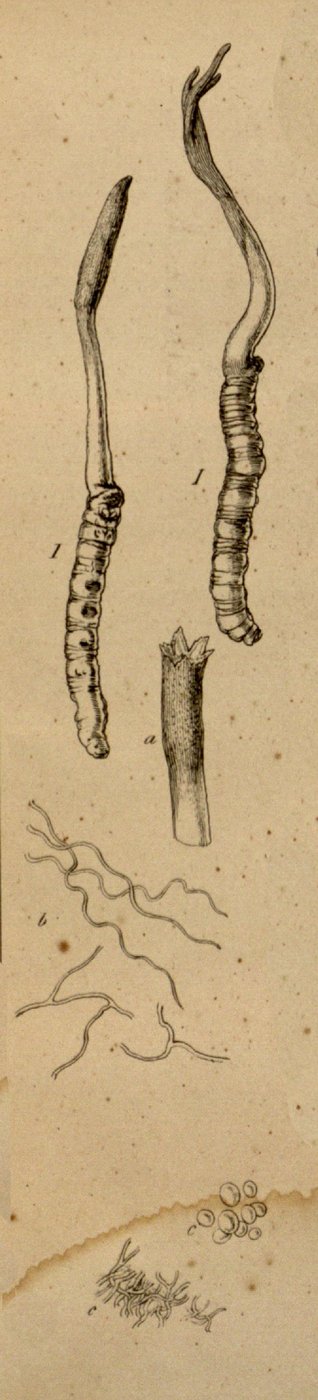
Caterpillar fungus
Ophiocordyceps sinensis; Tibetan yartsa gunbu, “summer grass, winter worm”
- Known today as
- A fungus that fills and kills the buried larvae of ghost moths on the Tibetan plateau, sending up a slender stalk.
- Kind
- Fungus, in 2 older authorities
- Constituents
- cordycepin
- Earliest authority here
- Dioscorides (c. AD 40–90)
- Qualities
- Hot and moist in the first degree. What the degrees mean
- In other databases
- GBIF search · Wikidata search
Revised October 3, 2026: Checked against its sources, each read in full, in part, or in its abstract. Version 1, first published September 25, 2026.
Caterpillar fungus: what was it used for?
A tonic for strength and vitality in Tibetan and Chinese medicine.
Caterpillar fungus: what does modern science say?
Studies in animals show some effects on energy and immunity; human evidence is weak. Most “cordyceps” sold now is the cultivated Cordyceps militaris.
Pharmacognosy & Toxicology
- Constituents
- Tuli, H. S., et al. (2013). “Cordycepin: a bioactive metabolite with therapeutic potential.” Life Sciences 93. Abstract read · the text read
The abstract of each source, beneath its citation. For Club members. About the Club or sign in.
Constituent names open the compound’s record at PubChem, and “ChEMBL” beside a name opens its record at ChEMBL, the European Bioinformatics Institute’s database of bioactive molecules. Where a mechanism line was checked against ChEMBL (ChEMBL 37, read 1 October 2026), the check is shown with the measured value and its source paper, or says plainly that nothing has been measured. Doses are as the references give them, for description only; this is not medical advice. Each source carries the result of its check against Crossref, PubMed, or the authority’s page: see Verification.
Caterpillar fungus: what lore surrounds it?
First described in Tibetan medical writing of the fifteenth century. Its fame soared when Chinese runners broke world records in 1993 and their coach credited it; at times it sells for more than its weight in gold.
In Their Own Words
Cooke, quoting Westwood, reports that the Chinese philosophers held the caterpillar fungus to be a herb in summer which changes into a worm when winter comes.
“The Chinese philosophers consider it as a herb during the summer season, but as soon as winter appears it changes into a worm.”
M. C. Cooke, M.A., LL.D., A.L.S., Vegetable Wasps and Plant Worms: a popular history of entomogenous fungi, or fungi parasitic upon insects, 'Chinese Plant Worm. Cordyceps sinensis', p. 201. London: Society for Promoting Christian Knowledge, 1892 (Internet Archive OCR text). The text, read in part
Cooke quotes Pereira that, according to Du Halde, its properties were thought similar to those of ginseng, and that it strengthened and renewed powers reduced by over-exertion or long sickness.
“According to Du Halde, its properties are considered to be similar to those of ging sing. It strengthens and renovates the powers of the system, which have been reduced either by over-exertion or long sickness.”
M. C. Cooke, M.A., LL.D., A.L.S., Vegetable Wasps and Plant Worms: a popular history of entomogenous fungi, or fungi parasitic upon insects, 'Chinese Plant Worm', pp. 202–203. London: Society for Promoting Christian Knowledge, 1892 (Internet Archive OCR text). The text, read in part
Each passage is quoted from the text named, which the press fetched and read, and was checked word for word against a fresh copy of it; the link opens that copy. Passages are given as printed, without the editors’ footnote numbers, and with words broken across lines joined.
Caterpillar fungus: what did the older authorities say?
- Dioscorides
- This entity is entirely omitted by the ancient master, as it is native only to the high, snow-bound plateaus of the Far East and was completely unknown to the Greek and Roman worlds during antiquity.
- Galen
- Not recorded in the classical text. If parsed by his method, its sweet taste indicates a moderate composition, while its ability to restore vitality and moisten the respiratory organs shows it to be Hot and Moist in the first degree, working to gently renew the body's innate heat and radical moisture.
Sources
- Winkler, D. (2008). Yartsa gunbu and the fungal commodification of Tibet’s rural economy. Economic Botany 62: 291–305. Verified against its record · doi:10.1007/s12231-008-9038-3
Verification
- Checked
- October 1, 2026, and October 3, 2026
- Passes
- Every sentence read against its sources, in the pass over the remaining 343 entries
- Every dated or regulatory claim checked by category across the database
- Every source read, in full, in part, or in its abstract, and every sentence checked against what was read (October 3, 2026)
- Sources
- 2 cited: 1 abstract read, 1 verified against its record. 1 with the abstract on file.
- Corrections
- None were needed.
What was checked, how, and what was found is set out on the Verification page. A checked source is one whose record was found; it does not make the entry medical advice.
Cite This Entry
Version 1 · first published September 25, 2026 · last revised October 3, 2026
- Chicago
“Caterpillar fungus.” In Materia Medica, edited by B. C. P. Statema. Version 1. The Thinking Press, 2026–. Last modified October 3, 2026. https://thethinkingpress.org/materia-medica/caterpillar-fungus.
- MLA
“Caterpillar fungus.” Materia Medica, edited by B. C. P. Statema, version 1, The Thinking Press, 3 Oct. 2026, thethinkingpress.org/materia-medica/caterpillar-fungus. Accessed 8 Oct. 2026.
- APA
Caterpillar fungus. (2026, October 3). In B. C. P. Statema (Ed.), Materia medica (Version 1). The Thinking Press. Retrieved October 8, 2026, from https://thethinkingpress.org/materia-medica/caterpillar-fungus
Club members keep entries on a shelf with private notes, print the plates as cards, and receive an entry by email each week. Create a free account before January 1, 2027 and all of it is yours for good. About the Club
See Also
Also in Dioscorides
Chamomile in Dioscorides · Cardamom in Dioscorides · Chaste tree in Dioscorides · Caraway broth in Dioscorides · everything Dioscorides names →
Also in Galen
Diatrion piperion in Galen · Armenian bole in Galen · Garlic in Galen · Theriac in Galen · everything Galen names →
Of the same qualities: hot and moist
Nearby in the alphabet
Catmint (Clinopodium nepeta) · Castoreum (The scent gland secretion of the beaver) · Cattail · Castor-oil plant, seeds of (Ricinus communis) · Centaury (Centaurium erythraea) · Cassia, flower of (the Indian laburnum) · Chaga (cracked, charcoal-like growth on living birch) · Cassia wood (Cinnamomum aromaticum (long known as Cinnamomum cassia))
_1.jpg)
Historical description, not medical advice.