
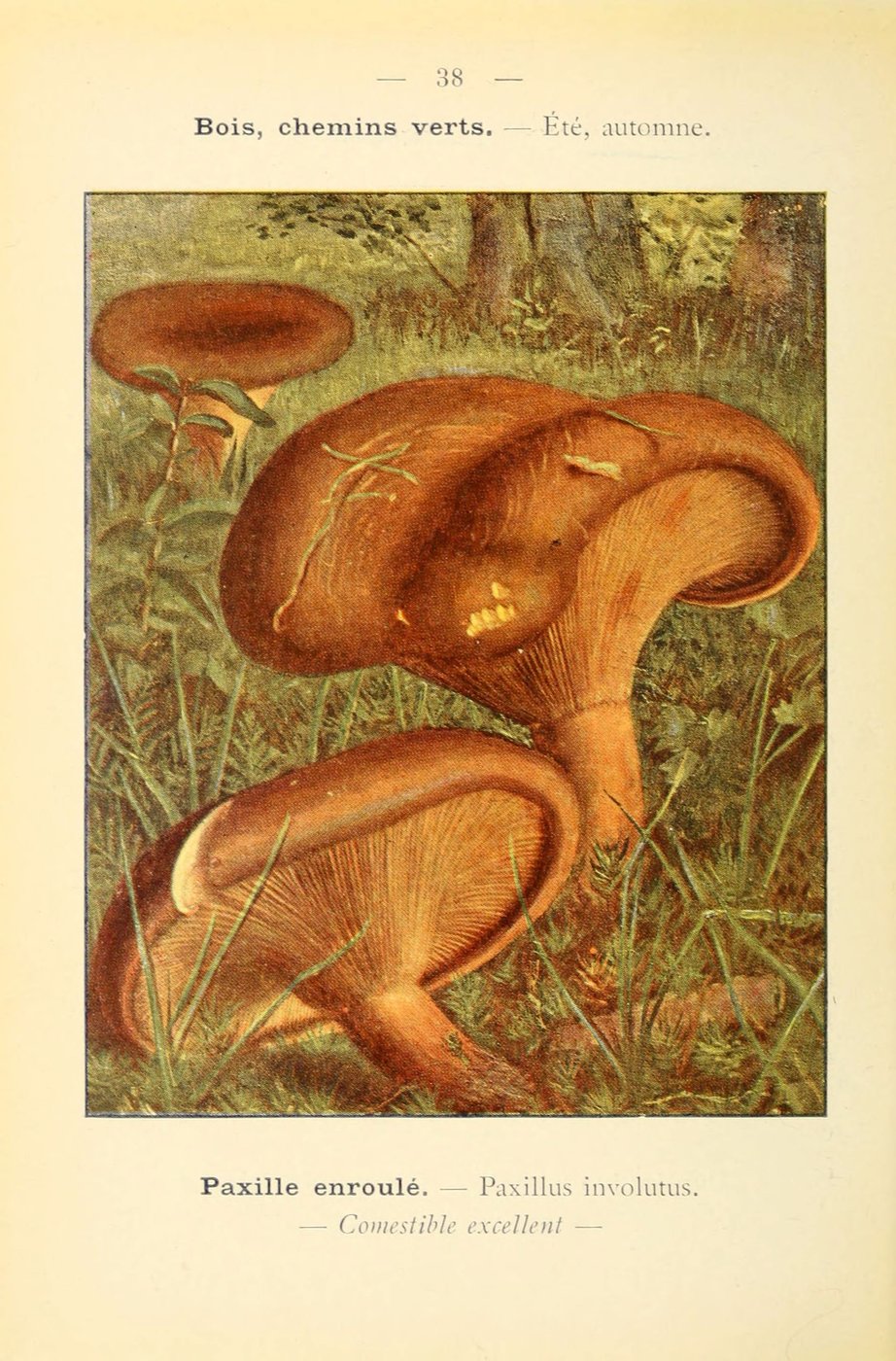
Brown roll-rim
Paxillus involutus
- Known today as
- A common brown mushroom with a rolled rim, of birch woods.
- Kind
- Fungus
- Constituents
- involutin, unknown antigen
- In other databases
- GBIF search · Wikidata search
Revised October 3, 2026: Checked against its sources, each read in full, in part, or in its abstract. Version 1, first published September 25, 2026.
Caution. Poisonous; the danger comes with repeated meals.
Brown roll-rim: what was it used for?
Once widely eaten in eastern Europe.
Brown roll-rim: what does modern science say?
Repeated eating can set off an immune reaction that destroys the red blood cells and can injure the kidneys.
Brown roll-rim: is it poisonous?
Yes, in some form or dose. Poisonous; the danger comes with repeated meals. Its poisoning is paxillus syndrome (immune haemolysis): One to three hours after a meal, in someone sensitised by earlier meals, sometimes years before. Historical description, not medical advice; in a poisoning, call a poison centre.
Pharmacognosy & Toxicology
- Constituents
- involutinthe browning pigment
- unknown antigenthe cause of the haemolysis
- Mechanism
- An antigen in the mushroom raises antibodies that, on a later meal, attach to the red cells and destroy them.
- Toxic dose
- Any meal after sensitisation; years of eating it may precede the reaction.
- Syndrome
- Paxillus syndrome (immune haemolysis)
- Standing
- None; guidebooks firmly warned against eating it only from 1990.
Constituent names open the compound’s record at PubChem, and “ChEMBL” beside a name opens its record at ChEMBL, the European Bioinformatics Institute’s database of bioactive molecules. Where a mechanism line was checked against ChEMBL (ChEMBL 37, read 1 October 2026), the check is shown with the measured value and its source paper, or says plainly that nothing has been measured. Doses are as the references give them, for description only; this is not medical advice. Each source carries the result of its check against Crossref, PubMed, or the authority’s page: see Verification.
Brown roll-rim: what lore surrounds it?
The German mycologist Julius Schäffer died after eating it in 1944; others have eaten it for years without harm before it struck.
In Their Own Words
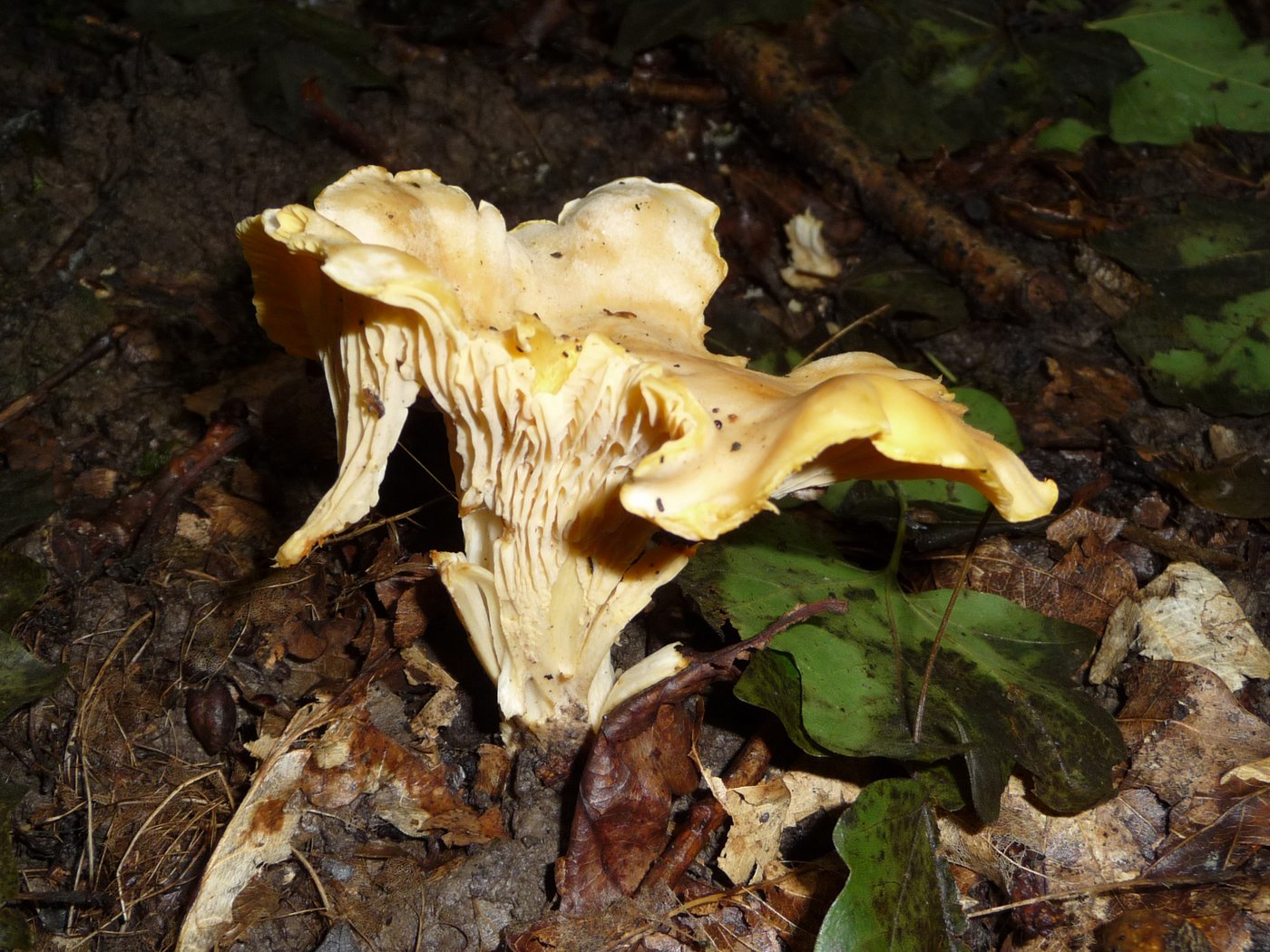
Cooke's Handbook (after Berkeley) describes the cap's margin as rolled in and downy, its edge striate from the pressure of the gills, and its flesh thick, firm and at first pale.
“…uneven; margin involute and downy, the extreme edge striate from the pressure of the gills; flesh thick, firm, at first pale”
M. C. Cooke, M.A., Handbook of British Fungi, with full descriptions of all the species, and illustrations of the genera, no. 547, Paxillus involutus, 'Involute Paxillus'. London and New York: Macmillan and Co., 1871 (Internet Archive OCR text). The text, read in part
Each passage is quoted from the text named, which the press fetched and read, and was checked word for word against a fresh copy of it; the link opens that copy. Passages are given as printed, without the editors’ footnote numbers, and with words broken across lines joined.
Sources
- Wikipedia, “Paxillus involutus,” en.wikipedia.org (read 2 October 2026). Read in full · the text read
Verification
- Checked
- October 1, 2026, and October 3, 2026
- Passes
- Every sentence read against its sources, in the fifty-entry sample
- The Standing line checked against the authority it names (EMA, WHO, FDA, CITES, Commission E)
- Every dated or regulatory claim checked by category across the database
- Every source read, in full, in part, or in its abstract, and every sentence checked against what was read (October 3, 2026)
- Sources
- 1 cited: 1 read in full.
- Corrections
- None were needed.
What was checked, how, and what was found is set out on the Verification page. A checked source is one whose record was found; it does not make the entry medical advice.
Cite This Entry
Version 1 · first published September 25, 2026 · last revised October 3, 2026
- Chicago
“Brown roll-rim.” In Materia Medica, edited by B. C. P. Statema. Version 1. The Thinking Press, 2026–. Last modified October 3, 2026. https://thethinkingpress.org/materia-medica/brown-roll-rim.
- MLA
“Brown roll-rim.” Materia Medica, edited by B. C. P. Statema, version 1, The Thinking Press, 3 Oct. 2026, thethinkingpress.org/materia-medica/brown-roll-rim. Accessed 8 Oct. 2026.
- APA
Brown roll-rim. (2026, October 3). In B. C. P. Statema (Ed.), Materia medica (Version 1). The Thinking Press. Retrieved October 8, 2026, from https://thethinkingpress.org/materia-medica/brown-roll-rim
Club members keep entries on a shelf with private notes, print the plates as cards, and receive an entry by email each week. Create a free account before January 1, 2027 and all of it is yours for good. About the Club
See Also
Drawing on the same sources: Wikipedia
Caesar’s mushroom · Brewer’s yeast · Carmelite water · the bibliography →
Nearby in the alphabet
Bryony (Bryonia dioica (now Bryonia cretica subsp) · Broom (Spartium junceum, or common broom, Cytisus scoparius) · Burdock · Butterbur (of the daisy family, with huge rhubarb-like leaves in damp places) · Breve (A written prayer or holy names folded and worn on the body) · Borax (brought as the crude salt tincal from the lakes of Tibet)
_(6459640617).jpg)
Historical description, not medical advice.