
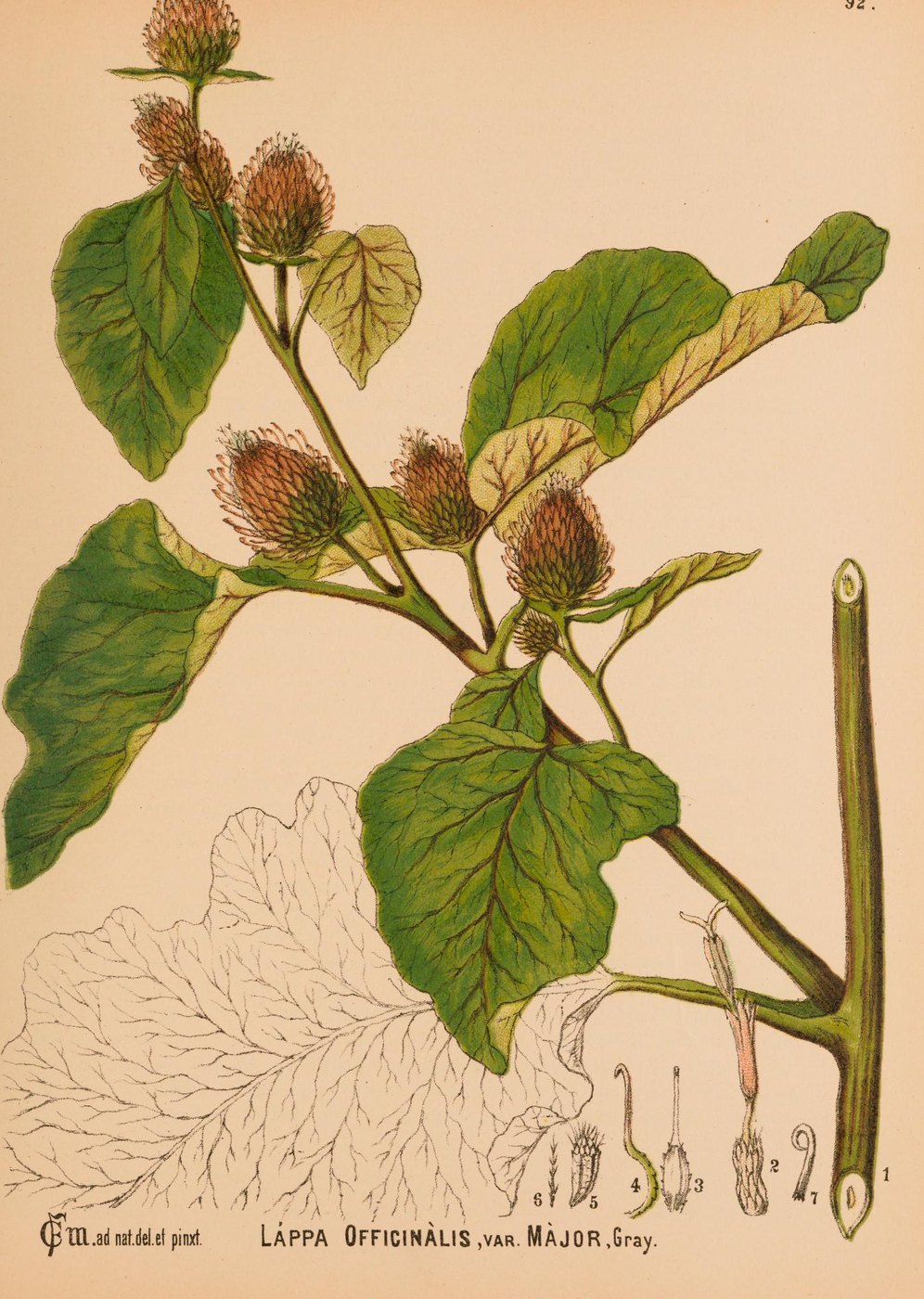
Burdock
Common burdock, Arctium minus; great burdock, Arctium lappa of Linnaeus, Lappa officinalis, Lappa major, Bardana major; bat weed; clotbur, wrongly; the Ojibwe gi’masan, big stickers; the Potawatomi asûkitä’boe, stickers
- Known today as
- The coarse biennial emigrant of roadsides and dwellings, three to five feet high, with great heart-shaped leaves cottony beneath and purple flower-heads in burrs of hooked scales, a deep root black outside and white within: native to Europe and Asia and spread westward across America by every coat and fleece its burrs could catch. It flowers from June to October.
- Kind
- Plant, in 5 older authorities
- Constituents
- inulin, arctigenin and arctiin, caffeoylquinic acids, and 1 more
- Earliest authority here
- Culpeper (1616–1654)
Caution. Contact dermatitis and other allergic reactions have been reported from burdock, and the seed lignan arctigenin is toxic at a dose; the root and peeled stems are old foods.
Burdock: what was it used for?
The Flambeau Ojibwe put the root into a medicine for pain in the stomach and held it a tonic; the Forest Potawatomi made a tea of the root for a general tonic and blood purifier; Densmore gives the root as diuretic, diaphoretic, and alterative, in the eighth United States Pharmacopoeia. In Europe and the East it was the depurant for every skin disease: Grieve has root or seeds decocted, an ounce to a pint and a half of water boiled down to a pint, a wineglassful three or four times a day, the leaves poulticed on tumours and gouty swellings, and the seeds the part the Americans preferred. Millspaugh gives the old decoction for pulmonary catarrh, rheumatism, gout, scrofula, and scurvy, thought better than sarsaparilla, and Woodville’s two dropsies relieved by it as a diuretic. As food, Rafinesque says the boiled roots, stems, and leaves were eaten in Canada and the root even raw like a radish, sweetish and austere, making the urine milky; Millspaugh has the young stems stripped of their rind eaten raw or boiled with oil, or in a potage with vinegar.
Burdock: foraging it in the Midwest
- Part
- Root of the first year; young peeled stems
- When
- Root in autumn before hard frost; stems in spring
Roadsides and waste ground about dwellings, everywhere; the roots, stems, and leaves were boiled and eaten in Canada and the root even raw, and the young stems stripped of their rind eaten in salad. The root is dug in autumn before the frost has touched the plant deeply.
After Rafinesque; Millspaugh. All the foragables of the Midwest. Historical record, not a field guide: identify before you gather, and read the whole entry.
Burdock: how is it taken as a tea?
Root or seeds in decoction, an ounce to a pint and a half of water boiled down to a pint, a wineglassful three or four times a day, for the skin above all; an infusion of the leaves for a weak stomach. The Potawatomi made a tea of the root as a tonic and blood purifier.
All the herbal teas of the database. Historical directions, not medical advice.
Burdock: what does modern science say?
A 2011 review gathers the laboratory work on root, seed, and leaf, antioxidant and antidiabetic compounds in the root, anti-inflammatory and tumour-inhibiting lignans in the seeds, and warns of contact dermatitis and allergic reactions. A 2023 systematic review of the fruit, the Chinese drug Arctii Fructus, counts more than two hundred compounds, chiefly the lignans arctiin and arctigenin, finds the fruit extract without toxicity but arctigenin toxic at a certain dose, and reports clinical studies of the fruit in chronic inflammation and ageing; the mechanisms, it says, still want study.
Pharmacognosy & Toxicology
- Constituents
- inulin ChEMBLup to 45 per cent of the root
- arctigenin and arctiinlignans of the seed
- caffeoylquinic acids
- polyacetylenesantimicrobial
- Mechanism
- The root is mildly diuretic and its inulin is a prebiotic; the lignans of the seed are anti-inflammatory in cells and animals; the “blood purifier” idea has no modern counterpart.
- Toxic dose
- Safe as food (gobo) and tea; the burrs are a contact irritant, and reports of poisoning from “burdock tea” were adulteration with belladonna root.
- Standing
- EMA monograph (2011) for the root as a diuretic and for mild skin conditions, on traditional use.
- EMA/HMPC (2011). Community herbal monograph on Arctium lappa L., radix (EMA/HMPC/573551/2010). Verified against its record
- Chan, Y.-S., et al. (2011). “A review of the pharmacological effects of Arctium lappa.” Inflammopharmacology 19. Verified against its record · doi:10.1007/s10787-010-0062-4
- Jin, X., et al. (2023). A systematic review on botany, ethnopharmacology, quality control, phytochemistry, pharmacology and toxicity of Arctium lappa L. fruit. Journal of Ethnopharmacology 308: 116223. doi:10.1016/j.jep.2023.116223 Verified against its record · PMID 36781057
The abstract of each source, beneath its citation. For Club members. About the Club or sign in.
Constituent names open the compound’s record at PubChem, and “ChEMBL” beside a name opens its record at ChEMBL, the European Bioinformatics Institute’s database of bioactive molecules. Where a mechanism line was checked against ChEMBL (ChEMBL 37, read 1 October 2026), the check is shown with the measured value and its source paper, or says plainly that nothing has been measured. Doses are as the references give them, for description only; this is not medical advice. Each source carries the result of its check against Crossref, PubMed, or the authority’s page: see Verification.
Burdock: what lore surrounds it?
Its burs, caught on a dog’s coat after a walk in the Alps, gave the Swiss engineer George de Mestral the idea for Velcro in the 1940s.
Named twice for its grip: Arctium from the Greek bear, for the shaggy heads, and lappa from a word for seizing, since, as Ray said, it may be derived either from laying hold or from licking. Shakespeare’s burs, Grieve reminds us, “they’ll stick where they are thrown.” The Ojibwe simply called it big stickers, and the Potawatomi stickers.
Burdock: what did the older authorities say?
- Culpeper
- Places it under Venus, and prescribes the leaves bruised with the white of an egg for burns.
- Huron H. Smith
- The big stickers: “The Flambeau Ojibwe use the root of burdock as one of the ingredients of a medicine for pain in the stomach. It is also supposed to have a tonic effect.” The Potawatomi “make a ‘tea’ from the Burdock root which is taken as a general tonic and blood purifier.”
- C. S. Rafinesque
- “Root valuable, diuretic, diaphoretic and detergent, equivalent to Aralia and Smilax. Useful in rheumatism, scurvy, syphilis, nephritis… gravel and gout. These properties are mild, since the boiled roots, stems and leaves are eaten in Canada; nay, the root even raw, like radishes, the taste is sweetish austere: the use of it makes the urine milky, and produces flatulence. The seeds are bitter and purgative.”
- Charles F. Millspaugh
- “The herb is so rank that man, the jackass, and caterpillar are the only animals that will eat of it. The young stems, stripped of their rind, may be eaten raw or boiled, as a salad with oil, or a potage with vinegar.” The fresh root is gathered in autumn, before the frost has touched the plant deeply.
- Mrs. M. Grieve
- “One of the best blood purifiers. In all skin diseases, it is a certain remedy,” alone or with yellow dock and sarsaparilla; root and seeds as a decoction of an ounce to a pint and a half boiled down to a pint, a wineglassful three or four times a day; the bruised leaves laid by the peasantry on the feet, and as a remedy for hysterical disorders. “Americans use the seeds only.”
Sources
- Grieve, M. (1931). A Modern Herbal, “Burdock.” Book, not indexed
- Culpeper, N. (1652). The English Physitian. Primary text
- Smith, H. H. (1932). Ethnobotany of the Ojibwe Indians, Bulletin of the Public Museum of the City of Milwaukee 4(3), “Common Burdock.” Project Gutenberg, 49527. Primary text
- Smith, H. H. (1933). Ethnobotany of the Forest Potawatomi Indians, Bulletin of the Public Museum of the City of Milwaukee 7(1), “Common Burdock.” Internet Archive, ethnobotany-of-the-forest-potawatomi-indians-by-huron-h.-smith-1933. Primary text
- Densmore, F. (1928). Uses of Plants by the Chippewa Indians, Forty-fourth Annual Report of the Bureau of American Ethnology, “Arctium minus.” Internet Archive, usesofplantsbych00dens. Primary text
- Millspaugh, C. F. (1887). American Medicinal Plants, vol. 1, no. 92, “Lappa,” and Plate 92. Internet Archive, americanmedicina01mill_0. Primary text
- Rafinesque, C. S. (1830). Medical Flora, or Manual of the Medical Botany of the United States of North America, vol. 2, “Arctium lappa,” p. 193. Internet Archive, b21468710_0002. Primary text
Verification
- Checked
- October 1, 2026
- Passes
- Every sentence read against its sources, in the pass over the remaining 343 entries
- The Standing line checked against the authority it names (EMA, WHO, FDA, CITES, Commission E)
- Every dated or regulatory claim checked by category across the database
- Sources
- 10 cited: 3 verified against its record, 6 primary text, 1 book, not indexed. 2 with the abstract on file.
- Corrections
- None were needed.
What was checked, how, and what was found is set out on the Verification page. A checked source is one whose record was found; it does not make the entry medical advice.
Cite This Entry
Version 1 · first published September 30, 2026
- Chicago
“Burdock.” In Materia Medica, edited by B. C. P. Statema. Version 1. The Thinking Press, 2026–. Last modified September 30, 2026. https://thethinkingpress.org/materia-medica/burdock.
- MLA
“Burdock.” Materia Medica, edited by B. C. P. Statema, version 1, The Thinking Press, 30 Sept. 2026, thethinkingpress.org/materia-medica/burdock. Accessed 8 Oct. 2026.
- APA
Burdock. (2026, September 30). In B. C. P. Statema (Ed.), Materia medica (Version 1). The Thinking Press. Retrieved October 8, 2026, from https://thethinkingpress.org/materia-medica/burdock
Club members keep entries on a shelf with private notes, print the plates as cards, and receive an entry by email each week. Create a free account before January 1, 2027 and all of it is yours for good. About the Club
See Also
Sharing inulin, caffeoylquinic acids, polyacetylenes
Cichorium intybus · Cichorium endivia · Taraxacum officinale · Inula helenium · Marrubium vulgare · Aster amellus · Eryngium maritimum · Buphthalmum salicifolium
Also in Nicholas Culpeper
Catmint in Nicholas Culpeper · Broom in Nicholas Culpeper · Centaury in Nicholas Culpeper · Blackthorn in Nicholas Culpeper · everything Nicholas Culpeper names →
Also in M. Grieve
Clove in M. Grieve · Bloodroot in M. Grieve · Ginseng in M. Grieve · Sumac in M. Grieve · everything M. Grieve names →
Drawing on the same sources: Grieve, Culpeper, Smith, Densmore
Butterbur · Borage · Caraway broth · Cantharides · Cattail · the bibliography →
Nearby in the alphabet
Bryony (Bryonia dioica (now Bryonia cretica subsp) · Caesar’s mushroom (egg-like when young and seated in a white cup) · Brown roll-rim (of birch woods) · Calamine (Zinc carbonate and zinc oxide) · Camphor (The crystalline gum of Cinnamomum camphora) · Brewer’s yeast (beer, and wine)
Historical description, not medical advice.