
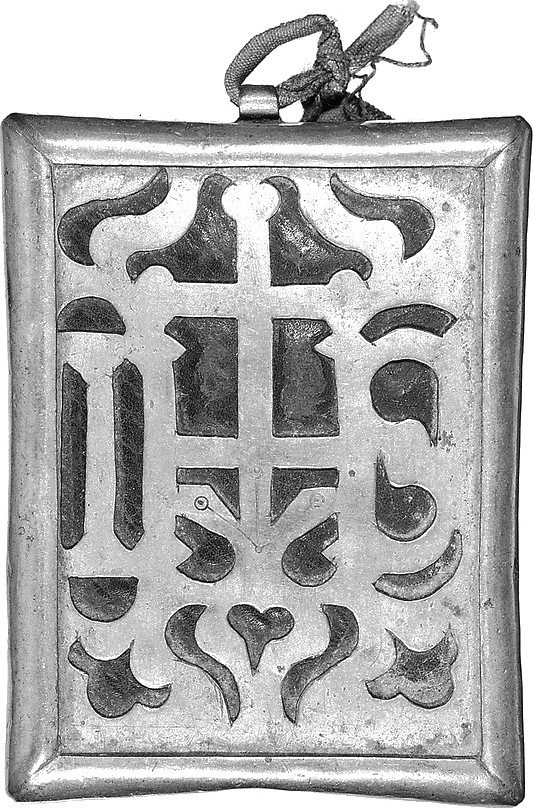
Breve
Breve
- Known today as
- A written prayer or holy names folded and worn on the body.
- Kind
- Sacramental, in 1 older authority
- Earliest authority here
- The Catholic Encyclopedia (New York, 1907–1914)
- In the Canale glossary
- On the Manner of Discerning and Healing the Bewitched, Appendix A: Treatise Two: Blessed Objects and Materials
Revised October 1, 2026: An authority added from a text read in full. Version 1, first published September 25, 2026.
Breve: what did Canale use it for?
Worn against demons, hexes, bindings, sigils, charms, and incantations; the Breve of St. Ubaldo (Treatise Two; note CIV).
Breve: what does modern science say?
The Church distinguished these from pagan amulets by Aquinas’s two conditions (note LXXV); its authorities had condemned superstitious amulets since the fourth century.
Breve: what did the older authorities say?
- The Catholic Encyclopedia
- The Catholic Encyclopedia lists among amulets “carved stones, bits of metal, figures of gods, strips of paper, or parchment bearing enigmatic phrases, blessings, and maledictions,” and discusses the Jewish tephillin, “the small leathern pouches containing passages of the law, and later known as phylacteries,” which “subsequently, however, … unquestionable were employed as such.” Pope St. Gregory the Great himself sent Queen Theodolinda “two phylacteria, one of which contained a fragment of the wood of the True Cross, the other a sentence of the Gospel,” and “the custom of carrying portions of the Sacred Scriptures as phylacteries is mentioned by St. Jerome and St. John Chrysostom.” The Council of Laodicea nonetheless “made the penalty for wearing them excommunication.”
Sources
- [5] Aquinas, Thomas. Summa Theologiae II-II, q. 96, a. 4. Trans. Fathers of the English Dominican Province, 2nd rev. ed. (1920). newadvent.org. Book, seen in reviews
- [21] Herbermann, C. G., et al. (eds.) (1907–1912). The Catholic Encyclopedia. New York: Robert Appleton Company. Online at newadvent.org. Articles: Agnus Dei (H. Thurston); Amulet (M. Hassett); Ash Wednesday (H. Thurston); Bells (H. Thurston); Holy Oils (H. Leclercq); Paschal Candle (H. Thurston); Scapular (J. Hilgers). Read in part · the text read
- The Catholic Encyclopedia (New York, 1907–1914), “Amulets, Use and Abuse of.” newadvent.org/cathen/01443b.htm Read in full · the text read
- The Catholic Encyclopedia (New York, 1907–1914), “Amulet.” newadvent.org/cathen/01443a.htm Read in full · the text read
Verification
- Checked
- October 1, 2026
- Passes
- Every dated or regulatory claim checked by category across the database
- Each quotation from the older authorities checked word for word against the text, read in full
- Sources
- 4 cited: 2 read in full, 1 read in part, 1 book, seen in reviews.
- Corrections
- None were needed.
What was checked, how, and what was found is set out on the Verification page. A checked source is one whose record was found; it does not make the entry medical advice.
Cite This Entry
Version 1 · first published September 25, 2026 · last revised October 1, 2026
- Chicago
“Breve.” In Materia Medica, edited by B. C. P. Statema. Version 1. The Thinking Press, 2026–. Last modified October 1, 2026. https://thethinkingpress.org/materia-medica/breve.
- MLA
“Breve.” Materia Medica, edited by B. C. P. Statema, version 1, The Thinking Press, 1 Oct. 2026, thethinkingpress.org/materia-medica/breve. Accessed 8 Oct. 2026.
- APA
Breve. (2026, October 1). In B. C. P. Statema (Ed.), Materia medica (Version 1). The Thinking Press. Retrieved October 8, 2026, from https://thethinkingpress.org/materia-medica/breve
Club members keep entries on a shelf with private notes, print the plates as cards, and receive an entry by email each week. Create a free account before January 1, 2027 and all of it is yours for good. About the Club
See Also
Also in The Catholic Encyclopedia
The Caravaca cross in The Catholic Encyclopedia · Blessed paper in The Catholic Encyclopedia · Concealed shoes in The Catholic Encyclopedia · Blessed candles in The Catholic Encyclopedia · everything The Catholic Encyclopedia names →
Nearby in the alphabet
Brewer’s yeast (beer, and wine) · Borax (brought as the crude salt tincal from the lakes of Tibet) · Broom (Spartium junceum, or common broom, Cytisus scoparius) · Borage (Borago officinalis) · Brown roll-rim (of birch woods) · Bogbean · Bryony (Bryonia dioica (now Bryonia cretica subsp) · Bloodstone (iron oxide, which streaks blood-red)
Historical description, not medical advice.