
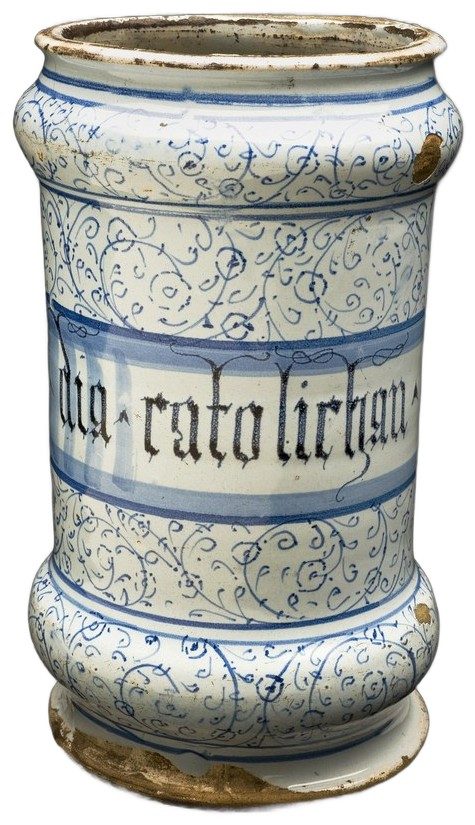
Diacatholicon
- Known today as
- A “universal” purgative electuary of the old apothecary, based on senna, rhubarb, cassia, and tamarind with various seeds.
- Kind
- Compound
- Constituents
- sennosides, rhein and emodin, cassia pulp and tamarind, and 2 more
- Poisoning
- The anthranoid purgatives
- In the Canale glossary
- On the Manner of Discerning and Healing the Bewitched, Appendix A: Treatise One, Part Three, Chapters 2–3: Purgative and Preparative Medicines
Revised October 3, 2026: Checked against its sources, each read in full, in part, or in its abstract. Version 1, first published September 25, 2026.
Diacatholicon: what did Canale use it for?
A starting purge, especially for melancholic patients (chs. 2, 4).
Diacatholicon: what does modern science say?
A laxative by modern reckoning for its senna, which the EMA accepts for short-term use in occasional constipation, and for its rhubarb, which in large doses is purgative. Culpeper called it a fine cooling purge for any part of the body.
Pharmacognosy & Toxicology
- Constituents
- sennosidesfrom the senna
- rhein and emodinfrom the rhubarb
- cassia pulp and tamarind
- polypody
- liquorice and sugar
- Mechanism
- The “universal” purge, built on senna, rhubarb, cassia, and tamarind: the bacteria of the large intestine turn senna’s sennosides into rhein anthrone, which stirs the colon, and the stool comes eight to twelve hours after the dose; Culpeper found the whole very gentle. A sound laxative by modern reckoning, whatever its claim on every humour.
- Toxic dose
- Culpeper gave an ounce or half an ounce at a time; long use of senna can upset the body’s water and electrolytes and lower potassium, and high doses taken too long have injured the liver.
- Syndrome
- The anthranoid purgatives
- Standing
- In the London Pharmacopoeia of 1653, as Catholicon; its senna is on the WHO Model List of Essential Medicines.
- Culpeper, N. (1653). Pharmacopoeia Londinensis, “Diacatholicon.” Read in part · the text read
- EMA/HMPC (2020). European Union herbal monograph on Senna alexandrina Mill., folium (EMA/HMPC/625849/2015). Read in full · the text read
Constituent names open the compound’s record at PubChem, and “ChEMBL” beside a name opens its record at ChEMBL, the European Bioinformatics Institute’s database of bioactive molecules. Where a mechanism line was checked against ChEMBL (ChEMBL 37, read 1 October 2026), the check is shown with the measured value and its source paper, or says plainly that nothing has been measured. Doses are as the references give them, for description only; this is not medical advice. Each source carries the result of its check against Crossref, PubMed, or the authority’s page: see Verification.
In Their Own Words
Culpeper names Diacatholicon, with lenitive electuary and pulp of cassia, among the gentle electuaries that may be taken in the manner he describes for opening medicines.
“In this manner you may take Lenitive Electuary, Diacatholicon, Pulp of Cassia, and the like gentle electuaries, as also all pills that have neither Diagrydium nor Colocynthus, in them.”
Nicholas Culpeper, The Complete Herbal, Of purging medicines, rule (5). London: Thomas Kelly, 17, Paternoster Row, MDCCCL (Project Gutenberg eBook #49513). The text, read in part
Quincy judges it at best an indifferent composition which, for all its ostentatious title, was hardly ever prescribed or made.
“…at beſt it is but an indifferent Compoſition, and, notwithſtanding its oſtentatious Title, hardly ever preſcrib'd or made.”
John Quincy, M.D., Pharmacopœia Officinalis & Extemporanea, or, A Complete English Dispensatory, Part III, electuaries: 'Catholicon, The Universal Purge'. London: printed for E. Bell and others, 1724; the edition number on the title page is illegible in the scan (Internet Archive OCR text). The text, read in part
Each passage is quoted from the text named, which the press fetched and read, and was checked word for word against a fresh copy of it; the link opens that copy. Passages are given as printed, without the editors’ footnote numbers, and with words broken across lines joined.
The Recipe
The recipe: 5 ingredients, each linked to its entry. For Club members. Create a free account or sign in.
Sources
- [28] Culpeper, N. (1653). Pharmacopœia Londinensis, or, The London Dispensatory [the Royal College of Physicians’ pharmacopoeia in English, with Culpeper’s commentary]. London: Peter Cole. Text Creation Partnership edition A35381. Read in part · the text read
- [41] European Medicines Agency, Committee on Herbal Medicinal Products (HMPC). Herbal monographs, assessment reports and public statements, ema.europa.eu, cited under the herb concerned: aniseed (summary, EMA/305345/2016); Aristolochia (public statement, EMEA/HMPC/138381/2005); asarone (public statement, EMEA/HMPC/139215/2005); caraway (EMA/HMPC/715092/2013); centaury (EMA/HMPC/277493/2015); chicory root (assessment report, EMA/HMPC/113041/2010); cinnamon (EMA/HMPC/246774/2009); clove (assessment report, EMA/HMPC/534946/2010); ethanol in herbal products (reflection paper, EMA/HMPC/85114/2008); fennel (EMEA/HMPC/372839/2016, Rev. 1, 2024); fumitory (draft assessment report, EMA/HMPC/367013/2021); greater celandine (public statement, EMA/HMPC/743927/2010); hops (EMA/HMPC/682384/2013); horehound (EMA/HMPC/604271/2012); mallow (assessment report, EMA/HMPC/749518/2016); marshmallow root (Althaeae radix); melissa (summary, EMA/HMPC/310761/2013); myrrh (assessment report and monograph, EMA/HMPC/96910/2010 and 96911/2010); peppermint oil (assessment report, EMEA/HMPC/349465/2006); pyrrolizidine alkaloids (public statement, EMA/HMPC/893108/2011); rhubarb (EMA/HMPC/113700/2019); sage (Salviae officinalis folium); wormwood (EMA/HMPC/751490/2016). Read in full · the text read
- [80] LiverTox: Clinical and Research Information on Drug-Induced Liver Injury. Bethesda (MD): National Institute of Diabetes and Digestive and Kidney Diseases. Entries: Germander (updated 12 March 2018); Pennyroyal Oil (updated 28 March 2020); Senna (updated 1 April 2020). Abstract read · the text read
- Wikipedia, “WHO Model List of Essential Medicines,” en.wikipedia.org (read 2 October 2026). Read in part · the text read
Verification
- Checked
- October 1, 2026, and October 3, 2026
- Passes
- Every sentence read against its sources, in the pass over the remaining 343 entries
- The Standing line checked against the authority it names (EMA, WHO, FDA, CITES, Commission E)
- Every dated or regulatory claim checked by category across the database
- Every source read, in full, in part, or in its abstract, and every sentence checked against what was read (October 3, 2026)
- Sources
- 6 cited: 2 read in full, 3 read in part, 1 abstract read. 1 with the abstract on file.
- Corrections
- None were needed.
What was checked, how, and what was found is set out on the Verification page. A checked source is one whose record was found; it does not make the entry medical advice.
Cite This Entry
Version 1 · first published September 25, 2026 · last revised October 3, 2026
- Chicago
“Diacatholicon.” In Materia Medica, edited by B. C. P. Statema. Version 1. The Thinking Press, 2026–. Last modified October 3, 2026. https://thethinkingpress.org/materia-medica/diacatholicon.
- MLA
“Diacatholicon.” Materia Medica, edited by B. C. P. Statema, version 1, The Thinking Press, 3 Oct. 2026, thethinkingpress.org/materia-medica/diacatholicon. Accessed 8 Oct. 2026.
- APA
Diacatholicon. (2026, October 3). In B. C. P. Statema (Ed.), Materia medica (Version 1). The Thinking Press. Retrieved October 8, 2026, from https://thethinkingpress.org/materia-medica/diacatholicon
Club members keep entries on a shelf with private notes, print the plates as cards, and receive an entry by email each week. Create a free account before January 1, 2027 and all of it is yours for good. About the Club
See Also
Poisoned alike: the anthranoid purgatives
Hiera picra · Compound fumitory · Lenitive electuary · Cassia, flower of · Madder · Yellow dock · Myrobalans · Rhubarb · the syndrome, with all of them →
Drawing on the same sources: Wikipedia, Culpeper
Diamoschu, sweet · Devil’s-bit scabious · Diascordium · Diaphenicon · the bibliography →
Nearby in the alphabet
Destroying angel (Pure white amanitas of Europe and North America) · Death cap (white-gilled mushroom of oak and beech woods, now spread worldwide) · Diatrion piperion (with aniseed and ginger) · Deadly webcap
Historical description, not medical advice.