
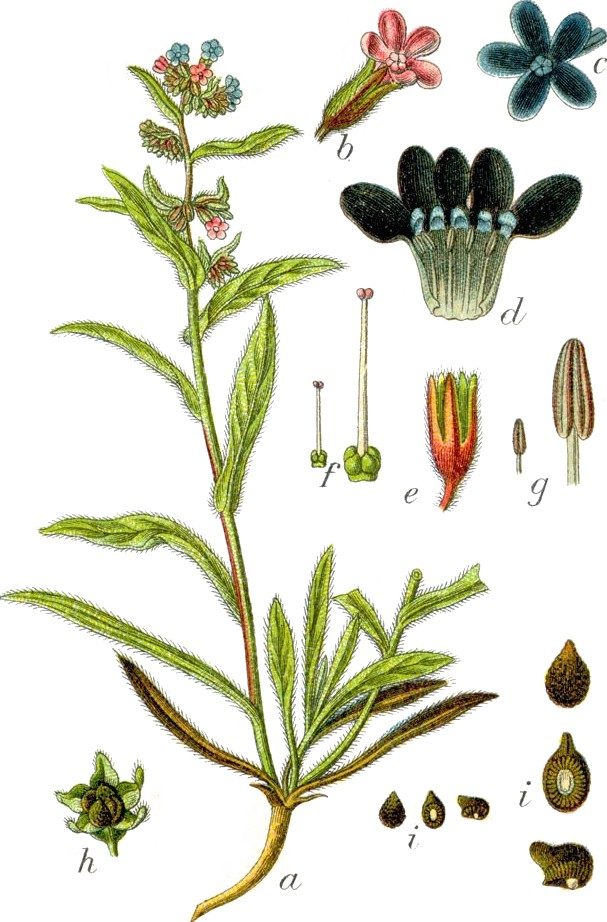
Cordial flowers and fruits
Fiori e frutti cordiali
- Known today as
- A standard apothecary decoction of “heart-strengthening” flowers (usually borage, bugloss, violet, rose) and fruits (in the London College’s decoction of flowers and fruits, figs, prunes, jujubes, and tamarinds).
- Kind
- Compound
- Constituents
- borage and bugloss, violet and rose, figs, prunes, jujubes, tamarinds
- In the Canale glossary
- On the Manner of Discerning and Healing the Bewitched, Appendix A: Treatise One, Part Three, Chapters 2–3: Purgative and Preparative Medicines
Revised October 3, 2026: Checked against its sources, each read in full, in part, or in its abstract. Version 1, first published September 25, 2026.
Cordial flowers and fruits: what did Canale use it for?
The liquid base of several draughts (chs. 2, 4).
Cordial flowers and fruits: what does modern science say?
A vehicle; Culpeper says the decoction strengthens the lungs and helps obstruction. The category of “cordials” rests on the old physiology of the heart and the vital spirits.
Pharmacognosy & Toxicology
- Constituents
- borage and buglosswith the pyrrolizidine alkaloids of borage
- violet and rose
- figs, prunes, jujubes, tamarindsthe fruits
- Mechanism
- The four cordial flowers of the London College, borage, bugloss, roses, and violets, boiled with figs, prunes, jujubes, and tamarinds as the liquid base of draughts: a sweet vehicle, the tamarinds mildly laxative; the cheer was in the name.
- Toxic dose
- A sweet decoction; borage carries pyrrolizidine alkaloids, whose intake from medicines taken by mouth German rules have set at 1 µg a day for at most six weeks a year.
- Standing
- A vehicle of the old pharmacy.
- Culpeper, N. (1653). Pharmacopoeia Londinensis. Read in part · the text read
Constituent names open the compound’s record at PubChem, and “ChEMBL” beside a name opens its record at ChEMBL, the European Bioinformatics Institute’s database of bioactive molecules. Where a mechanism line was checked against ChEMBL (ChEMBL 37, read 1 October 2026), the check is shown with the measured value and its source paper, or says plainly that nothing has been measured. Doses are as the references give them, for description only; this is not medical advice. Each source carries the result of its check against Crossref, PubMed, or the authority’s page: see Verification.
In Their Own Words
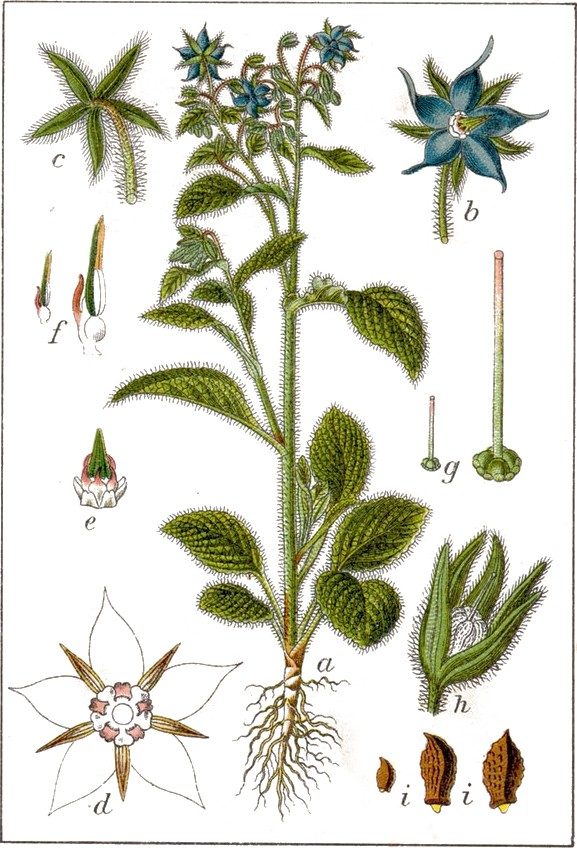
Culpeper's catalogue names the four cordial flowers as borage, bugloss, roses and violets.
“The four cordial Flowers. Borrage, Bugloss, Roses, Violets.”
Nicholas Culpeper, M.D., The Complete Herbal ... to which are now first annexed, the English Physician Enlarged, and Key to Physic, Catalogue of Simples: the compound names, 'The four cordial Flowers'. A new edition. London: Thomas Kelly, 17, Paternoster Row, MDCCCL (Project Gutenberg eBook #49513). The text, read in part
Each passage is quoted from the text named, which the press fetched and read, and was checked word for word against a fresh copy of it; the link opens that copy. Passages are given as printed, without the editors’ footnote numbers, and with words broken across lines joined.
The Recipe
The recipe: 7 ingredients, each linked to its entry. For Club members. Create a free account or sign in.
Sources
- [28] Culpeper, N. (1653). Pharmacopœia Londinensis, or, The London Dispensatory [the Royal College of Physicians’ pharmacopoeia in English, with Culpeper’s commentary]. London: Peter Cole. Text Creation Partnership edition A35381. Read in part · the text read
- EMA/HMPC (2021). Public statement on the use of herbal medicinal products containing toxic, unsaturated pyrrolizidine alkaloids (PAs) (EMA/HMPC/893108/2011 Rev. 1). Read in full · the text read
- Anthonie, F. (1616). The Apologie, or Defence of a Verity Heretofore Published Concerning a Medicine Called Aurum Potabile. London: John Legatt. Text Creation Partnership edition A20238. Read in part · the text read
Verification
- Checked
- October 1, 2026, and October 3, 2026
- Passes
- Every sentence read against its sources, in the pass over the remaining 343 entries
- The Standing line checked against the authority it names (EMA, WHO, FDA, CITES, Commission E)
- Every dated or regulatory claim checked by category across the database
- Every source read, in full, in part, or in its abstract, and every sentence checked against what was read (October 3, 2026)
- Sources
- 4 cited: 1 read in full, 3 read in part.
- Corrections
- None were needed.
What was checked, how, and what was found is set out on the Verification page. A checked source is one whose record was found; it does not make the entry medical advice.
Cite This Entry
Version 1 · first published September 25, 2026 · last revised October 3, 2026
- Chicago
“Cordial flowers and fruits.” In Materia Medica, edited by B. C. P. Statema. Version 1. The Thinking Press, 2026–. Last modified October 3, 2026. https://thethinkingpress.org/materia-medica/cordial-flowers-and-fruits.
- MLA
“Cordial flowers and fruits.” Materia Medica, edited by B. C. P. Statema, version 1, The Thinking Press, 3 Oct. 2026, thethinkingpress.org/materia-medica/cordial-flowers-and-fruits. Accessed 8 Oct. 2026.
- APA
Cordial flowers and fruits. (2026, October 3). In B. C. P. Statema (Ed.), Materia medica (Version 1). The Thinking Press. Retrieved October 8, 2026, from https://thethinkingpress.org/materia-medica/cordial-flowers-and-fruits
Club members keep entries on a shelf with private notes, print the plates as cards, and receive an entry by email each week. Create a free account before January 1, 2027 and all of it is yours for good. About the Club
See Also
Drawing on the same sources: Anthonie, Culpeper
Aurum potabile · Cowslip · Coral, red · Crabs’ eyes · the bibliography →
Nearby in the alphabet
Coriander (seed and leaf) · Corn smut · Copal · Cornicello · Contact relics · Confection of hyacinth (sapphire, emerald, and other stones, with coral, pearls, and gold)
Historical description, not medical advice.