
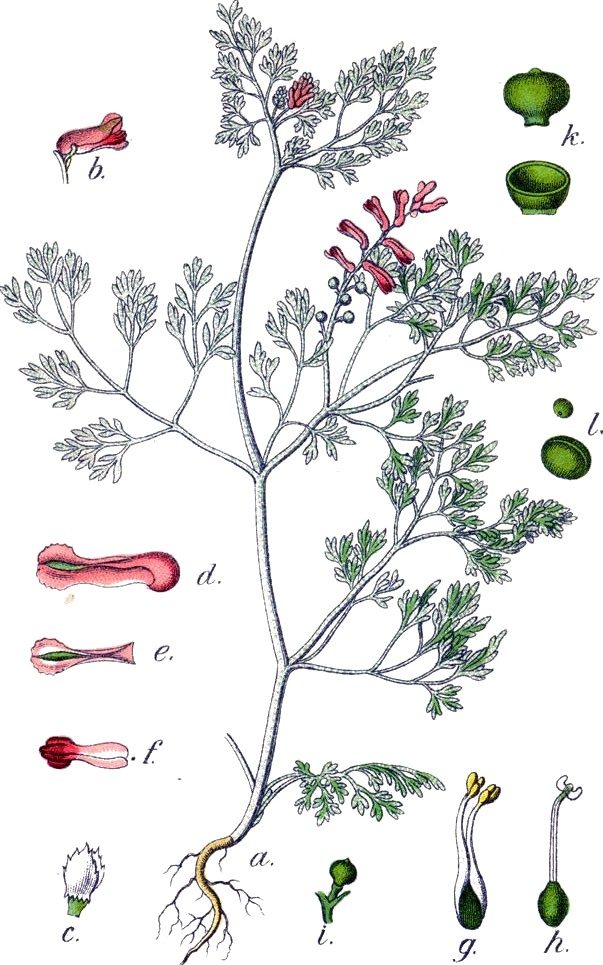
Compound fumitory
Fumoterra composta
- Known today as
- A syrup or compound of fumitory, Fumaria officinalis, with other herbs.
- Kind
- Compound
- Constituents
- protopine, fumaric acid, cassia and tamarind pulp, and 1 more
- Poisoning
- The anthranoid purgatives
- In other databases
- GBIF search · Wikidata search
- In the Canale glossary
- On the Manner of Discerning and Healing the Bewitched, Appendix A: Treatise One, Part Three, Chapters 2–3: Purgative and Preparative Medicines
Revised October 3, 2026: Checked against its sources, each read in full, in part, or in its abstract. Version 1, first published September 25, 2026.
Compound fumitory: what did Canale use it for?
A starting purge, and in syrup and water a preparative for melancholic patients (chs. 2–3).
Compound fumitory: what does modern science say?
Fumitory is still accepted in European herbal medicine as a traditional remedy for fullness, slow digestion, and wind, and in animals its extracts even out a bile flow that has been raised or lowered by experiment; Culpeper counted it only a gentle purge.
Pharmacognosy & Toxicology
- Constituents
- protopine ChEMBLan isoquinoline alkaloid of fumitory
- fumaric acid ChEMBL
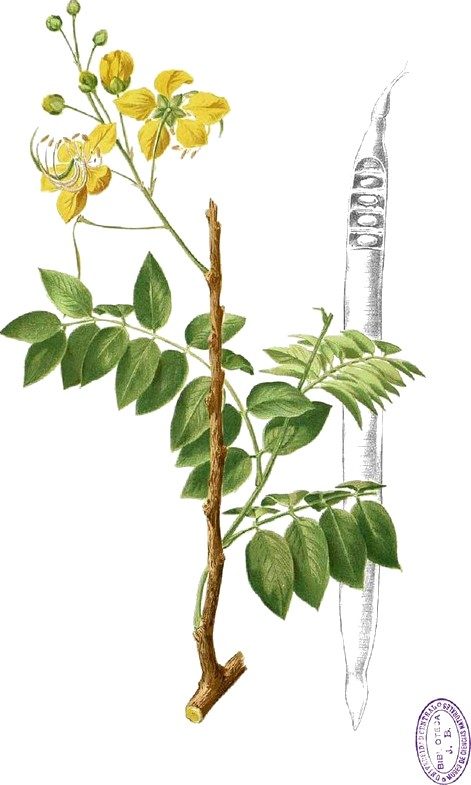
- cassia and tamarind pulpfrom Mesue’s greater syrup
- myrobalans
- Mechanism
- Fumitory is a bitter whose extracts in animals even out a disturbed bile flow, with light antispasmodic action, and it has an EMA monograph; Mesue’s greater syrup of fumitory purged by its myrobalans, which he counted gentle purges, and its cassia and tamarinds. Fumaric acid, found in fumitory, gave the fumaric acid esters registered for psoriasis in Germany since 1994, and dimethyl fumarate is now also approved in the United States for relapsing multiple sclerosis; it is made by laboratory synthesis.
- Toxic dose
- Culpeper would give two ounces of the syrup by itself every morning, and liked it for its gentleness.
- Syndrome
- The anthranoid purgatives
- Standing
- Fumitory herb has an EMA monograph (2011, revised 2023) for digestive disturbances; the compound syrup stood in the London Pharmacopoeia of 1653.
- Mrowietz, U., and Asadullah, K. (2005). “Dimethylfumarate for psoriasis: more than a dietary curiosity.” Trends in Molecular Medicine 11. Abstract read · the text read
The abstract of each source, beneath its citation. For Club members. About the Club or sign in.
Constituent names open the compound’s record at PubChem, and “ChEMBL” beside a name opens its record at ChEMBL, the European Bioinformatics Institute’s database of bioactive molecules. Where a mechanism line was checked against ChEMBL (ChEMBL 37, read 1 October 2026), the check is shown with the measured value and its source paper, or says plainly that nothing has been measured. Doses are as the references give them, for description only; this is not medical advice. Each source carries the result of its check against Crossref, PubMed, or the authority’s page: see Verification.
Compound fumitory: what lore surrounds it?
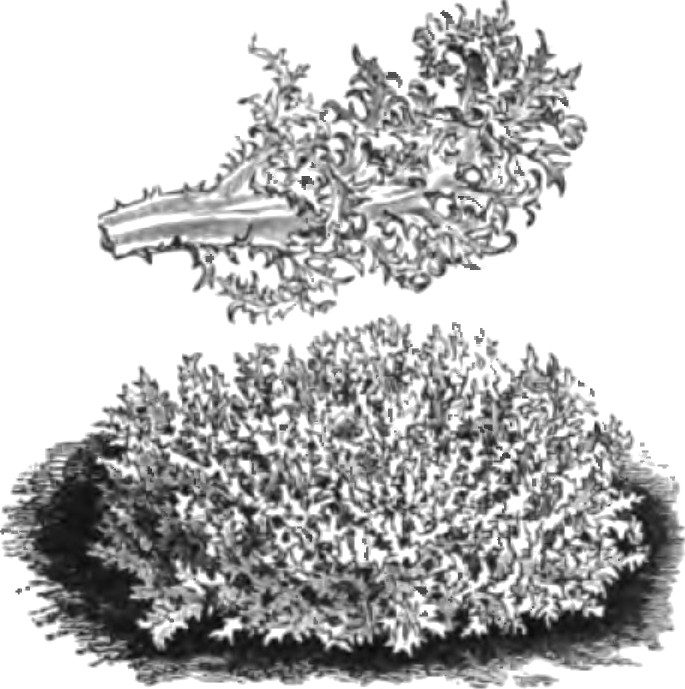
The plant’s name carries its lore: fumus terrae, “earth smoke,” said to come from its whitish blue-green colour, like smoke rising from the ground, or, as Pliny is reported to have held, from its juice, which brings such tears that the sight dims as with smoke; and a legend had it that the plant grew not from seed but from vapours rising out of the earth.
In Their Own Words
Culpeper calls the College syrup of fumitory a pretty concocter of melancholy, and so a help for diseases arising from it, including diseases of the skin.
“The receipt is a pretty concocter of melancholy, and therefore a rational help for diseases arising thence, both internal and external, it helps diseases of the skin”
Nicholas Culpeper, M.D., The Complete Herbal ... to which are now first annexed, the English Physician Enlarged, and Key to Physic, Altering Syrups: Syrupus de Fumaria, or Syrup of Fumitory. A new edition. London: Thomas Kelly, 17, Paternoster Row, MDCCCL (Project Gutenberg eBook #49513). The text, read in part
Each passage is quoted from the text named, which the press fetched and read, and was checked word for word against a fresh copy of it; the link opens that copy. Passages are given as printed, without the editors’ footnote numbers, and with words broken across lines joined.
The Recipe
The recipe: 2 ingredients, each linked to its entry. For Club members. Create a free account or sign in.
Sources
- [28] Culpeper, N. (1653). Pharmacopœia Londinensis, or, The London Dispensatory [the Royal College of Physicians’ pharmacopoeia in English, with Culpeper’s commentary]. London: Peter Cole. Text Creation Partnership edition A35381. Read in part · the text read
- [41] European Medicines Agency, Committee on Herbal Medicinal Products (HMPC). Herbal monographs, assessment reports and public statements, ema.europa.eu, cited under the herb concerned: aniseed (summary, EMA/305345/2016); Aristolochia (public statement, EMEA/HMPC/138381/2005); asarone (public statement, EMEA/HMPC/139215/2005); caraway (EMA/HMPC/715092/2013); centaury (EMA/HMPC/277493/2015); chicory root (assessment report, EMA/HMPC/113041/2010); cinnamon (EMA/HMPC/246774/2009); clove (assessment report, EMA/HMPC/534946/2010); ethanol in herbal products (reflection paper, EMA/HMPC/85114/2008); fennel (EMEA/HMPC/372839/2016, Rev. 1, 2024); fumitory (draft assessment report, EMA/HMPC/367013/2021); greater celandine (public statement, EMA/HMPC/743927/2010); hops (EMA/HMPC/682384/2013); horehound (EMA/HMPC/604271/2012); mallow (assessment report, EMA/HMPC/749518/2016); marshmallow root (Althaeae radix); melissa (summary, EMA/HMPC/310761/2013); myrrh (assessment report and monograph, EMA/HMPC/96910/2010 and 96911/2010); peppermint oil (assessment report, EMEA/HMPC/349465/2006); pyrrolizidine alkaloids (public statement, EMA/HMPC/893108/2011); rhubarb (EMA/HMPC/113700/2019); sage (Salviae officinalis folium); wormwood (EMA/HMPC/751490/2016). Read in full · the text read
- EMA/HMPC (2023). European Union herbal monograph on Fumaria officinalis L., herba, Revision 1 (EMA/HMPC/367011/2021). Read in full · the text read
- Mesue (1589). I libri di Gio. Mesue de i semplici purgativi, et delle medicine composte, ed. G. Rossetto. Venice. Read in part · the text read
- Grieve, M. (1931). A Modern Herbal, “Fumitory.” London: Jonathan Cape. Read in part · the text read
- Wikipedia, “Fumaric acid,” en.wikipedia.org (read 2 October 2026). Read in full · the text read
- Wikipedia, “Dimethyl fumarate,” en.wikipedia.org (read 2 October 2026). Read in full · the text read
Verification
- Checked
- October 1, 2026, and October 3, 2026
- Passes
- Every sentence read against its sources, in the pass over the remaining 343 entries
- The Standing line checked against the authority it names (EMA, WHO, FDA, CITES, Commission E)
- Every dated or regulatory claim checked by category across the database
- Every source read, in full, in part, or in its abstract, and every sentence checked against what was read (October 3, 2026)
- Sources
- 8 cited: 4 read in full, 3 read in part, 1 abstract read. 1 with the abstract on file.
- Corrections
- None were needed.
What was checked, how, and what was found is set out on the Verification page. A checked source is one whose record was found; it does not make the entry medical advice.
Cite This Entry
Version 1 · first published September 25, 2026 · last revised October 3, 2026
- Chicago
“Compound fumitory.” In Materia Medica, edited by B. C. P. Statema. Version 1. The Thinking Press, 2026–. Last modified October 3, 2026. https://thethinkingpress.org/materia-medica/compound-fumitory.
- MLA
“Compound fumitory.” Materia Medica, edited by B. C. P. Statema, version 1, The Thinking Press, 3 Oct. 2026, thethinkingpress.org/materia-medica/compound-fumitory. Accessed 8 Oct. 2026.
- APA
Compound fumitory. (2026, October 3). In B. C. P. Statema (Ed.), Materia medica (Version 1). The Thinking Press. Retrieved October 8, 2026, from https://thethinkingpress.org/materia-medica/compound-fumitory
Club members keep entries on a shelf with private notes, print the plates as cards, and receive an entry by email each week. Create a free account before January 1, 2027 and all of it is yours for good. About the Club
See Also
Poisoned alike: the anthranoid purgatives
Diacatholicon · Cassia, flower of · Hiera picra · Yellow dock · Lenitive electuary · Rhubarb · Madder · Myrobalans · the syndrome, with all of them →
Sharing fumaric acid
Drawing on the same sources: Grieve, Wikipedia
Cubeb · Coltsfoot · Cumin · Confection of alkermes · Common ink cap · Confection of hyacinth · the bibliography →
Nearby in the alphabet
Concealed shoes · Common earthball (yellow-brown ball with a black interior, of acid woodland) · Comfrey (Symphytum officinale) · Contact relics
Historical description, not medical advice.