
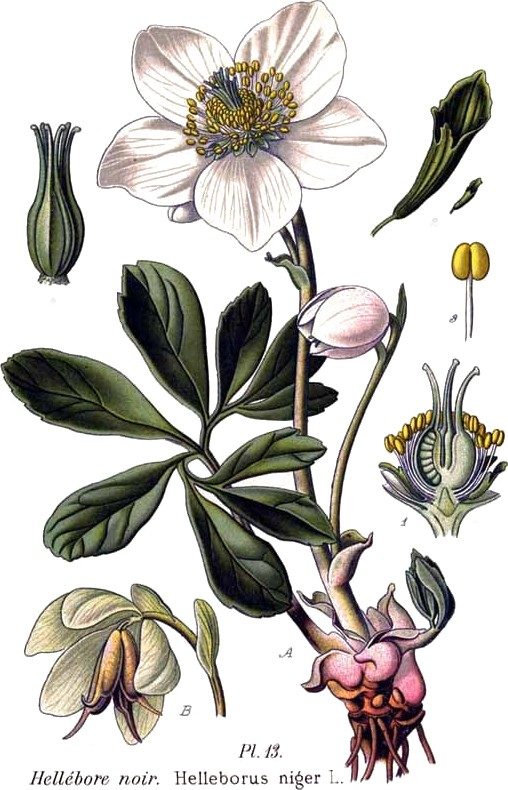
Black hellebore
Elleboro nero
- Known today as
- The Christmas rose, Helleborus niger; the bark of the root was used.
- Kind
- Plant, in 3 older authorities
- Constituents
- hellebrin, protoanemonin
- Poisoning
- Cardiac glycoside poisoning
- Earliest authority quoted here
- Hippocratic writers (c. 460–c. 370 BC)
- Qualities
- Hot and dry in the third degree (Culpeper). What the degrees mean
- In other databases
- Plants of the World Online search · GBIF search · Wikidata search
- In the Canale glossary
- On the Manner of Discerning and Healing the Bewitched, Appendix A: Part Three, Chapter 4: Stronger Purgatives and Compound Medicines
Revised November 1, 2026: Checked against its sources, each read in full, in part, or in its abstract. Corrected from the press's evidence dossier on the entry, every change checked in the sources read. Version 1, first published September 25, 2026.
Caution. Hazardous in some form or dose; see Safety, below.
Black hellebore: what did Canale use it for?
Among the stronger purges, for melancholic patients, and its extract among the other commended medicines (ch. 4).
Before anyone takes it
- Pregnancy and breast-feeding
- The old authorities used it to bring on the menses and to procure abortion. Dioscorides, 2000
Black hellebore: what does modern science say?
Hellebore, the black and the white alike, was the classical remedy for madness and melancholy from the Hippocratic writers to the seventeenth century. It is a violent purgative and a cardiac poison, and has no place in conventional medicine today.
Black hellebore: is it poisonous?
Yes, in some form or dose. Its poisoning is cardiac glycoside poisoning: Hours. Historical description, not medical advice; in a poisoning, call a poison centre.
Before anyone takes it
- Pregnancy and breast-feeding
- The old authorities used it to bring on the menses and to procure abortion. Dioscorides, 2000
- Children
- Pliny already forbade it to the old and to children. Pliny
- Side effects
- The fresh root is violently irritant on the skin, and the dry powder causes violent sneezing. Grieve, 1931
- A related hellebore burns and reddens skin and mucous membranes, and rarely causes dermatitis. Brajanovska and Bauer, 2018
- Toxic dose
- All parts are poisonous, and even the seeds alone can prove fatal, by Maieron’s account of a list of poisonous plants. Maieron, 2018
- In cats, hellebrin killed at 0.1 mg per kg into a vein, and a 10 mg dose by mouth was lethal, as Brajanovska reports Karrer. Brajanovska and Bauer, 2018
- Poisoning
- Its glycosides act on the heart like digitalis; no modern human case of black hellebore poisoning was found to describe the picture. Brajanovska and Bauer, 2018
- With the regulators
- It is no longer used in conventional medicine for its toxicity; homeopathic dilutions are still given. Maieron, 2018
The toxic dose and the poisoning
- Toxic dose
- Uncertain; by Maieron’s account of a list of poisonous plants, all parts are poisonous and even the seeds alone can prove fatal. No human case report was found.
- Syndrome
- Cardiac glycoside poisoning
The references for these lines are listed under Pharmacognosy, in Science. Doses are as the references give them, for description only; this is not medical advice. In a poisoning, call a poison centre.
The claims on its safety, checked
The evidence beneath each verdict here, in the words of the sources read, is for members. Join free
Partly confirmedBlack hellebore is a cardiac poison.
By the old pharmacology and animal work: its glycoside is a heart poison of the digitalis kind; no human case of black hellebore heart poisoning was found.
Treat as a heart poison of the digitalis kind; no human case series exists to describe it.
UncertainIts poisoning is cardiac glycoside poisoning, coming on within hours.
Inferred from its glycosides; no human case of black hellebore poisoning, and so no onset time, was found.
UncertainProtoanemonin causes vomiting, inflammation of the mouth and throat, and abdominal pain.
An irritant, by the sources read, which do not list these symptoms; no human case of black hellebore was found.
Partly confirmedAll parts of the plant are poisonous, and eating even the seeds alone can prove fatal.
As Maieron reports an unnamed list of poisonous plants; no human case was found.
Treat every part as poisonous.
Each verdict is on the press’s scale, from confirmed to never documented, and rests on the sources read, in full, in part or in their abstracts. How the press checks. A summary of what was read, not medical advice.
Black hellebore: what did the older authorities say?
- Hippocratic writersc. 460–c. 370 BC
- Open the belly with black hellebore, which “acts more pleasantly and effectually than the peplium,” and put those troubled with a defluxion from the head on “a course of hellebore.”
- Myth
- Pliny gives the black hellebore the name melampodion from Melampus the diviner, or, as others had it, from a shepherd of that name who saw his she-goats purged by it and cured the daughters of Proetus of their madness with the goats’ milk.
- Horace65–8 BC
- Of the ambitious man: “Let him make a voyage [then] to Anticyra,” the town on the Gulf of Corinth famous for its hellebore, whose name became a byword for a cure for madness.
Black hellebore: what lore surrounds it?
Folkard tells how Melampus learned the purge from goats that had fed on hellebore and cured the mad daughters of Prœtus, after which “Black Hellebore was used to purify houses, and to hallow dwellings, and the ancients entertained the belief that by strewing or perfuming their apartments with this plant, they drove away evil spirits.” The root was dug with rites: “the devotee first drawing a circle round the plant with a sword, and then, turning to the east, offering a prayer to Apollo and Æsculapius,” while an eagle overhead “was considered so ominous as to predict the certain death of the persons who took up the plant.” R. Turner, writing in 1663, says, as Folkard reports, that hellebore “was thought to cure such as seemed to be possessed with the Devil, and therefore was by some called Fuga Dæmonum,” and the Anticyra of the proverb Naviga ad Anticyram grew it in abundance.
The drug of madness and melancholy stood exactly where Canale’s art had to draw its line: which sufferers were ill, and which bewitched. Yet Canale purged the bewitched too: he faults priests who purge them with antimony and white hellebore without a physician, and gives his own measured purges, black hellebore among them.
Used in These Compounds
Black hellebore is an ingredient of 2 compound medicines in the database. For Club members. Create a free account or sign in.
Its history and lore, checked
The evidence beneath each verdict here, in the words of the sources read, is for members. Join free
History and names12 claims
Partly confirmedCanale: black hellebore is the strongest purge for melancholic patients.
As history: a recipe with the root of black hellebore stands in Canale’s chapter on the stronger purges, after his note on the melancholic humour; ‘strongest’ could not be read in the OCR.
ConfirmedCanale counts the extract of black hellebore among the other commended medicines.
As history: Canale 1622, OCR.
Partly confirmedBlack hellebore was the classical remedy for madness from Hippocrates on.
Hellebore, black and white alike, was given for madness and melancholy from the Hippocratic writers to the seventeenth century; the Hippocratic passages read give it for purging and for defluxion of the head.
ConfirmedBlack hellebore has no place in conventional medicine today.
Maieron; Brajanovska.
Partly confirmedNo longer used in medicine for its toxicity, save in homeopathy and in creams for some skin diseases.
Maieron says so; homeopathic Helleborus niger 12x is still injected in a German geriatric hospital.
ConfirmedThe Hippocratic writers open the belly with black hellebore, which ‘acts more pleasantly and effectually than the peplium’.
As history: On Regimen in Acute Diseases, Adams’s translation.
ConfirmedThe Hippocratic writers put those troubled with a defluxion from the head on ‘a course of hellebore’.
As history: Appendix to On Regimen in Acute Diseases, section 16; the kind of hellebore is not named.
ConfirmedPliny gives the black hellebore the name melampodion from Melampus the diviner, or from a shepherd who saw his she-goats purged by it and cured the daughters of Proetus with their milk.
As history: Natural History 25.21.
ConfirmedHorace, of the ambitious man: ‘Let him make a voyage [then] to Anticyra.’
As history: Satires II.3, Smart’s translation.
Partly confirmedAnticyra, on the Gulf of Corinth, was famous for its hellebore, and its name became a byword for a cure for madness.
Folkard; Dioscorides puts the best black hellebore there; Pliny’s translators note Anticyra in Phocis was a peninsula, not an island.
Not supportedHellebore purged the ill; the exorcist addressed the bewitched.
Canale’s text, read in a poor OCR, has the bewitched purged too: he faults priests who purge them with antimony and white hellebore without a physician, and gives measured purges of his own.
ConfirmedBlack hellebore is hot and dry in the third degree (Culpeper).
As history: Culpeper’s College simples.
Each verdict is on the press’s scale, from confirmed to never documented, and rests on the sources read, in full, in part or in their abstracts. How the press checks. A summary of what was read, not medical advice.
Black hellebore: what does the evidence say?
The press read 16 sources for this entry and checked 23 of its claims against them (November 1, 2026). The claims are given as they stood when checked; where the reading found the entry wrong, the entry was corrected that day. Of the verdicts in this entry, 9 confirmed, 8 partly confirmed, 1 plausible but untested, 2 uncertain, 1 not supported and 1 never documented. The verdicts on one medical or safety claim wait until a named pharmacologist or physician has read it.
The evidence beneath each verdict here, in the words of the sources read, is for members. One verdict’s is open, as a sample. Join free
Medicine2 claims
Partly confirmedHellebrin and the other bufadienolide glycosides act on the heart as the digitalis glycosides do.
Described as digitalis-like in reviews and in old animal work; ChEMBL holds no measurement against the target, as the page says.
The evidence: one source read
heleborein exhibited cardiac function similar to that of digitalis
for adult cats at intravenous administration is 0.1 mg/kg
Brajanovska, A., & Bauer, B. (2018). Helleborus sp.: an ethnopharmacological and toxicological review. Macedonian Pharmaceutical Bulletin 64(1): 3–9. Read in full · the text read
This verdict’s evidence is open to every reader, as a sample of what members read under each.
A heart poison of the digitalis kind.
Plausible, untestedBlack hellebore cures madness and melancholy.
Never tested; the label records only the absence of trials.
The plant4 claims
ConfirmedBlack hellebore contains hellebrin, a bufadienolide glycoside.
Isolated from its underground parts; bufadienolides from the whole plant.
ConfirmedBlack hellebore contains protoanemonin, an irritant.
Measured in its extracts; protoanemonin is the irritant of the buttercups.
Never documentedGoats that browse black hellebore are purged by it.
No study found; Pliny says the black hellebore kills horses, oxen and swine.
Partly confirmedKnown today as the Christmas rose, Helleborus niger; the bark of the root was used.
The Christmas rose is Helleborus niger, and the root’s rind was used; whether the Greeks’ black hellebore was this species is disputed.
The verdicts on its safety under Safety and on its history and lore under History.
What no one yet knows
- What does black hellebore poisoning look like in a person, and how soon does it begin? No modern human case report of Helleborus niger poisoning was found; the page’s syndrome and timing are inferred from its glycosides.
- How much black hellebore is dangerous to a person? The only figures read are hellebrin in cats and an unnamed list’s statement that the seeds alone can kill.
- How much hellebrin does Helleborus niger hold, compared with the hellebores the pharmacological work used? The review read centres on Helleborus odorus; the analyses of H. niger read give its compounds but not a dose-ready content.
- Which plant was the black hellebore of the Greeks? Editors disagree: Tournefort gives Helleborus niger, Littre Helleborus orientalis, Sibthorp (as Grieve reports) Helleborus officinalis; Adams has the Hippocratic plant only as ‘probably’ H. niger.
- Did hellebore do anything for melancholy or madness beyond purging? No trial exists; whether the purge, the narcotic action or the ritual helped cannot now be told.
- Does homeopathic Helleborus niger help dementia? One retrospective study reports better scores; its authors ask for randomised, blinded trials.
Each verdict is on the press’s scale, from confirmed to never documented, and rests on the sources read, in full, in part or in their abstracts. How the press checks. A summary of what was read, not medical advice.
Pharmacognosy
- Constituents
- hellebrin ChEMBLa bufadienolide glycoside
- protoanemoninan irritant
- Mechanism
- Hellebrin and the other bufadienolide glycosides act on the heart as the digitalis glycosides do; protoanemonin causes vomiting, inflammation of the mouth and throat, and abdominal pain.
- Checked against ChEMBL
- hellebrin: No measurement in ChEMBL for “acts on the heart as the digitalis glycosides do” (85 activities recorded, none against the target named); the line rests on its references.
- Standing
- No longer used in medicine for its toxicity, save in homeopathy (a German hospital still injects Helleborus niger 12x) and, by Maieron’s account, in creams for some skin diseases.
- Vagedes, J., et al. (2026). Subcutaneous application of Helleborus niger 12x in older patients with dementia: a retrospective cohort study. Frontiers in Public Health 14: 1758447. Abstract read · the text read
The abstract of each source, beneath its citation. For Club members. About the Club or sign in.
Constituent names open the compound’s record at PubChem, and “ChEMBL” beside a name opens its record at ChEMBL, the European Bioinformatics Institute’s database of bioactive molecules. Where a mechanism line was checked against ChEMBL (ChEMBL 37, read 1 October 2026), the check is shown with the measured value and its source paper, or says plainly that nothing has been measured. Doses are as the references give them, for description only; this is not medical advice. Each source carries the result of its check against Crossref, PubMed, or the authority’s page: see Verification.
What Medicine Makes of It
- Melancholy and the DemonThe black bile, the devil’s bath, and depression.
- The Purge, the Vomit, and the BathWhat the regimen did to the body.
- LycanthropyThe werewolf confessions, and the clinical lycanthropy of the wards.
Sources
- [15] Brajanovska, A., & Bauer, B. (2018). Helleborus sp.: an ethnopharmacological and toxicological review. Macedonian Pharmaceutical Bulletin 64(1): 3–9. doi:10.33320/maced.pharm.bull.2018.64.01.001 Read in full · the text read
- [28] Culpeper, N. (1653). Pharmacopœia Londinensis, or, The London Dispensatory [the Royal College of Physicians’ pharmacopoeia in English, with Culpeper’s commentary]. London: Peter Cole. Text Creation Partnership edition A35381. Read in part · the text read
- [82] Maieron, M. A. (2018). On the hellebore trail: an anthropological research into madness. Medicina Historica 2(1): 5–18. Read in full · the text read
- [118] Walkden, M. (2022). “That they may vomit out their folly”: the gut-mind axis and hellebore in early modern England. Journal of British Studies 61(3): 535–562. doi:10.1017/jbr.2021.189 Read in full · the text read
- Hippocrates. The Genuine Works of Hippocrates, vol. 1, trans. F. Adams (1849). London: Sydenham Society. Project Gutenberg #72583. Read in part · the text read
- Pliny the Elder, Natural History 25.21, trans. J. Bostock & H. T. Riley (1855), Perseus Digital Library. Read in part · the text read
- Horace. The Works of Horace, trans. C. Smart, rev. T. A. Buckley (1863). Project Gutenberg #14020. Read in part · the text read
- Canali [Canale], F. (1622). Del modo di conoscer et sanare i maleficiati, et dell’antichissimo et ottimo uso del benedire. Brescia. Google Books scan on the Internet Archive. Read in part · the text read
- Folkard, R. (1884). Plant Lore, Legends, and Lyrics. Project Gutenberg 44638. Read in part · the text read
Verification
- Checked
- October 1, 2026, October 17, 2026
- Passes
- Read against its sources in the pass over the remaining 343 entries
- Every dated or regulatory claim checked by category across the database
- The mechanism read against ChEMBL (ChEMBL 37): curated mechanisms and measured activity
- Every source read, in full, in part, or in its abstract, and every sentence checked against what was read (October 17, 2026)
- Sources
- 10 cited: 3 read in full, 6 read in part, 1 abstract read. 1 with the abstract on file.
- Corrections
- None recorded.
What was checked, how, and what was found is set out on the Verification page. A checked source is one whose record was found; it does not make the entry medical advice.
Club members can point at a technical term in this entry, such as a constituent, an action, or a word of Jung’s, to read its definition from the source. The Club.
Cite This Entry
Version 1 · first published September 25, 2026 · last revised November 1, 2026
- Chicago
“Black hellebore.” In Materia Medica, edited by B. C. P. Statema. Version 1. The Thinking Press, 2026–. Last modified November 1, 2026. https://thethinkingpress.org/materia-medica/black-hellebore.
- MLA
“Black hellebore.” Materia Medica, edited by B. C. P. Statema, version 1, The Thinking Press, 1 Nov. 2026, thethinkingpress.org/materia-medica/black-hellebore. Accessed 22 Nov. 2026.
- APA
Black hellebore. (2026, November 1). In B. C. P. Statema (Ed.), Materia medica (Version 1). The Thinking Press. Retrieved November 22, 2026, from https://thethinkingpress.org/materia-medica/black-hellebore
See Also
Poisoned alike: cardiac glycoside poisoning
Foxglove · Toad · Oleander · Squill · Oxymel, and oxymel of squill · the syndrome, with all of them →
Also in Hippocrates and the Hippocratic Writers
Honey in Hippocrates and the Hippocratic Writers · Valerian in Hippocrates and the Hippocratic Writers · Honeyed wine and honeyed water in Hippocrates and the Hippocratic Writers · Hyssop in Hippocrates and the Hippocratic Writers · everything Hippocrates and the Hippocratic Writers names →
Drawing on the same sources: Folkard
Of the same qualities: hot and dry
Black pepper · Bitter aloes · Cardamom · Betony · Cinnamon · Balm · what the degrees mean →
Nearby in the alphabet
Black haw · Black seed · Black cohosh · Black walnut · Blackcurrant · Bistort (snakeweed)
Historical description, not medical advice.
