
Stinkhorn
Phallus impudicus
- Known today as
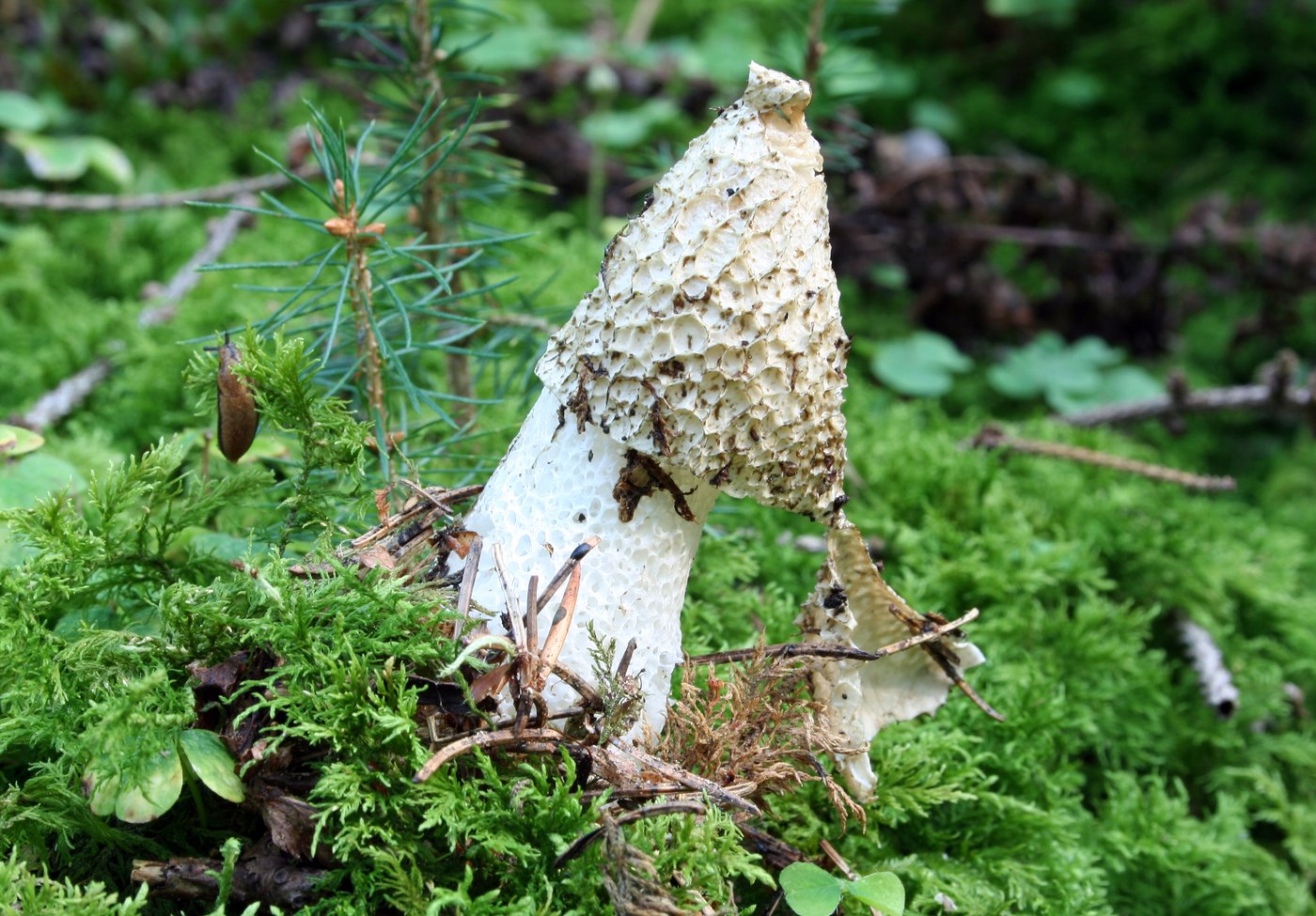
- A white, phallic mushroom capped with stinking green slime, hatched from a buried “egg.”
- Kind
- Fungus
- Constituents
- dimethyl sulfide and methanethiol, polysaccharides
- In other databases
- GBIF search · Wikidata search
Stinkhorn: what was it used for?
The “eggs” were eaten in folk medicine against gout and as a love charm.
Stinkhorn: what does modern science say?
Flies eat the slime and carry off the spores. The egg is edible.
Pharmacognosy & Toxicology
- Constituents
- dimethyl sulfide and methanethiolthe carrion smell of the gleba
- polysaccharidesin the egg
- Mechanism
- The “egg” is edible and mild, and the folk uses for gout and love rest on the shape of the mature fungus; the smell is the chemistry of carrion, which draws the flies that spread the spores. Darwin’s daughter Etty is recorded burning them from the woods for decency.
- Toxic dose
- A food in the egg stage.
- Standing
- A curiosity; eaten pickled in parts of France and Germany.
- Johnson, S. D., and Jürgens, A. (2010). “Convergent evolution of carrion and faecal scent mimicry in fly-pollinated angiosperm flowers and a stinkhorn fungus.” South African Journal of Botany 76. Verified against its record · doi:10.1016/j.sajb.2010.07.012
Constituent names open the compound’s record at PubChem, and “ChEMBL” beside a name opens its record at ChEMBL, the European Bioinformatics Institute’s database of bioactive molecules. Where a mechanism line was checked against ChEMBL (ChEMBL 37, read 1 October 2026), the check is shown with the measured value and its source paper, or says plainly that nothing has been measured. Doses are as the references give them, for description only; this is not medical advice. Each source carries the result of its check against Crossref, PubMed, or the authority’s page: see Verification.
Stinkhorn: what lore surrounds it?
Called witch’s egg or devil’s egg in the egg stage. Gwen Raverat recalls in Period Piece how her aunt Etty, Charles Darwin’s daughter, hunted stinkhorns in the woods and burned them in secret, for the sake of the maids’ morals.
In Their Own Words
Charles McIlvaine describes the young stinkhorn in the egg stage as white or dull green, semi-gelatinous and growing in bunches of up to a dozen, and says it is then very good fried.
“When in the egg-shape it is white or light dull-green, semi-gelatinous, tenacious and elastic. As many as a dozen sometimes grow in a bunch, each from a peculiar white, cord-like root or mycelium. They look, when young, like bubbles of some thick substance. In this condition they are very good when fried.”
Captain Charles McIlvaine, Toadstools, Mushrooms, Fungi, Edible and Poisonous; One Thousand American Fungi, Phallus impudicus, pp. 573–574. Indianapolis: The Bowen-Merrill Company (named in the preface; the scan has no title page), Internet Archive OCR text. The text, read in part
The 1911 Britannica describes Phallus impudicus as growing from a white egg-like body and known at several yards by its disgusting odour, and calls it highly poisonous.
“The fruit-body before it ruptures may reach the size of a hen’s egg and is white in colour; from this there grows out a hollow cylindrical structure which can be distinguished at the distance of several yards by its disgusting odour. It is highly poisonous.”
Encyclopædia Britannica, eleventh edition: Fungi, “Fungi”: the Phalloideae. The 1911 Encyclopædia Britannica, as transcribed on Wikisource. The text, read in part
Each passage is quoted from the text named, which the press fetched and read, and was checked word for word against a fresh copy of it; the link opens that copy. Passages are given as printed, without the editors’ footnote numbers, and with words broken across lines joined.
Sources
- Raverat, G. (1952). Period Piece. Verified against its record · doi:10.3998/mpub.10149
Verification
- Checked
- October 1, 2026
- Passes
- Every sentence read against its sources, in the pass over the remaining 343 entries
- The Standing line checked against the authority it names (EMA, WHO, FDA, CITES, Commission E)
- Every dated or regulatory claim checked by category across the database
- Sources
- 2 cited: 2 verified against its record.
- Corrections
- None were needed.
What was checked, how, and what was found is set out on the Verification page. A checked source is one whose record was found; it does not make the entry medical advice.
Cite This Entry
Version 1 · first published September 25, 2026
- Chicago
“Stinkhorn.” In Materia Medica, edited by B. C. P. Statema. Version 1. The Thinking Press, 2026–. Last modified September 25, 2026. https://thethinkingpress.org/materia-medica/stinkhorn.
- MLA
“Stinkhorn.” Materia Medica, edited by B. C. P. Statema, version 1, The Thinking Press, 25 Sept. 2026, thethinkingpress.org/materia-medica/stinkhorn. Accessed 8 Oct. 2026.
- APA
Stinkhorn. (2026, September 25). In B. C. P. Statema (Ed.), Materia medica (Version 1). The Thinking Press. Retrieved October 8, 2026, from https://thethinkingpress.org/materia-medica/stinkhorn
Club members keep entries on a shelf with private notes, print the plates as cards, and receive an entry by email each week. Create a free account before January 1, 2027 and all of it is yours for good. About the Club
See Also
Sharing polysaccharides
Drawing on the same sources: Johnson
Nearby in the alphabet
The stole (the sign of his sacred office) · St. Zacharias cross (each standing for a Latin invocation against the plague) · Storax calamite (packed in reeds (calami) for export) · St. Walburga’s oil (A clear liquid that gathers on the stone slab over the relics of St) · Sugar (Saccharum officinarum) · St. John’s wort (Hypericum perforatum) · Sulfur (Brimstone) · St. John’s fires (The bonfires lit across Europe on the eve of the Nativity of St)

Historical description, not medical advice.