
Sumac
Smooth sumac, Rhus glabra of Linnaeus; staghorn or velvet sumac, Rhus typhina, Rhus hirta; shumake; Rafinesque’s shimiac; the Ojibwe bakwanak, binding tree; the dried berries sacacomi of the Canada trade; not the poison sumac, Rhus vernix
- Known today as
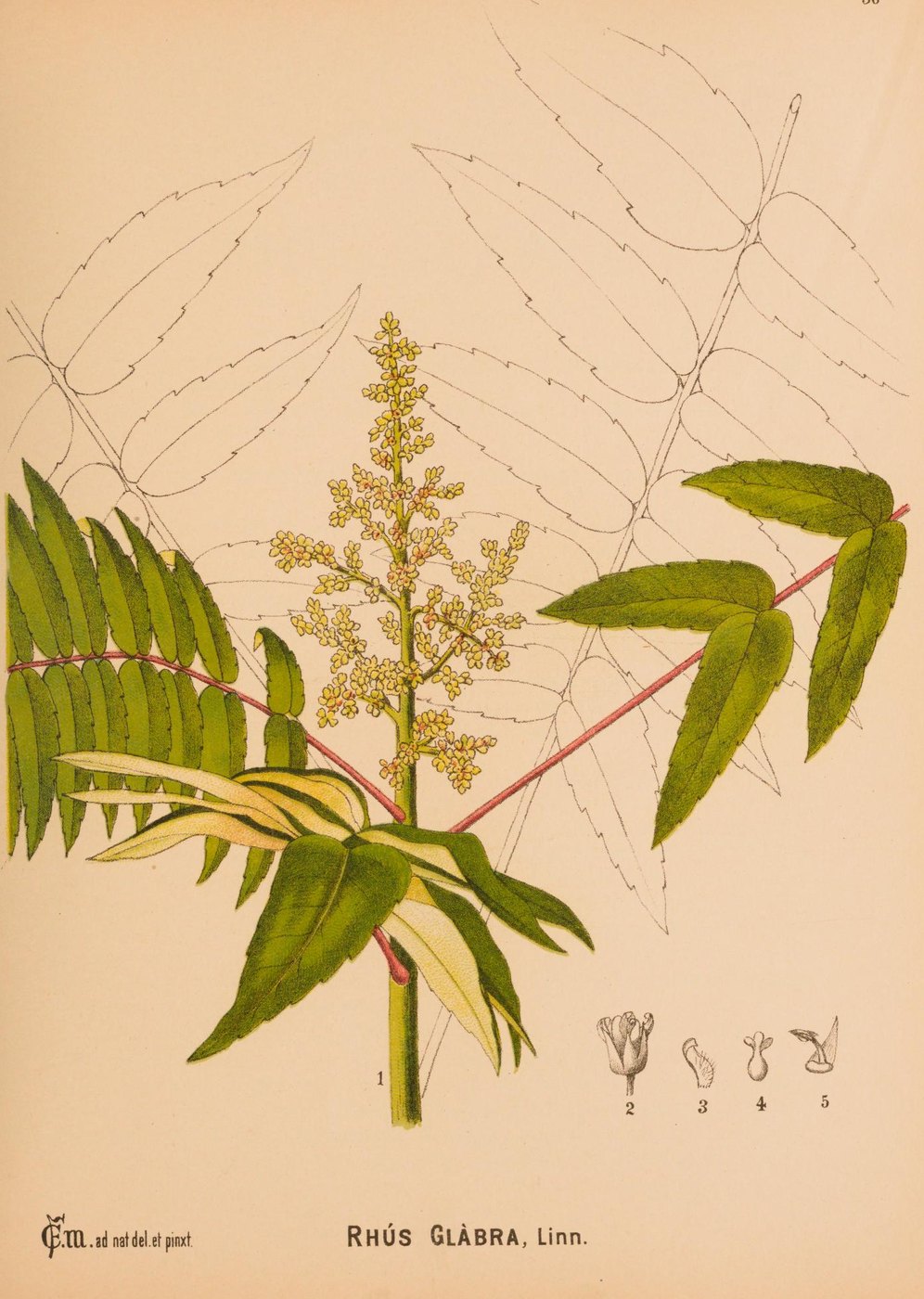
- The red-fruited sumacs of the roadsides and rocky barrens, shrubs of five to fifteen feet with long pinnate leaves on crimson stalks and dense upright cones of small fruits clothed in acid crimson hairs: the smooth sumac common throughout North America, and the staghorn, velvet-twigged, of the north-east and the Lake country. The poisonous sumacs, Grieve says, are told from these by their loose axillary panicles and smooth fruit.
- Kind
- Plant, in 4 older authorities
- Constituents
- malic acid, tannic and gallic acids, 7-O-methyl anthocyanins
- Earliest authority here
- Huron H. Smith
Caution. The red-berried sumacs are harmless; the poison sumac of the swamps, with white smooth fruit in hanging axillary clusters, is a cousin of poison ivy and is told from them by that fruit. Nothing read for this entry describes any harm from the red berries or the tea.
Sumac: what was it used for?
Among the Flambeau Ojibwe, Smith says, all parts of the smooth sumac are medicine: the root-bark tea a hemostatic, the inner bark of trunk and twig an astringent in combinations, the blossoms steeped for sore eyes, the leaves in poultices, and the fruit “a throat cleanser as well as being the basis of a beverage” much like lemonade, the tart berries sweetened with maple sugar and soaked in water, or dried and cooked with maple sugar for a hot drink in winter. The Wisconsin tribes generally, by Smith’s Potawatomi volume, used the staghorn’s root bark to stop bleeding and its leaves for a gargle in sore throat, tonsillitis, and erysipelas. Densmore gives the dried ripe fruit as astringent and refrigerant; Millspaugh a cold infusion of the berries as a cooling drink in fevers, the root bark as a dressing for ulcers and a wash for sore mouths; Rafinesque the berries in dysentery, sore throat, and putrid fevers, and the efflorescence on them, which is malic acid, “used as salt and vinegar.” The leaves tan morocco and dye black; the dried berries were smoked under the names sacacomi and kinnikinnick.
Sumac: foraging it in the Midwest
- Part
- Ripe red berries
- When
- Late summer and autumn, before the rains
Rocky and barren ground and thickets throughout; the berries are gathered before rain has washed the acid down from their hairs, soaked in water with maple sugar for a drink like lemonade, and dried for a hot drink in winter. Only the red hairy fruit in dense upright heads; the poison sumac’s fruit is white, smooth, and hanging.
After Smith; Grieve. All the foragables of the Midwest. Historical record, not a field guide: identify before you gather, and read the whole entry.
Sumac: how is it taken as a tea?
The ripe red berries steeped in cold water and sweetened with maple sugar, a drink like lemonade, by the Flambeau Ojibwe; dried and cooked with maple sugar for a hot drink in winter. Grieve has the infusion of the berries, one to four fluid ounces, and as a gargle.
All the herbal teas of the database. Historical directions, not medical advice.
Sumac: what does modern science say?
The burgundy fruits of the staghorn sumac owe their colour to an unusual set of anthocyanins, 7-O-methylated and galloylated, isolated and named in 2013, two of them pyranoanthocyanins previously unknown. The tannins of its leaves, hydrolysable ones, protected red blood cells in the laboratory against oxidative and hypotonic stress as well as the condensed tannins of grape seed and stiffened their membranes more. Both studies are of chemistry and cells; neither is a trial.
Pharmacognosy & Toxicology
- Constituents
- malic acid ChEMBLthe acid of the crimson hairs on the fruit, the efflorescence Rafinesque’s people used for salt and vinegar
- tannic and gallic acidsin fruit, leaves, and bark, by Densmore; the hydrolysable tannins of the leaves protected red cells against oxidative stress in the laboratory
- 7-O-methyl anthocyaninsthe unusual galloylated pigments of the staghorn’s burgundy fruit, with two pyranoanthocyanins, sumadins A and B, previously unknown
- Mechanism
- Astringency and acidity: the tannins account for the hemostatic, gargle, and tanning uses, the malic acid for the lemonade. In the one cell study the leaf tannins reduced haemolysis and oxidation of glutathione, lipid, and haemoglobin and stiffened the red cell membrane.
- Toxic dose
- An infusion of the berries, by Millspaugh and Grieve, one to four fluid ounces; the fluid extract of bark or berries, one to two drachms, by Grieve.
- Standing
- A drink and a dye with a chemistry worth the chemists’ attention and no trial behind the medicine.
- Kirby, C. W., Wu, T., Tsao, R., & McCallum, J. L. (2013). Isolation and structural characterization of unusual pyranoanthocyanins and related anthocyanins from Staghorn sumac (Rhus typhina L.) via UPLC-ESI-MS, 1H, 13C, and 2D NMR spectroscopy. Phytochemistry 94: 284–293. doi:10.1016/j.phytochem.2013.06.017 Verified against its record · PMID 23850248
- Olchowik, E., et al. (2012). Stabilization of erythrocytes against oxidative and hypotonic stress by tannins isolated from sumac leaves (Rhus typhina L.) and grape seeds (Vitis vinifera L.). Cellular & Molecular Biology Letters 17: 333–348. doi:10.2478/s11658-012-0014-7 Verified against its record · PMID 22491984
The abstract of each source, beneath its citation. For Club members. About the Club or sign in.
Constituent names open the compound’s record at PubChem, and “ChEMBL” beside a name opens its record at ChEMBL, the European Bioinformatics Institute’s database of bioactive molecules. Where a mechanism line was checked against ChEMBL (ChEMBL 37, read 1 October 2026), the check is shown with the measured value and its source paper, or says plainly that nothing has been measured. Doses are as the references give them, for description only; this is not medical advice. Each source carries the result of its check against Crossref, PubMed, or the authority’s page: see Verification.
Sumac: what lore surrounds it?
Rafinesque heard that the Indian flutes were made of the hollow stems, and Smith that the Ojibwe name means the binding tree. The lemonade of the sumac, maple-sweetened, is one of the few native drinks that passed whole into the settlers’ kitchens, and the malic acid that frosts the ripe berries was the salt and vinegar of people who had neither.
Sumac: what did the older authorities say?
- Huron H. Smith
- The Flambeau Ojibwe “gather the berries to make a pleasant beverage much like lemonade. The berries are tart and are sweetened with maple sugar, soaked in water until required for use. They also gather and dry them for winter use.” Staghorn sumac grew about Leech Lake, Minnesota, where the smooth was absent, and the Pillager Ojibwe used it in the same ways and stored the dried seed-heads for winter. With bloodroot, the inner bark and pith gave an orange dye.
- C. S. Rafinesque
- “All the species medical, two series of them. 1. Harmless. 2. Poisonous.” Of the harmless, the roots were used by Indians and dye wool reddish; the leaves, full of tannin, make the Morocco leather; the berries “have an agreeable acid taste, make a cooling drink infused in water. Efflorescence on them used as salt and vinegar: it is malic acid.” Sucacomi, the berries dried in ovens after bread, was an article of trade in Canada, “fine substitute of tobacco, those who use it loath tobacco!”
- Mrs. M. Grieve
- “The berries should be gathered before the rain has removed their downy covering, for they are no longer acid when this has been washed off. They have a sour, astringent, not unpleasant taste, and are eaten freely by the country people.” The non-poisonous sumacs have fruit clothed with acid crimson hairs in dense terminal panicles; the poisonous have axillary panicles and smooth fruit.
- Charles F. Millspaugh
- “One of our least nocuous species,” of rocky or barren soil throughout North America. An infusion of the berries furnishes an unequalled black dye for wool; the Western Indians smoke roots and leaves with tobacco as kinikah. “I have known the juice of the root to remove warts,” he adds, and known them to vanish as readily from a neighbour’s potato rubbed on and thrown over the left shoulder.
Sources
- Smith, H. H. (1932). Ethnobotany of the Ojibwe Indians, Bulletin of the Public Museum of the City of Milwaukee 4(3), “Smooth Sumac” and “Staghorn Sumac,” under medicines, foods, and dyes. Project Gutenberg, 49527. Primary text
- Smith, H. H. (1933). Ethnobotany of the Forest Potawatomi Indians, Bulletin of the Public Museum of the City of Milwaukee 7(1), “Staghorn Sumac.” Internet Archive, ethnobotany-of-the-forest-potawatomi-indians-by-huron-h.-smith-1933. Primary text
- Densmore, F. (1928). Uses of Plants by the Chippewa Indians, Forty-fourth Annual Report of the Bureau of American Ethnology, “Rhus glabra.” Internet Archive, usesofplantsbych00dens. Primary text
- Millspaugh, C. F. (1887). American Medicinal Plants, vol. 1, no. 36, “Rhus glabra,” and Plate 36. Internet Archive, americanmedicina01mill_0. Primary text
- Rafinesque, C. S. (1830). Medical Flora, or Manual of the Medical Botany of the United States of North America, vol. 2, “Rhus,” pp. 256–257. Internet Archive, b21468710_0002. Primary text
- Grieve, M. A Modern Herbal, “Sumachs.” As published on botanical.com. Standard reference work
Verification
- Checked
- October 1, 2026
- Passes
- Every sentence read against its sources, in the pass over the remaining 343 entries
- The Standing line checked against the authority it names (EMA, WHO, FDA, CITES, Commission E)
- Every dated or regulatory claim checked by category across the database
- Sources
- 8 cited: 2 verified against its record, 5 primary text, 1 standard reference work. 2 with the abstract on file.
- Corrections
- None were needed.
What was checked, how, and what was found is set out on the Verification page. A checked source is one whose record was found; it does not make the entry medical advice.
Cite This Entry
Version 1 · first published October 4, 2026
- Chicago
“Sumac.” In Materia Medica, edited by B. C. P. Statema. Version 1. The Thinking Press, 2026–. Last modified October 4, 2026. https://thethinkingpress.org/materia-medica/sumac.
- MLA
“Sumac.” Materia Medica, edited by B. C. P. Statema, version 1, The Thinking Press, 4 Oct. 2026, thethinkingpress.org/materia-medica/sumac. Accessed 8 Oct. 2026.
- APA
Sumac. (2026, October 4). In B. C. P. Statema (Ed.), Materia medica (Version 1). The Thinking Press. Retrieved October 8, 2026, from https://thethinkingpress.org/materia-medica/sumac
Club members keep entries on a shelf with private notes, print the plates as cards, and receive an entry by email each week. Create a free account before January 1, 2027 and all of it is yours for good. About the Club
See Also
Sharing malic acid
Also in M. Grieve
Bloodroot in M. Grieve · Rosemary rice water in M. Grieve · Burdock in M. Grieve · Pokeweed in M. Grieve · everything M. Grieve names →
Drawing on the same sources: Smith, Densmore, Millspaugh, Rafinesque
Nearby in the alphabet
Sweet almond, oil of (Oil pressed from sweet almonds) · Sulfur (Brimstone) · Sweet flag (Acorus calamus) · Sugar (Saccharum officinarum) · Sweet woodruff · Storax calamite (packed in reeds (calami) for export) · Tamarind (The pod pulp of Tamarindus indica) · The stole (the sign of his sacred office)
Historical description, not medical advice.