
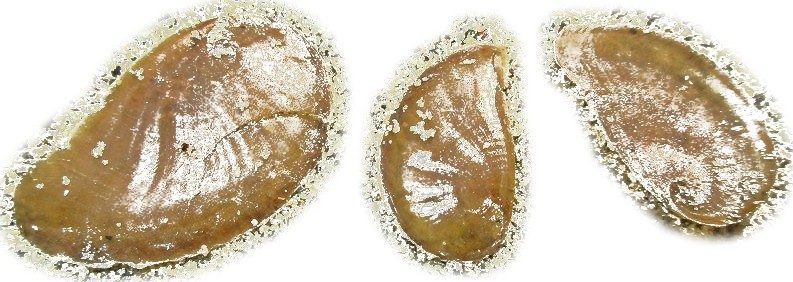
Onycha and stacte
- Known today as
- Ingredients of the Temple incense (Exodus 30:34). Onycha is probably the operculum of a sea snail; stacte, probably liquid myrrh.
- Kind
- Sacramental
- Constituents
- benzoic and cinnamic acids, the operculum of a sea snail, myrrh’s furanosesquiterpenes
- In the Canale glossary
- On the Manner of Discerning and Healing the Bewitched, Appendix A: Treatise Two: Blessed Objects and Materials
Onycha and stacte: what did Canale use it for?
Named in the blessing of the ingredients of the oil, “which together with Onycha you once composed into the sacred incense” (Treatise Two).
Onycha and stacte: what does modern science say?
Their identification is still debated; they appear here through Scripture, not the apothecary.
Pharmacognosy & Toxicology
- Constituents
- benzoic and cinnamic acidsif the onycha was benzoin, as many hold
- the operculum of a sea snailStrombus or Murex, if onycha was the shell
- myrrh’s furanosesquiterpenesstacte is usually taken as the liquid myrrh
- Mechanism
- Two ingredients of the Temple incense (Exodus 30:34) whose identity is disputed: stacte as a flowing myrrh or storax, onycha as a mollusc operculum (which smells of burnt horn and nothing better) or benzoin. Either way the pharmacology is a scented smoke; the mollusc operculum is still an incense ingredient in Yemen and India.
- Toxic dose
- None.
- Standing
- A matter for the philologist; the incense of the Temple is not reconstructed with confidence.
- Abrahams, H. J. (1979). “Onycha, ingredient of the ancient Jewish incense: an attempt at identification.” Economic Botany 33. Verified against its record · doi:10.1007/bf02858295
Constituent names open the compound’s record at PubChem, and “ChEMBL” beside a name opens its record at ChEMBL, the European Bioinformatics Institute’s database of bioactive molecules. Where a mechanism line was checked against ChEMBL (ChEMBL 37, read 1 October 2026), the check is shown with the measured value and its source paper, or says plainly that nothing has been measured. Doses are as the references give them, for description only; this is not medical advice. Each source carries the result of its check against Crossref, PubMed, or the authority’s page: see Verification.
In Their Own Words
The 1911 Britannica identifies the biblical onycha (sheheleth) as the operculum or “nail” of a species of Strombus, known in Europe as Blatta byzantina,; it calls it the celebrated odoriferous shell of the ancients.
“…onycha (Heb. sheḥeleth), the celebrated odoriferous shell of the ancients, the operculum or “nail” of a species of Strombus or “wing shell,” formerly well known in Europe under the name of Blatta byzantina”
Encyclopædia Britannica, eleventh edition: Incense, “Incense”, vol. 14: the aromatics named in the Bible. The 1911 Encyclopædia Britannica, as transcribed on Wikisource. The text, read in full
Pliny says the myrrh tree is cut twice a year, and that before any incision is made it exudes of its own accord a liquid called stacte.
“Incisions are made in the myrrh-tree also twice a year, and at the same season as in the incense-tree; but in the case of the myrrh-tree they are all made the way up from the root as far as the branches which are able to bear it. The tree spontaneously exudes, before the incision is made, a liquid which bears the name of stacte,”
Pliny the Elder; translated by John Bostock, M.D., F.R.S., and H. T. Riley, Esq., B.A., The Natural History of Pliny, Vol. III, Book XII, ch. 35, “The nature and various kinds of myrrh”. London: Henry G. Bohn, York Street, Covent Garden, MDCCCLV (Project Gutenberg eBook #59131). The text, read in part
Each passage is quoted from the text named, which the press fetched and read, and was checked word for word against a fresh copy of it; the link opens that copy. Passages are given as printed, without the editors’ footnote numbers, and with words broken across lines joined.
Sources
- [93] Nongmaithem, B. D., Mouatt, P., Smith, J., Rudd, D., Russell, M., Sullivan, C., & Benkendorff, K. (2017). Volatile and bioactive compounds in opercula from Muricidae molluscs supports their use in ceremonial incense and traditional medicines. Scientific Reports 7: 17404. doi:10.1038/s41598-017-17551-3 Verified against its record · doi:10.1038/s41598-017-17551-3
Verification
- Checked
- October 1, 2026
- Passes
- Every sentence read against its sources, in the pass over the remaining 343 entries
- The Standing line checked against the authority it names (EMA, WHO, FDA, CITES, Commission E)
- Every dated or regulatory claim checked by category across the database
- Sources
- 2 cited: 2 verified against its record. 1 with the abstract on file.
- Corrections
- None were needed.
What was checked, how, and what was found is set out on the Verification page. A checked source is one whose record was found; it does not make the entry medical advice.
Cite This Entry
Version 1 · first published September 25, 2026
- Chicago
“Onycha and stacte.” In Materia Medica, edited by B. C. P. Statema. Version 1. The Thinking Press, 2026–. Last modified September 25, 2026. https://thethinkingpress.org/materia-medica/onycha-and-stacte.
- MLA
“Onycha and stacte.” Materia Medica, edited by B. C. P. Statema, version 1, The Thinking Press, 25 Sept. 2026, thethinkingpress.org/materia-medica/onycha-and-stacte. Accessed 8 Oct. 2026.
- APA
Onycha and stacte. (2026, September 25). In B. C. P. Statema (Ed.), Materia medica (Version 1). The Thinking Press. Retrieved October 8, 2026, from https://thethinkingpress.org/materia-medica/onycha-and-stacte
Club members keep entries on a shelf with private notes, print the plates as cards, and receive an entry by email each week. Create a free account before January 1, 2027 and all of it is yours for good. About the Club
See Also
Sharing benzoic and cinnamic acids
Nearby in the alphabet
Opium poppy (Papaver somniferum) · Onion (Allium cepa) · Opopanax (a Mediterranean plant of the carrot family) · Olive-wood ash lye (Lye made by steeping the ash of olive wood in river water) · Orache (garden orache, a spinach-like plant) · Olive oil and holy water (Fine olive oil) · Oregano and squinanth (Origanum vulgare) · Oil of the sick

Historical description, not medical advice.