
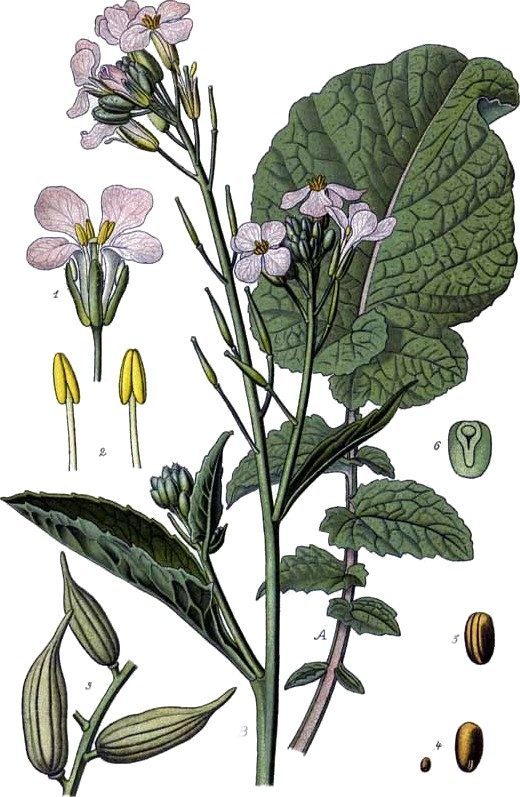
Radish
Rafano
- Known today as
- Garden radish, Raphanus sativus (now classed by Kew as Raphanus raphanistrum subsp. sativus): root, juice, and seed.
- Kind
- Plant, in 1 older authority
- Constituents
- glucoraphasatin, 4-methylthio-3-butenyl isothiocyanate, sulforaphene
- Earliest authority here
- Herodotus (c. 484–c. 425 BC)
- In other databases
- Plants of the World Online search · GBIF search · Wikidata search
- In the Canale glossary
- On the Manner of Discerning and Healing the Bewitched, Appendix A: Part Three, Chapter 5: Vomitory Medicines
Revised October 1, 2026: Lore added from texts read in full. Version 1, first published September 25, 2026.
Radish: what did Canale use it for?
One of the principal milder vomits, in many forms; hellebore roots are also stuck into a radish (ch. 5).
Radish: what does modern science say?
Pliny advises radishes eaten fasting to promote vomiting.
Pharmacognosy & Toxicology
- Constituents
- glucoraphasatina glucosinolate
- 4-methylthio-3-butenyl isothiocyanatethe pungency
- sulforaphene ChEMBL
- Mechanism
- The isothiocyanates irritate the stomach, which is the mild vomit, and stimulate bile flow, the basis of the black radish’s use for the gallbladder; they are antibacterial and induce detoxifying enzymes in cells.
- Toxic dose
- A food; the juice in quantity irritates the gut and the thyroid in the iodine-deficient.
- Standing
- A food; black radish root has a traditional-use listing in France for digestive complaints.
- Gutiérrez, R. M. P., and Perez, R. L. (2004). “Raphanus sativus (radish): their chemistry and biology.” Scientific World Journal 4. Verified against its record · doi:10.1100/tsw.2004.131
The abstract of each source, beneath its citation. For Club members. About the Club or sign in.
Constituent names open the compound’s record at PubChem, and “ChEMBL” beside a name opens its record at ChEMBL, the European Bioinformatics Institute’s database of bioactive molecules. Where a mechanism line was checked against ChEMBL (ChEMBL 37, read 1 October 2026), the check is shown with the measured value and its source paper, or says plainly that nothing has been measured. Doses are as the references give them, for description only; this is not medical advice. Each source carries the result of its check against Crossref, PubMed, or the authority’s page: see Verification.
Radish: what lore surrounds it?
The Germans, Folkard writes, gave a blue-flowered wild radish the name Hederich, “and they have an old superstition that whoever wears a crown composed of Hederich is enabled to detect witches. A wreath of Hederich is sometimes placed on cows before leaving their stalls to be milked, in order to protect them from the effect of the Evil Eye.” In England “to dream of Radishes signifies the discovery of secrets, domestic quarrels, and misfortune,” and the mountain spirit Rübezahl is “the Counter of Radishes,” from the tale of the imprisoned princess who had him count his radishes while she touched one with her wand, “and it became a horse,” and rode away.
Thiselton-Dyer has the radish among the charms against the evil eye, where “the German folk wear the radish,” and notes that “in Germany, too, a species of wild radish is said to reveal witches.”
Grieve: “In the days of the Pharaohs, the Radish was extensively cultivated in Egypt,” and Linnaeus reported that the wild radish, ground with barley in wet Swedish seasons, was “eaten in barley bread, causing violent convulsive complaints, or an epidemic, spasmodic disease.”
Radish: what did the older authorities say?
- Herodotus
- Reports an inscription on the Great Pyramid recording what was spent on radishes, onions, and garlic for the workmen.
Sources
- [98] Pliny the Elder. The Natural History. Trans. J. Bostock and H. T. Riley. London, 1855. Perseus Digital Library, Tufts University. Cited by book and chapter. Primary text
- Folkard, R. (1884). Plant Lore, Legends, and Lyrics, “Radish.” Project Gutenberg #44638. Primary text
- Thiselton-Dyer, T. F. (1889). The Folk-lore of Plants. Project Gutenberg #10118. Read in part · the text read
- Grieve, M. (1931). A Modern Herbal, “Radish.” botanical.com/botanical/mgmh/r/radish01.html Standard reference work
Verification
- Checked
- October 1, 2026
- Passes
- Every sentence read against its sources, in the pass over the remaining 343 entries
- The Standing line checked against the authority it names (EMA, WHO, FDA, CITES, Commission E)
- Every dated or regulatory claim checked by category across the database
- Each quotation from the older authorities checked word for word against the text, read in full
- Sources
- 5 cited: 1 read in part, 1 verified against its record, 2 primary text, 1 standard reference work. 1 with the abstract on file.
- Corrections
- None were needed.
What was checked, how, and what was found is set out on the Verification page. A checked source is one whose record was found; it does not make the entry medical advice.
Cite This Entry
Version 1 · first published September 25, 2026 · last revised October 1, 2026
- Chicago
“Radish.” In Materia Medica, edited by B. C. P. Statema. Version 1. The Thinking Press, 2026–. Last modified October 1, 2026. https://thethinkingpress.org/materia-medica/radish.
- MLA
“Radish.” Materia Medica, edited by B. C. P. Statema, version 1, The Thinking Press, 1 Oct. 2026, thethinkingpress.org/materia-medica/radish. Accessed 8 Oct. 2026.
- APA
Radish. (2026, October 1). In B. C. P. Statema (Ed.), Materia medica (Version 1). The Thinking Press. Retrieved October 8, 2026, from https://thethinkingpress.org/materia-medica/radish
Club members keep entries on a shelf with private notes, print the plates as cards, and receive an entry by email each week. Create a free account before January 1, 2027 and all of it is yours for good. About the Club
See Also
Also in Herodotus
Storax calamite in Herodotus · Onion in Herodotus · Alum in Herodotus · Myrrh in Herodotus · everything Herodotus names →
Drawing on the same sources: Folkard, Thiselton-Dyer, Grieve
Round birthwort · Purslane · Savin · Snail · Snapdragon · Rosemary · Puffball · Rosemary rice water · the bibliography →
Historical description, not medical advice.