
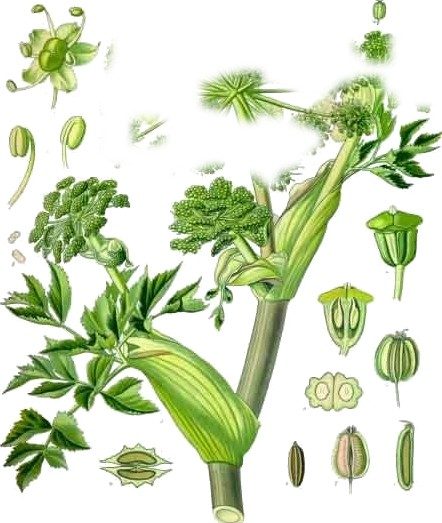
Masterwort and angelica
Imperatoria; angelica
- Known today as
- Peucedanum ostruthium and Angelica archangelica.
- Kind
- Plant, in 1 older authority
- Constituents
- imperatorin, ostruthol, angelicin and xanthotoxin, and 1 more
- Poisoning
- Phytophotodermatitis
- Earliest authority here
- Culpeper (1616–1654)
- In other databases
- Plants of the World Online search · GBIF search · Wikidata search
- In the Canale glossary
- On the Manner of Discerning and Healing the Bewitched, Appendix A: Part Three, Chapter 9: Anointings
Revised October 1, 2026: An older authority added from a text read in full. Lore added from texts read in full. Version 1, first published September 25, 2026.
Masterwort and angelica: what did Canale use it for?
Roots in the oil; among the amulets (chs. 9–10).
Masterwort and angelica: what does modern science say?
Legend says an angel revealed angelica in a dream as a cure for plague. Both roots are used for digestive complaints.
Pharmacognosy & Toxicology
- Constituents
- imperatorin ChEMBLa furanocoumarin, in both
- ostruthol ChEMBLin masterwort
- angelicin and xanthotoxinfuranocoumarins
- beta-phellandrene ChEMBLthe angelica oil
- Mechanism
- Both are Apiaceae roots whose bitters and oil are carminative and whose furanocoumarins photosensitise the skin: a reader who rubs the oil on and goes into the sun blisters. Imperatorin is studied for anticonvulsant and vasodilator actions in rodents.
- Toxic dose
- Safe at tea doses; avoid the sun after handling; the roots can be confused with hemlock water-dropwort.
- Syndrome
- Phytophotodermatitis
- Standing
- Neither has an EMA monograph of its own: angelica root is assessed by the EMA within the bitter tea mixtures (Species amarae) and is approved by the German Commission E for dyspepsia and loss of appetite.
- Blumenthal, M., ed. (1998). The Complete German Commission E Monographs, “Angelica root.” Standard reference work
- Sarkhail, P. (2014). “Traditional uses, phytochemistry and pharmacological properties of the genus Peucedanum.” Journal of Ethnopharmacology 156. Verified against its record · doi:10.1016/j.jep.2014.08.034
The abstract of each source, beneath its citation. For Club members. About the Club or sign in.
Constituent names open the compound’s record at PubChem, and “ChEMBL” beside a name opens its record at ChEMBL, the European Bioinformatics Institute’s database of bioactive molecules. Where a mechanism line was checked against ChEMBL (ChEMBL 37, read 1 October 2026), the check is shown with the measured value and its source paper, or says plainly that nothing has been measured. Doses are as the references give them, for description only; this is not medical advice. Each source carries the result of its check against Crossref, PubMed, or the authority’s page: see Verification.
Masterwort and angelica: what lore surrounds it?
Of angelica Folkard writes that “its old German name of Root of the Holy Ghost is still retained in some northern countries,” that “the Laplanders believe that the use of it strengthens life, and they therefore chew it as they would do Tobacco; they also employ it to crown their poets,” and that Du Bartas called it the “happy counterbane Sent down from heav'n by some celestial scout.” According to Fuchsius its roots “worn suspended round the neck, would guard the wearer against the baneful power of witches and enchantments,” and Gerarde has a piece of the root chewed to “drive away pestilential air.”
Thiselton-Dyer says the angelica “was thought to be specially noisome to witches” and “was in olden times used as an antidote for poisons.”
Grieve writes that in Courland, Livonia and the lakelands of Pomerania and East Prussia the peasants “march into the towns carrying the Angelica flower-stems and to offer them for sale, chanting some ancient ditty in Lettish words, so antiquated as to be unintelligible even to the singers themselves,” which she takes for “a survival of some Pagan festival.” “According to one legend, Angelica was revealed in a dream by an angel to cure the plague”; another says it blooms on the day of Michael the Archangel “and is on that account a preservative against evil spirits and witchcraft,” so that it was called “The Root of the Holy Ghost.” She adds that the Muscatel flavour of some Rhine wines “is (or is suspected to be) due to the secret use of Angelica.”
Masterwort and angelica: what did the older authorities say?
- Culpeper
- Of angelica: an herb of the Sun in Leo, to be gathered when he is there; “In all epidemical diseases caused by Saturn, that is as good a preservative as grows,” resisting poison by comforting the heart, blood, and spirits, the root in powder to half a dram with treacle in carduus water and the patient laid to sweat; the stalks or roots candied and eaten fasting are preservatives in time of infection.
Sources
- [40] ESCOP (2021). Angelicae radix (angelica root). ESCOP Monographs. European Scientific Cooperative on Phytotherapy. escop.com. Verified against its record · doi:10.1007/s11418-020-01438-1
- [54] Grieve, M. (1931). A Modern Herbal. Online edition, botanical.com, cited under the plant concerned. Read in part · the text read
- [127] Zwirchmayr, J., Grienke, U., Hummelbrunner, S., Seigner, J., de Martin, R., Dirsch, V. M., & Rollinger, J. M. (2020). A biochemometric approach for the identification of in vitro anti-inflammatory constituents in masterwort. Biomolecules 10(5): 679. doi:10.3390/biom10050679 Verified against its record · doi:10.3390/biom10050679
- Culpeper, N. (1653). The Complete Herbal, “Angelica.” Project Gutenberg #49513. Primary text
- Folkard, R. (1884). Plant Lore, Legends, and Lyrics, “Angelica.” Project Gutenberg #44638. Primary text
- Thiselton-Dyer, T. F. (1889). The Folk-lore of Plants. Project Gutenberg #10118. Read in part · the text read
- Grieve, M. (1931). A Modern Herbal, “Angelica.” botanical.com/botanical/mgmh/a/anegl037.html Standard reference work
Verification
- Checked
- October 1, 2026
- Passes
- Every sentence read against its sources, in the pass over the remaining 343 entries
- The Standing line checked against the authority it names (EMA, WHO, FDA, CITES, Commission E)
- Every dated or regulatory claim checked by category across the database
- Each quotation from the older authorities checked word for word against the text, read in full
- Sources
- 9 cited: 2 read in part, 3 verified against its record, 2 primary text, 2 standard reference work. 1 with the abstract on file.
- Corrections
- None were needed.
What was checked, how, and what was found is set out on the Verification page. A checked source is one whose record was found; it does not make the entry medical advice.
Cite This Entry
Version 1 · first published September 25, 2026 · last revised October 1, 2026
- Chicago
“Masterwort and angelica.” In Materia Medica, edited by B. C. P. Statema. Version 1. The Thinking Press, 2026–. Last modified October 1, 2026. https://thethinkingpress.org/materia-medica/masterwort-and-angelica.
- MLA
“Masterwort and angelica.” Materia Medica, edited by B. C. P. Statema, version 1, The Thinking Press, 1 Oct. 2026, thethinkingpress.org/materia-medica/masterwort-and-angelica. Accessed 8 Oct. 2026.
- APA
Masterwort and angelica. (2026, October 1). In B. C. P. Statema (Ed.), Materia medica (Version 1). The Thinking Press. Retrieved October 8, 2026, from https://thethinkingpress.org/materia-medica/masterwort-and-angelica
Club members keep entries on a shelf with private notes, print the plates as cards, and receive an entry by email each week. Create a free account before January 1, 2027 and all of it is yours for good. About the Club
See Also
Poisoned alike: phytophotodermatitis
Citron · Lovage · Dittany · Fig · the syndrome, with all of them →
Also in Nicholas Culpeper
Moonwort in Nicholas Culpeper · Madder in Nicholas Culpeper · Motherwort in Nicholas Culpeper · Juniper in Nicholas Culpeper · everything Nicholas Culpeper names →
Drawing on the same sources: Culpeper, Folkard, Thiselton-Dyer, Grieve
Mint, oil of · Mallow and marshmallow · Meadow saffron · Mayapple · Marigold · the bibliography →
Nearby in the alphabet
Mastic · Marking-nut electuary (Semecarpus anacardium (note XLIV)) · Marjoram and jasmine (Origanum majorana) · Meadowsweet · Manna (Fraxinus ornus, of Calabria and Sicily)
Historical description, not medical advice.