
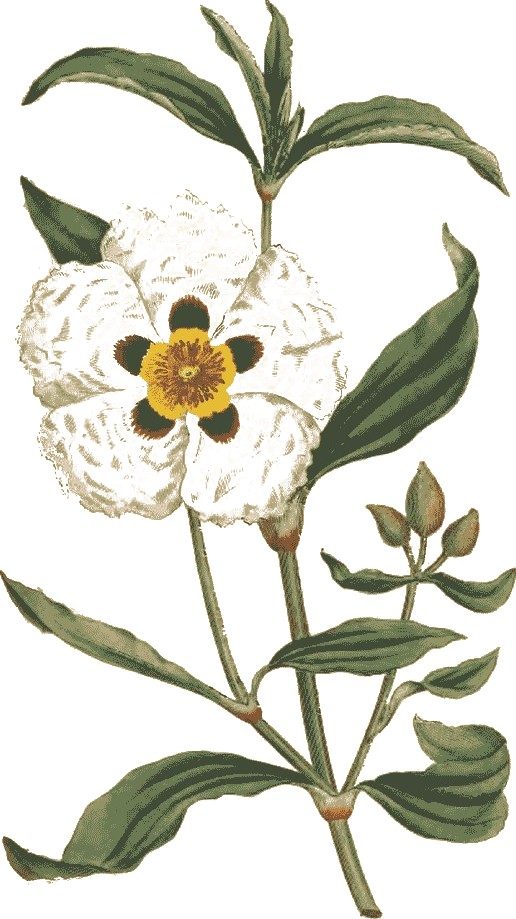
Labdanum
Laudano; ladano
- Known today as
- The resin of the rockrose, Cistus ladanifer and C. creticus.
- Kind
- Resin & Wood, in 1 older authority
- Constituents
- labdanolic acid, ambrox precursors, alpha-pinene and camphene
- Earliest authority here
- Herodotus (c. 484–c. 425 BC)
- In other databases
- Plants of the World Online search · GBIF search · Wikidata search
- In the Canale glossary
- On the Manner of Discerning and Healing the Bewitched, Appendix A: Part Three, Chapters 7–8: The Bath and Fumigations
Revised October 1, 2026: Lore added from texts read in full. Version 1, first published September 25, 2026.
Labdanum: what did Canale use it for?
In the fumigation and the oil (chs. 8–9).
Labdanum: what does modern science say?
A perfume base. Not to be confused with laudanum, the tincture of opium.
Pharmacognosy & Toxicology
- Constituents
- labdanolic acid ChEMBLa labdane diterpene
- ambrox precursorssclareol-like diterpenes, the base of synthetic ambergris
- alpha-pinene and camphene
- Mechanism
- The gum of the rock-rose, combed from goats’ beards in antiquity: an antiseptic resin and a perfume fixative of the amber family, whose diterpenes are the industrial precursors of ambroxide. In the fumigation and the oil it is a scent.
- Toxic dose
- Safe externally.
- Standing
- A perfumery material; Cistus leaf tea has small trials for colds (Kalus, 2009).
- Kalus, U., et al. (2009). “Cistus incanus (CYSTUS052) for treating patients with infection of the upper respiratory tract.” Antiviral Research 84. Verified against its record · doi:10.1016/j.antiviral.2009.10.001
The abstract of each source, beneath its citation. For Club members. About the Club or sign in.
Constituent names open the compound’s record at PubChem, and “ChEMBL” beside a name opens its record at ChEMBL, the European Bioinformatics Institute’s database of bioactive molecules. Where a mechanism line was checked against ChEMBL (ChEMBL 37, read 1 October 2026), the check is shown with the measured value and its source paper, or says plainly that nothing has been measured. Doses are as the references give them, for description only; this is not medical advice. Each source carries the result of its check against Crossref, PubMed, or the authority’s page: see Verification.
Labdanum: what lore surrounds it?
Folkard says the ladanum of the Cretan cistus is “more highly valued as a perfume, and extensively used in oriental countries in fumigations,” gathered “by means of a kind of rake, to which numerous leather thongs are appended instead of teeth.” “In olden times this resin was believed to have been gathered from the shrubs by goats who rubbed their beards against the leaves,” which Gerarde called a fable of the “Greekish monkes,” but Bacon kept: “There are some teares of trees, which are kembed from the beards of goats; for when the goats bite and crop them, especially in the morning, the dew being on, the teare cometh forth, and hangeth upon their beards: of this sort is some kinde of Ladanum.”
Labdanum: what did the older authorities say?
- Herodotus
- Says that labdanum was combed from the beards of goats that had browsed among the rockrose bushes.
Sources
- [38] Encyclopaedia Britannica, online edition, britannica.com. Articles: Ambergris; Aristolochiaceae; Asafetida; Azurite; Castor-oil plant; Civet; Dragon’s blood; Garden cress; Jet; Kermes; Laudanum; Lye; Monemvasía; Musk; Precious coral; Saltpetre; Sulfur dioxide; Tartar emetic; Tropaeolum. Book, seen in reviews
- [47] Frazão, D. F., et al. (2022). Labdanum resin from Cistus ladanifer L.: a natural and sustainable ingredient for skin care cosmetics with relevant cosmeceutical bioactivities. Plants 11(11): 1477. doi:10.3390/plants11111477 Verified against its record · doi:10.3390/plants11111477
- Folkard, R. (1884). Plant Lore, Legends, and Lyrics, “Cistus.” Project Gutenberg #44638. Primary text
Verification
- Checked
- October 1, 2026
- Passes
- Every sentence read against its sources, in the pass over the remaining 343 entries
- The Standing line checked against the authority it names (EMA, WHO, FDA, CITES, Commission E)
- Every dated or regulatory claim checked by category across the database
- Each quotation from the older authorities checked word for word against the text, read in full
- Sources
- 4 cited: 2 verified against its record, 1 primary text, 1 book, seen in reviews. 1 with the abstract on file.
- Corrections
- None were needed.
What was checked, how, and what was found is set out on the Verification page. A checked source is one whose record was found; it does not make the entry medical advice.
Cite This Entry
Version 1 · first published September 25, 2026 · last revised October 1, 2026
- Chicago
“Labdanum.” In Materia Medica, edited by B. C. P. Statema. Version 1. The Thinking Press, 2026–. Last modified October 1, 2026. https://thethinkingpress.org/materia-medica/labdanum.
- MLA
“Labdanum.” Materia Medica, edited by B. C. P. Statema, version 1, The Thinking Press, 1 Oct. 2026, thethinkingpress.org/materia-medica/labdanum. Accessed 8 Oct. 2026.
- APA
Labdanum. (2026, October 1). In B. C. P. Statema (Ed.), Materia medica (Version 1). The Thinking Press. Retrieved October 8, 2026, from https://thethinkingpress.org/materia-medica/labdanum
Club members keep entries on a shelf with private notes, print the plates as cards, and receive an entry by email each week. Create a free account before January 1, 2027 and all of it is yours for good. About the Club
See Also
Also in Herodotus
Myrrh in Herodotus · Hemp in Herodotus · Onion in Herodotus · Garlic in Herodotus · everything Herodotus names →
Drawing on the same sources: Folkard
Lesser bean-trefoil · Gum arabic · Mallow and marshmallow · the bibliography →
Nearby in the alphabet
Lady’s mantle · Koji mould (The mould grown on steamed rice or soybeans) · Lapis lazuli, pills of · Kermes (which yield a red dye used since antiquity) · Laudanum (with saffron, cinnamon, and cloves) · Juniper (The berries and wood of Juniperus communis) · Laurel (Laurus nobilis) · Juneberry
Historical description, not medical advice.