
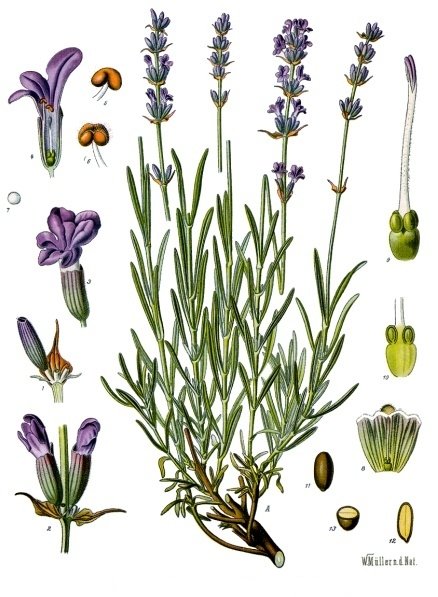
Lavender
Lavandula; Greek stoichas
- Known today as
- Lavandula angustifolia and French lavender, L. stoechas.
- Kind
- Plant, in 1 older authority
- Constituents
- linalool, linalyl acetate
- Earliest authority here
- Dioscorides (c. AD 40–90)
- Qualities
- Hot and dry (Galenic tradition). What the degrees mean
- In other databases
- Plants of the World Online search · GBIF search · Wikidata search
Lavender: what was it used for?
A “cephalic,” warming and drying the brain: for giddiness, palsy, and the falling sickness; its distilled water and oil perfumed linen and the sickroom.
Lavender: how is it taken as a tea?
A tea of the tops in moderate strength for the headache of fatigue and exhaustion; taken too freely it gripes, and the oil in large doses is a narcotic poison.
All the herbal teas of the database. Historical directions, not medical advice.
Lavender: what does modern science say?
Its oil, rich in linalool, calms mildly; capsules of lavender oil have performed modestly against anxiety in controlled trials.
Pharmacognosy & Toxicology
- Constituents
- Mechanism
- Linalool reduces the release of glutamate and acts on voltage-gated calcium channels; an oral preparation of the oil, Silexan, has reduced anxiety in several controlled trials, in one as well as lorazepam.
- Checked against ChEMBL
- linalool: No measurement in ChEMBL for “acts on voltage-gated calcium channels” (144 activities recorded, none against the target named); the line rests on its references.
- Toxic dose
- No serious harm; the oil on the skin of boys was linked to breast growth in a few reported cases.
- Standing
- Silexan is licensed in Germany for restlessness and anxious mood.
- Woelk, H., and Schläfke, S. (2010). “A multi-center, double-blind, randomised study of the lavender oil preparation Silexan in comparison to lorazepam for generalized anxiety disorder.” Phytomedicine 17. Verified against its record · doi:10.1016/j.phymed.2009.10.006
- Kasper, S., et al. (2010). “Silexan, an orally administered Lavandula oil preparation, is effective in the treatment of subsyndromal anxiety disorder.” International Clinical Psychopharmacology 25. Verified against its record · doi:10.1097/yic.0b013e32833b3242
The abstract of each source, beneath its citation. For Club members. About the Club or sign in.
Constituent names open the compound’s record at PubChem, and “ChEMBL” beside a name opens its record at ChEMBL, the European Bioinformatics Institute’s database of bioactive molecules. Where a mechanism line was checked against ChEMBL (ChEMBL 37, read 1 October 2026), the check is shown with the measured value and its source paper, or says plainly that nothing has been measured. Doses are as the references give them, for description only; this is not medical advice. Each source carries the result of its check against Crossref, PubMed, or the authority’s page: see Verification.
Lavender: what lore surrounds it?
Its name is traditionally linked to the Latin lavare, to wash, for its long use in the bath and the laundry.
Used in These Compounds
Lavender is an ingredient of 1 compound medicine in the database. For Club members. Create a free account or sign in.
Lavender: what did the older authorities say?
- Dioscorides
- Names stoichas after the Stoechades, the islands off the coast of Gaul where it grew, and gives it for the chest.
Sources
- Dioscorides, De materia medica. Read in part · the text read
- Gerard, J. (1597). The Herball. Verified against its record · doi:10.5962/bhl.title.99400
- Grieve, M. A Modern Herbal, “Lavenders.” As published on botanical.com.
Verification
- Checked
- October 1, 2026
- Passes
- Every sentence read against its sources, in the pass over the remaining 343 entries
- The Standing line checked against the authority it names (EMA, WHO, FDA, CITES, Commission E)
- Every dated or regulatory claim checked by category across the database
- The mechanism read against ChEMBL (ChEMBL 37): curated mechanisms and measured activity
- Sources
- 5 cited: 1 read in part, 3 verified against its record, 1 not yet checked. 2 with the abstract on file.
- Corrections
- None were needed.
What was checked, how, and what was found is set out on the Verification page. A checked source is one whose record was found; it does not make the entry medical advice.
Cite This Entry
Version 1 · first published September 25, 2026
- Chicago
“Lavender.” In Materia Medica, edited by B. C. P. Statema. Version 1. The Thinking Press, 2026–. Last modified September 25, 2026. https://thethinkingpress.org/materia-medica/lavender.
- MLA
“Lavender.” Materia Medica, edited by B. C. P. Statema, version 1, The Thinking Press, 25 Sept. 2026, thethinkingpress.org/materia-medica/lavender. Accessed 8 Oct. 2026.
- APA
Lavender. (2026, September 25). In B. C. P. Statema (Ed.), Materia medica (Version 1). The Thinking Press. Retrieved October 8, 2026, from https://thethinkingpress.org/materia-medica/lavender
Club members keep entries on a shelf with private notes, print the plates as cards, and receive an entry by email each week. Create a free account before January 1, 2027 and all of it is yours for good. About the Club
See Also
Sharing linalool, linalyl acetate
Also in Dioscorides
Licorice in Dioscorides · Iva in Dioscorides · Mandrake in Dioscorides · Isinglass in Dioscorides · everything Dioscorides names →
Drawing on the same sources: Dioscorides, Gerard, Grieve
Litharge · Juniper · Madonna lily · Marigold · Horehound · Meadowsweet · Lovage · Lady’s mantle · the bibliography →
Of the same qualities: hot and dry
Long pepper · Myrrh · Hyssop · Onion · Honey · what the degrees mean →
Nearby in the alphabet
Leech (Hirudo medicinalis) · Laurel (Laurus nobilis) · Lenitive electuary · Laudanum (with saffron, cinnamon, and cloves) · Lesser bean-trefoil (Anagyris foetida, a Mediterranean shrub) · Lapis lazuli, pills of · Letters from Heaven

Historical description, not medical advice.