
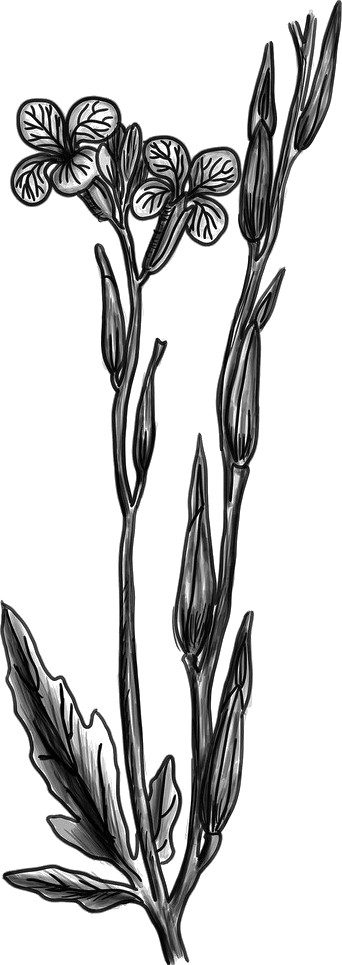
Rocket
Rucola
- Known today as
- Eruca vesicaria, salad rocket.
- Kind
- Plant, in 2 older authorities
- Constituents
- glucoerucin, erucin, erucic acid
- Earliest authority quoted here
- Pliny (AD 23/24–79)
- In other databases
- Plants of the World Online · GBIF · Wikidata
- In the Canale glossary
- On the Manner of Discerning and Healing the Bewitched, Appendix A: Part Three, Chapter 5: Vomitory Medicines
Revised October 17, 2026: Tradition, lore, modern assessment, and sources extended. Checked against its sources, each read in full, in part, or in its abstract. Version 1, first published September 25, 2026.
Rocket: what did Canale use it for?
Its seed among the milder vomits (ch. 5).
Rocket: what does modern science say?
Rocket species hold very high concentrations of glucosinolates and flavonols (Bell and Wagstaff, 2014).
The toxic dose and the poisoning
- Toxic dose
- A food; the seed oil is high in erucic acid, which the European Union limits in food oils.
The references for these lines are listed under Pharmacognosy, in Science. Doses are as the references give them, for description only; this is not medical advice. In a poisoning, call a poison centre.
Rocket: what did the older authorities say?
- Dioscoridesc. AD 40–90
- Says the seed and the leaf of euzomon provoke lust and urine, and that it is eaten raw with lettuce to temper its heat.
- PlinyAD 23/24–79
- Rocket “is a great provocative of lust,” and so the Romans mixed it with lettuce in their dishes, “the excess of cold in the one being compensated by the equal degree of heat in the other.” Its seed is a remedy for the venom of the scorpion, and taken in wine before a flogging it was said to “impart a certain degree of insensibility to the body.”
Pharmacognosy
- Constituents
- glucoerucina glucosinolate
- erucin ChEMBLits isothiocyanate
- erucic acid ChEMBLin the seed oil
- Mechanism
- A mustard-oil salad: the isothiocyanates are the pungency and irritate the stomach in seed doses, Canale’s mild vomit; the aphrodisiac reputation from Roman times has no pharmacology. Erucin is studied for the same enzyme-inducing action as broccoli’s sulforaphane.
- Standing
- A salad; the seed oil (taramira) is used in South Asia.
- Bell, L., and Wagstaff, C. (2014). “Glucosinolates, myrosinase hydrolysis products, and flavonols found in rocket.” Journal of Agricultural and Food Chemistry 62. Abstract read · the text read
The abstract of each source, beneath its citation. For Club members. About the Club or sign in.
Constituent names open the compound’s record at PubChem, and “ChEMBL” beside a name opens its record at ChEMBL, the European Bioinformatics Institute’s database of bioactive molecules. Where a mechanism line was checked against ChEMBL (ChEMBL 37, read 1 October 2026), the check is shown with the measured value and its source paper, or says plainly that nothing has been measured. Doses are as the references give them, for description only; this is not medical advice. Each source carries the result of its check against Crossref, PubMed, or the authority’s page: see Verification.
What Medicine Makes of It
- Binding, Ligature, and ImpotenceThe knotted cord, and psychogenic impotence.
Sources
- Dioscorides, De materia medica II. Read in part · the text read
- Pliny, Natural History XIX–XX. Read in part · the text read
- rocket
Verification
- Checked
- October 1, 2026, October 17, 2026
- Passes
- Read against its sources in the pass over the remaining 343 entries
- Every dated or regulatory claim checked by category across the database
- Every source read, in full, in part, or in its abstract, and every sentence checked against what was read (October 17, 2026)
- Sources
- 4 cited: 2 read in part, 1 abstract read, 1 not yet checked. 1 with the abstract on file.
- Corrections
- None recorded.
What was checked, how, and what was found is set out on the Verification page. A checked source is one whose record was found; it does not make the entry medical advice.
Club members can point at a technical term in this entry, such as a constituent, an action, or a word of Jung’s, to read its definition from the source. The Club.
Cite This Entry
Version 1 · first published September 25, 2026 · last revised October 17, 2026
- Chicago
“Rocket.” In Materia Medica, edited by B. C. P. Statema. Version 1. The Thinking Press, 2026–. Last modified October 17, 2026. https://thethinkingpress.org/materia-medica/rocket.
- MLA
“Rocket.” Materia Medica, edited by B. C. P. Statema, version 1, The Thinking Press, 17 Oct. 2026, thethinkingpress.org/materia-medica/rocket. Accessed 22 Nov. 2026.
- APA
Rocket. (2026, October 17). In B. C. P. Statema (Ed.), Materia medica (Version 1). The Thinking Press. Retrieved November 22, 2026, from https://thethinkingpress.org/materia-medica/rocket
See Also
Also in Dioscorides
Rose in Dioscorides · Rhubarb in Dioscorides · Rosemary in Dioscorides · Rhodiola in Dioscorides · everything Dioscorides names →
Also in Pliny the Elder
Rosemary rice water in Pliny the Elder · Ragwort in Pliny the Elder · Rowan in Pliny the Elder · Primrose in Pliny the Elder · everything Pliny the Elder names →
Drawing on the same sources: Dioscorides, Pliny
Saffron · Purslane · Scammony · Silphium · Quicksilver · Thyme · the bibliography →
Nearby in the alphabet
Roman chamomile · The Roman Ritual (issued by Pope Paul V in 1614, the year of Canale’s treatise) · Roquefort mould (The blue mould of blue cheeses) · Rest-harrow · Rosary (Strings of prayer beads) · Reishi (red to pinkish-brown when mature, found in oak woods)
Historical description, not medical advice.
