
Juneberry
Serviceberry, shadbush, Saskatoon; Amelanchier canadensis of Medicus, Mespilus canadensis of Linnaeus, Pyrus Botryapium, Aronia Botryapium; Amelanchier laevis, Amelanchier alnifolia; the Ojibwe gozîgagô’mînûn, thorny berry; the Potawatomi bosîkwa’komînûn
- Known today as
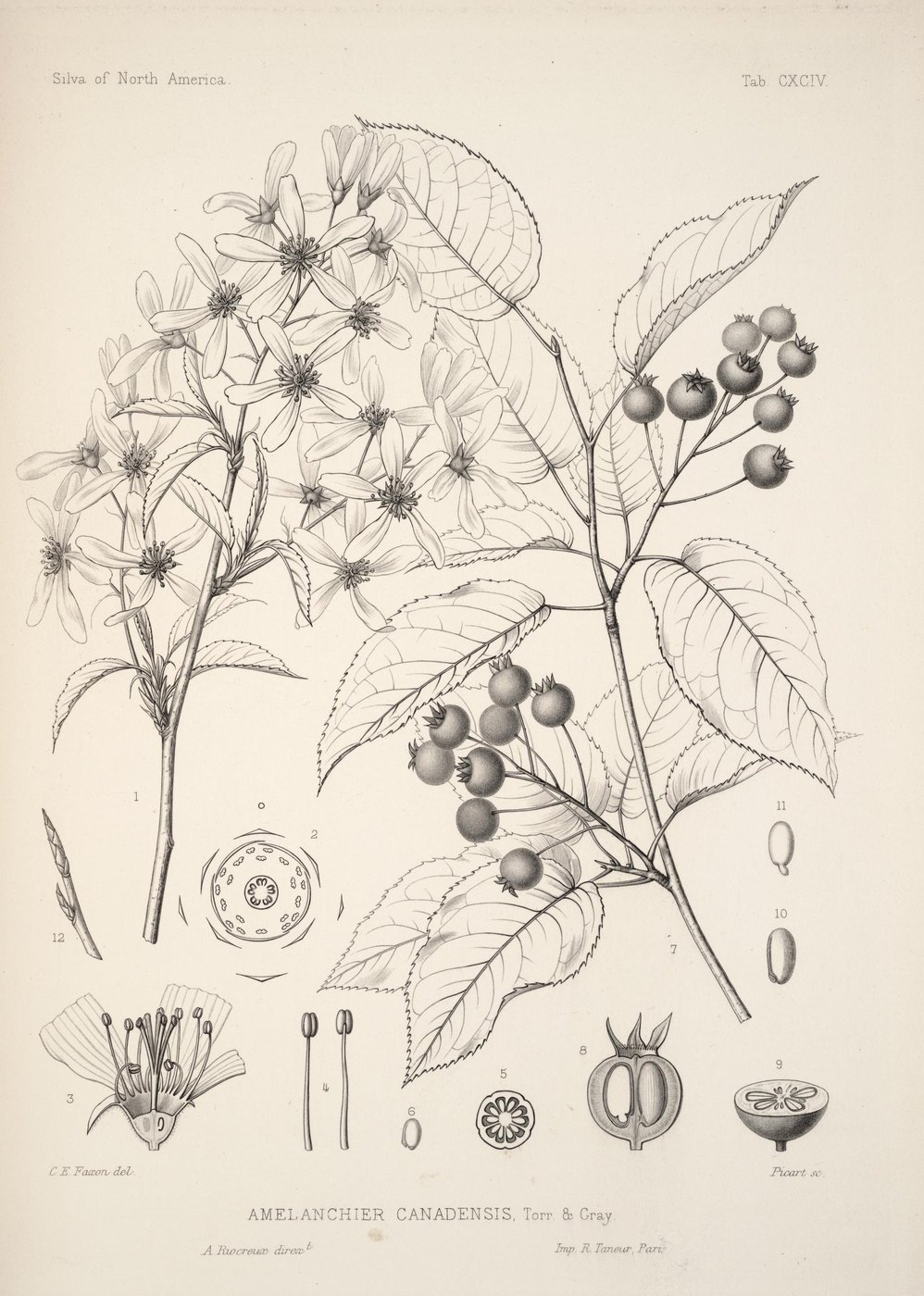
- The shadbushes of the rich upland woods, small trees or tall shrubs that open their white strap-petalled flowers in loose racemes as the leaves unfold, from the end of March in the South to the end of May in the North, and ripen in early summer a sweet edible fruit, red at first and dark purple with a bloom when ripe. Amelanchier canadensis ranges from Newfoundland to Florida and west to Minnesota, Nebraska, and Kansas, growing with the oaks, hickories, sugar maples, and birches.
- Kind
- Plant, in 3 older authorities
- Constituents
- anthocyanins, carotenoids
- Earliest authority here
- Frances Densmore
- In other databases
- Plants of the World Online search · GBIF search · Wikidata search
Caution. A food. Nothing read for this entry describes harm from the fruit.
Juneberry: what was it used for?
Food first. The Chippewa, Densmore says, called them Juneberries, found them abundantly in their country, and “considered them the simplest form of refreshment”; the Flambeau and Pillager Ojibwe dried them for winter, “the Indians often preferring them to blueberries,” and the Forest Potawatomi relished them fresh and dried or canned them. The bark was medicine: the Pillager Ojibwe made a tea of it for the expectant mother, and the Forest Potawatomi a tonic of the root bark; Smith could find no record of any medicinal use by white men. Sargent knew the fruit as sweet and edible and the hard satiny wood as the handle of tools.
Juneberry: foraging it in the Midwest
- Part
- Fruit
- When
- June and early summer
Upland woods with the oaks and maples, and the swamp form on stream banks; the Chippewa found them abundant, took them on journeys, and dried them for winter, often preferring them to blueberries. “Take some Juneberries with you.”
After Densmore; Smith. All the foragables of the Midwest. Historical record, not a field guide: identify before you gather, and read the whole entry.
Juneberry: what does modern science say?
The Saskatoon berry, the western species, has been examined as a crop: forty-eight bioactive compounds in four genotypes grown in Poland, among them four anthocyanins, nine phenolic acids, flavonols, flavan-3-ols, carotenoids, and tocopherols, with the antioxidant capacity varying by clone. In a 2008 study of four berries of the traditional Native American diet, including this one and the chokecherry, the carotenoids were potent inhibitors of aldose reductase, the enzyme of diabetic microvascular damage, and the phenolics lowered glucose and the expression of inflammatory genes in the laboratory assays.
Pharmacognosy & Toxicology
- Constituents
- anthocyaninsfour in the Saskatoon berry, with nine phenolic acids, nine flavonols, and seven flavan-3-ols
- carotenoidsseven, with tocopherols; the carotenoids of the Native diet berries inhibited aldose reductase
- Mechanism
- In laboratory assays the nonpolar fraction of these berries inhibited aldose reductase, the enzyme of diabetic microvascular damage, and the phenolics lowered glucose and the expression of IL-1β and COX-2.
- Toxic dose
- A fruit, fresh or dried; a tea of the bark for the expectant mother, by the Pillager Ojibwe.
- Standing
- A fruit of the Native diet with a rich phytochemistry and no trial.
- Lachowicz, S., Oszmiański, J., & Pluta, S. (2017). The composition of bioactive compounds and antioxidant activity of Saskatoon berry (Amelanchier alnifolia Nutt.) genotypes grown in central Poland. Food Chemistry 235: 234–243. doi:10.1016/j.foodchem.2017.05.050 Verified against its record · PMID 28554632
- Burns Kraft, T. F., et al. (2008). Phytochemical composition and metabolic performance-enhancing activity of dietary berries traditionally used by Native North Americans. Journal of Agricultural and Food Chemistry 56: 654–660. doi:10.1021/jf071999d Verified against its record · PMID 18211018
The abstract of each source, beneath its citation. For Club members. About the Club or sign in.
Constituent names open the compound’s record at PubChem, and “ChEMBL” beside a name opens its record at ChEMBL, the European Bioinformatics Institute’s database of bioactive molecules. Where a mechanism line was checked against ChEMBL (ChEMBL 37, read 1 October 2026), the check is shown with the measured value and its source paper, or says plainly that nothing has been measured. Doses are as the references give them, for description only; this is not medical advice. Each source carries the result of its check against Crossref, PubMed, or the authority’s page: see Verification.
Juneberry: what lore surrounds it?
The shad bush flowers when the shad run and the Juneberry ripens in June; the service berry, by one account or another, bloomed when the ground thawed enough for burials and the services could be held, though no source read for this entry says so, and the name is left to the reader. What Densmore heard was a proverb and a song: take some Juneberries with you.
Juneberry: what did the older authorities say?
- Frances Densmore
- “These are called ‘Juneberries’ by the Chippewa and are found abundantly in their country. They are considered the simplest form of refreshment. ‘Take some Juneberries with you,’ is a common saying among the Chippewa. A certain song contains the words ‘Juneberries I would take to eat on my journey if I were a son-in-law.’”
- Huron H. Smith
- The Flambeau Ojibwe knew the smooth Juneberry only as a food, “although some tribes use the bark as a medicine. Juneberries were also dried for winter use, the Indians often preferring them to blueberries.” The Pillager Ojibwe said the bark was to make a tea for the expectant mother, and the Forest Potawatomi used the root bark for a tonic. “There is no record of its medicinal use by white men.”
- Charles Sprague Sargent
- A tree sometimes forty to fifty feet high; the flowers “appear from the end of March at the south to the end of May at the north when the leaves are grown to nearly one third of their size”; the fruit, which ripens in early summer, is sweet and edible, dark purple with a slight glaucous bloom. The wood is heavy, exceedingly hard, and satiny, occasionally used for the handles of tools; and American pomologists had lately paid some attention to the cultivation and improvement of the juicier swamp form.
Sources
- Densmore, F. (1928). Uses of Plants by the Chippewa Indians, Forty-fourth Annual Report of the Bureau of American Ethnology, “Amelanchier canadensis. Shadbush,” under foods. Internet Archive, usesofplantsbych00dens. Primary text
- Smith, H. H. (1932). Ethnobotany of the Ojibwe Indians, Bulletin of the Public Museum of the City of Milwaukee 4(3), “Smooth Juneberry,” under medicines and foods. Project Gutenberg, 49527. Primary text
- Smith, H. H. (1933). Ethnobotany of the Forest Potawatomi Indians, Bulletin of the Public Museum of the City of Milwaukee 7(1), “Juneberry.” Internet Archive, ethnobotany-of-the-forest-potawatomi-indians-by-huron-h.-smith-1933. Primary text
- Sargent, C. S. (1892). The Silva of North America, vol. 4, “Amelanchier Canadensis. Shad Bush. Service Berry,” pp. 125–129 and Plates CXCIII–CXCV. Internet Archive, mobot31753000329240. Primary text
Verification
- Checked
- October 1, 2026
- Passes
- Every sentence read against its sources, in the pass over the remaining 343 entries
- The Standing line checked against the authority it names (EMA, WHO, FDA, CITES, Commission E)
- Every dated or regulatory claim checked by category across the database
- Sources
- 6 cited: 2 verified against its record, 4 primary text. 2 with the abstract on file.
- Corrections
- None were needed.
What was checked, how, and what was found is set out on the Verification page. A checked source is one whose record was found; it does not make the entry medical advice.
Cite This Entry
Version 1 · first published October 4, 2026
- Chicago
“Juneberry.” In Materia Medica, edited by B. C. P. Statema. Version 1. The Thinking Press, 2026–. Last modified October 4, 2026. https://thethinkingpress.org/materia-medica/juneberry.
- MLA
“Juneberry.” Materia Medica, edited by B. C. P. Statema, version 1, The Thinking Press, 4 Oct. 2026, thethinkingpress.org/materia-medica/juneberry. Accessed 8 Oct. 2026.
- APA
Juneberry. (2026, October 4). In B. C. P. Statema (Ed.), Materia medica (Version 1). The Thinking Press. Retrieved October 8, 2026, from https://thethinkingpress.org/materia-medica/juneberry
Club members keep entries on a shelf with private notes, print the plates as cards, and receive an entry by email each week. Create a free account before January 1, 2027 and all of it is yours for good. About the Club
See Also
Sharing anthocyanins, carotenoids
Malva sylvestris · Sambucus nigra · Rosa gallica · Cantharellus cibarius
Drawing on the same sources: Densmore, Smith, Sargent
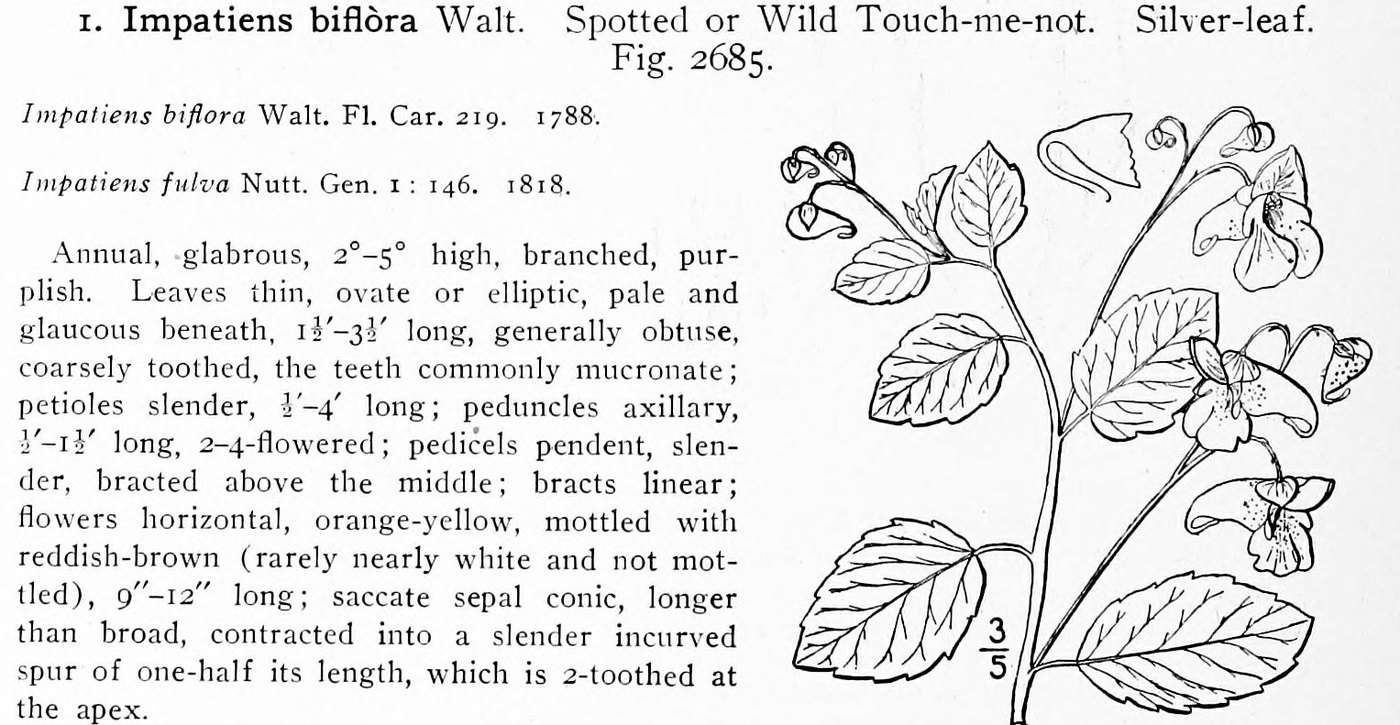
Milkweed · Cattail · Ramps · Jewelweed · Black walnut · Chokecherry · the bibliography →
Nearby in the alphabet
Juniper (The berries and wood of Juniperus communis) · Kermes (which yield a red dye used since antiquity) · Jet, oil of (a dense variety of lignite) · Koji mould (The mould grown on steamed rice or soybeans) · Jelly ear (rubbery, ear-shaped fungus, chiefly on elder) · Labdanum (Cistus ladanifer and C) · James’s powder (secret in its making)
Historical description, not medical advice.