
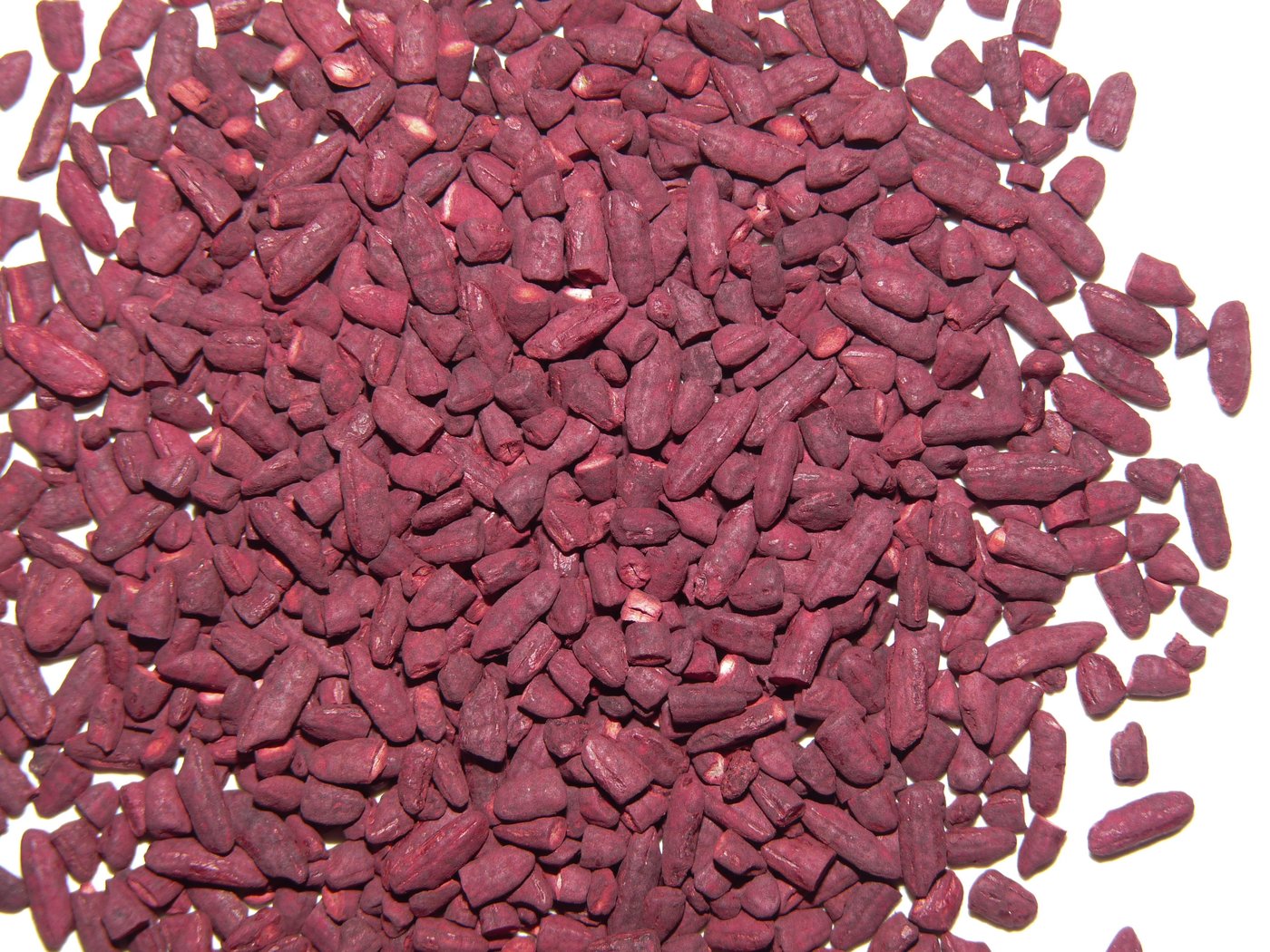
Red yeast rice
Monascus purpureus; Chinese hong qu
- Known today as
- Rice fermented with a red mould.
- Kind
- Fungus
- Constituents
- monacolin K, citrinin
- In other databases
- GBIF search · Wikidata search
Revised October 17, 2026: Checked against its sources, each read in full, in part, or in its abstract. Version 1, first published September 25, 2026.
Caution. Acts as a statin; not to be combined with statin drugs.
Red yeast rice: what was it used for?
A food coloring, wine starter, and medicine in China for the blood and digestion.
Red yeast rice: what does modern science say?
It contains monacolin K, the same molecule as the drug lovastatin (isolated by Merck from the mould Aspergillus terreus in the same month of 1979 in which Endo found monacolin K), and lowers cholesterol; supplements vary in strength and can contain citrinin, a mycotoxin toxic to the kidneys of animals.
The toxic dose and the poisoning
- Toxic dose
- Supplements vary a hundredfold in monacolin K, and carry the muscle and liver effects of a statin unlabelled.
The references for these lines are listed under Pharmacognosy, in Science. Doses are as the references give them, for description only; this is not medical advice. In a poisoning, call a poison centre.
Red yeast rice: what lore surrounds it?
Listed in Li Shizhen’s Compendium of Materia Medica (1578).
Pharmacognosy
- Constituents
- monacolin K ChEMBLidentical to the drug lovastatin
- citrinin ChEMBLa mycotoxin, nephrotoxic in animals, found in a third of the products tested
- Mechanism
- Monacolin K inhibits HMG-CoA reductase, the enzyme of cholesterol synthesis: it is lovastatin, which Endo isolated from Monascus ruber in February 1979, and which he showed lowered the plasma cholesterol of rats and rabbits.
- Checked against ChEMBL
- monacolin K: ChEMBL’s curated mechanism: inhibitor 3-hydroxy-3-methylglutaryl-coenzyme A reductase.
- Standing
- The US Food and Drug Administration counts products with more than trace amounts of monacolin K as unapproved new drugs; the European Union limits them to under 3 mg a day since 2022.
- Endo, A. (1979). “Monacolin K, a new hypocholesterolemic agent produced by a Monascus species.” Journal of Antibiotics 32. Read in full · the text read
- Gordon, R. Y., et al. (2010). “Marked variability of monacolin levels in commercial red yeast rice products.” Archives of Internal Medicine 170. Abstract read · the text read
The abstract of each source, beneath its citation. For Club members. About the Club or sign in.
Constituent names open the compound’s record at PubChem, and “ChEMBL” beside a name opens its record at ChEMBL, the European Bioinformatics Institute’s database of bioactive molecules. Where a mechanism line was checked against ChEMBL (ChEMBL 37, read 1 October 2026), the check is shown with the measured value and its source paper, or says plainly that nothing has been measured. Doses are as the references give them, for description only; this is not medical advice. Each source carries the result of its check against Crossref, PubMed, or the authority’s page: see Verification.
Sources
- Li Shizhen, Bencao gangmu (1578). Read in part · the text read
- Endo, A. (2010). A historical perspective on the discovery of statins. Proceedings of the Japan Academy, Series B 86: 484–493. Read in full · the text read
- Commission Regulation (EU) 2022/860 of 1 June 2022 amending Annex III to Regulation (EC) No 1925/2006 as regards monacolins from red yeast rice. Official Journal of the European Union L 151: 37. Read in full · the text read
- Chen, X., et al. (2026). Research progress, safety regulation and application prospects in health food development of red yeast rice-derived bioactive compounds: a critical narrative review. Foods 15: 1146. Read in part · the text read
- Tsai, T.-H. (2026). Before Linnaeus and Darwin: the hierarchical taxonomy of Li Shizhen’s Bencao Gangmu. Frontiers in Pharmacology. Read in part · the text read
Verification
- Checked
- October 1, 2026, October 17, 2026
- Passes
- Read against its sources in the pass over the remaining 343 entries
- Every dated or regulatory claim checked by category across the database
- The mechanism read against ChEMBL (ChEMBL 37): curated mechanisms and measured activity
- Every source read, in full, in part, or in its abstract, and every sentence checked against what was read (October 17, 2026)
- Sources
- 7 cited: 3 read in full, 3 read in part, 1 abstract read. 1 with the abstract on file.
- Corrections
- None recorded.
What was checked, how, and what was found is set out on the Verification page. A checked source is one whose record was found; it does not make the entry medical advice.
Club members can point at a technical term in this entry, such as a constituent, an action, or a word of Jung’s, to read its definition from the source. The Club.
Cite This Entry
Version 1 · first published September 25, 2026 · last revised October 17, 2026
- Chicago
“Red yeast rice.” In Materia Medica, edited by B. C. P. Statema. Version 1. The Thinking Press, 2026–. Last modified October 17, 2026. https://thethinkingpress.org/materia-medica/red-yeast-rice.
- MLA
“Red yeast rice.” Materia Medica, edited by B. C. P. Statema, version 1, The Thinking Press, 17 Oct. 2026, thethinkingpress.org/materia-medica/red-yeast-rice. Accessed 22 Nov. 2026.
- APA
Red yeast rice. (2026, October 17). In B. C. P. Statema (Ed.), Materia medica (Version 1). The Thinking Press. Retrieved November 22, 2026, from https://thethinkingpress.org/materia-medica/red-yeast-rice
See Also
Drawing on the same sources: Chen, Tsai, Gordon
Nearby in the alphabet
Red roses (Dried petals of Rosa gallica) · Rest-harrow · Red clover · Rhodiola · Raspberry leaf (Rubus idaeus) · Rhubarb (Rheum officinale and R) · Ramps (the wild leek of the hardwood forests of the Great Lakes and the East)
Historical description, not medical advice.

