
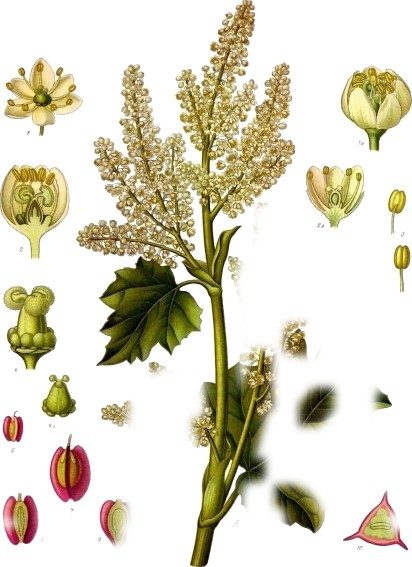
Rhubarb
Rabarbaro
- Known today as
- The root of Chinese rhubarb, Rheum officinale and R. palmatum, long brought to Europe overland through the Levant; not the garden rhubarb stalk.
- Kind
- Plant, in 1 older authority
- Constituents
- sennosides A and B, rhein and emodin, tannins, and 1 more
- Poisoning
- The anthranoid purgatives
- Earliest authority here
- Dioscorides (c. AD 40–90)
- In other databases
- Plants of the World Online search · GBIF search · Wikidata search
- In the Canale glossary
- On the Manner of Discerning and Healing the Bewitched, Appendix A: Part Three, Chapter 4: Stronger Purgatives and Compound Medicines
Rhubarb: what did Canale use it for?
The principal purge for choleric and sanguine patients (ch. 4).
Rhubarb: what does modern science say?
Confirmed. Its anthraquinones are laxative in larger doses, while its tannins make it astringent in small ones, and it is still used.
Pharmacognosy & Toxicology
- Constituents
- sennosides A and Bdianthrone glycosides
- rhein and emodinanthraquinones
- tanninsgallotannins, which astringe after the purge
- oxalic acid ChEMBLin the leaf, which is the poison
- Mechanism
- The anthranoids pass unabsorbed to the colon, where bacteria free the anthrones that stimulate peristalsis and secretion eight to twelve hours later; the tannins then bind, which is why the old writers said rhubarb purged and then stayed. The medicinal root is Rheum palmatum from China; the garden stalk is a food, and its leaf’s oxalate has killed.
- Toxic dose
- 0.5–2 g of root purges; chronic use darkens the colon lining (melanosis coli) and lowers potassium; the leaf at a few hundred grams gives oxalate kidney failure.
- Syndrome
- The anthranoid purgatives
- Standing
- EMA monograph (2007, revised 2020) for short-term constipation; a WHO monograph; in the Chinese Pharmacopoeia as da huang.
- EMA/HMPC (2007). European Union herbal monograph on Rheum palmatum L. and Rheum officinale Baillon, radix (EMEA/HMPC/189624/2007; revised 2020). Verified against its record
- Cao, Y.-J., et al. (2017). “Advances in bio-active constituents, pharmacology and clinical applications of rhubarb.” Chinese Medicine 12. Verified against its record · doi:10.1186/s13020-017-0158-5
The abstract of each source, beneath its citation. For Club members. About the Club or sign in.
Constituent names open the compound’s record at PubChem, and “ChEMBL” beside a name opens its record at ChEMBL, the European Bioinformatics Institute’s database of bioactive molecules. Where a mechanism line was checked against ChEMBL (ChEMBL 37, read 1 October 2026), the check is shown with the measured value and its source paper, or says plainly that nothing has been measured. Doses are as the references give them, for description only; this is not medical advice. Each source carries the result of its check against Crossref, PubMed, or the authority’s page: see Verification.
Rhubarb: what lore surrounds it?
As its fame as a purge spread along the Silk Road from China through Persia, recorded by the Castilian ambassador Ruy González de Clavijo early in the fifteenth century, the finest rhubarb root came to cost more in Europe than cinnamon or saffron, the two benchmarks of medieval luxury.
Used in These Compounds
Rhubarb is an ingredient of 1 compound medicine in the database. For Club members. Create a free account or sign in.
Rhubarb: what did the older authorities say?
- Dioscorides
- Calls it rha, the root from beyond the Bosporus, a name taken from the river Rha, the Volga, along which it came.
Sources
- [41] European Medicines Agency, Committee on Herbal Medicinal Products (HMPC). Herbal monographs, assessment reports and public statements, ema.europa.eu, cited under the herb concerned: aniseed (summary, EMA/305345/2016); Aristolochia (public statement, EMEA/HMPC/138381/2005); asarone (public statement, EMEA/HMPC/139215/2005); caraway (EMA/HMPC/715092/2013); centaury (EMA/HMPC/277493/2015); chicory root (assessment report, EMA/HMPC/113041/2010); cinnamon (EMA/HMPC/246774/2009); clove (assessment report, EMA/HMPC/534946/2010); ethanol in herbal products (reflection paper, EMA/HMPC/85114/2008); fennel (EMEA/HMPC/372839/2016, Rev. 1, 2024); fumitory (draft assessment report, EMA/HMPC/367013/2021); greater celandine (public statement, EMA/HMPC/743927/2010); hops (EMA/HMPC/682384/2013); horehound (EMA/HMPC/604271/2012); mallow (assessment report, EMA/HMPC/749518/2016); marshmallow root (Althaeae radix); melissa (summary, EMA/HMPC/310761/2013); myrrh (assessment report and monograph, EMA/HMPC/96910/2010 and 96911/2010); peppermint oil (assessment report, EMEA/HMPC/349465/2006); pyrrolizidine alkaloids (public statement, EMA/HMPC/893108/2011); rhubarb (EMA/HMPC/113700/2019); sage (Salviae officinalis folium); wormwood (EMA/HMPC/751490/2016). Read in full · the text read
- [54] Grieve, M. (1931). A Modern Herbal. Online edition, botanical.com, cited under the plant concerned. Read in part · the text read
- [86] Memorial Sloan Kettering Cancer Center, Integrative Medicine. Rhubarb. Last updated 8 November 2022. mskcc.org. Book, seen in reviews
- [89] Mosleh, G., Zaeri, M., Hemmati, S., & Mohagheghzadeh, A. (2023). A comprehensive review on rhubarb astringent/laxative actions and the role of aquaporins as hub genes. Phytochemistry Reviews 22: 565–586. doi:10.1007/s11101-022-09851-y Verified against its record · doi:10.1007/s11101-022-09851-y
- Silk Road Gourmet, on rhubarb’s Silk Road history. Book, not indexed
Verification
- Checked
- October 1, 2026
- Passes
- Every sentence read against its sources, in the pass over the remaining 343 entries
- The Standing line checked against the authority it names (EMA, WHO, FDA, CITES, Commission E)
- Every dated or regulatory claim checked by category across the database
- Sources
- 7 cited: 1 read in full, 1 read in part, 3 verified against its record, 1 book, seen in reviews, 1 book, not indexed. 1 with the abstract on file.
- Corrections
- None were needed.
What was checked, how, and what was found is set out on the Verification page. A checked source is one whose record was found; it does not make the entry medical advice.
Cite This Entry
Version 1 · first published September 25, 2026
- Chicago
“Rhubarb.” In Materia Medica, edited by B. C. P. Statema. Version 1. The Thinking Press, 2026–. Last modified September 25, 2026. https://thethinkingpress.org/materia-medica/rhubarb.
- MLA
“Rhubarb.” Materia Medica, edited by B. C. P. Statema, version 1, The Thinking Press, 25 Sept. 2026, thethinkingpress.org/materia-medica/rhubarb. Accessed 8 Oct. 2026.
- APA
Rhubarb. (2026, September 25). In B. C. P. Statema (Ed.), Materia medica (Version 1). The Thinking Press. Retrieved October 8, 2026, from https://thethinkingpress.org/materia-medica/rhubarb
Club members keep entries on a shelf with private notes, print the plates as cards, and receive an entry by email each week. Create a free account before January 1, 2027 and all of it is yours for good. About the Club
See Also
Poisoned alike: the anthranoid purgatives
Yellow dock · Myrobalans · Cassia, flower of · Madder · Compound fumitory · Lenitive electuary · Diacatholicon · Hiera picra · the syndrome, with all of them →
Sharing rhein and emodin, tannins, oxalic acid
Rosa gallica · Rosa gallica · Sorbus aucuparia · Plantago major · Sorrel, syrup of · Portulaca oleracea · Inonotus obliquus
Also in Dioscorides
Rocket in Dioscorides · Ox eye in Dioscorides · Orris in Dioscorides · everything Dioscorides names →
Nearby in the alphabet
Reishi (red-brown bracket of hardwoods) · The Roman Ritual (issued by Pope Paul V in 1614, the year of Canale’s treatise) · Red yeast rice (Rice fermented with a red mould) · Roquefort mould (The blue mould of blue cheeses) · Rosary (Strings of prayer beads) · Ramps (the wild leek of the hardwood forests of the Great Lakes and the East)
Historical description, not medical advice.