
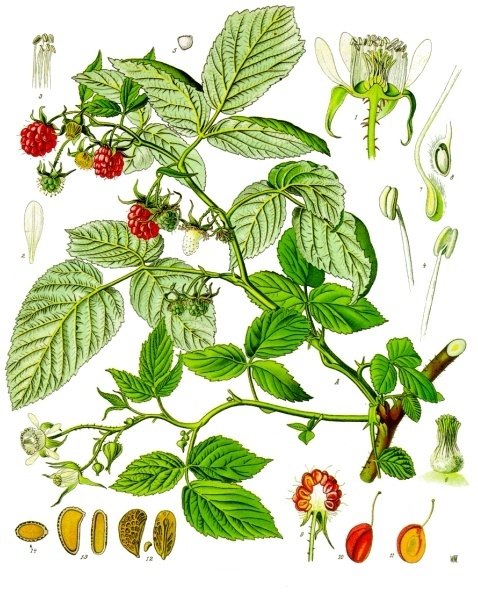
Raspberry leaf
Rubus idaeus; Raspbis, Hindberry, Bramble of Mount Ida; Greek Batos Idaia, Latin Rubus Idaea; Danish Hindebar, Dutch Braamboss, Saxon Hindbeer; Gerard’s Raspis
- Known today as
- The leaves of the raspberry, Rubus idaeus: a shrub with erect, biennial stems from creeping perennial roots, native to many parts of Europe and wild in parts of Britain, flowering in May and June.
- Kind
- Plant, in 2 older authorities
- Earliest authority here
- Dioscorides, as Grieve records (c. AD 40–90)
- In other databases
- Plants of the World Online search · GBIF search · Wikidata search
Caution. Raspberry leaf acts on the muscle of the uterus in laboratory studies, and its authors warn that finding no harm in their small study “should not be taken as evidence that raspberry leaf is safe.” In pregnancy it should be taken only with the knowledge of the midwife or doctor.
Raspberry leaf: what was it used for?
Astringent and stimulant, Grieve says. The leaf tea, an ounce of dried leaves to a pint of boiling water, was a gargle for sore mouths and canker of the throat and a wash for wounds and ulcers; with powdered slippery elm bark the leaves made a poultice for wounds, burns and scalds. Taken cold, the infusion was “a reliable remedy for extreme laxity of the bowels,” and it served in the stomach complaints of children. Above all “Raspberry Leaf Tea is valuable during parturition. It should be taken freely, warm.”
Raspberry leaf: how is it taken as a tea?
An ounce of the dried leaves to a pint of boiling water: as a gargle and a wash, cold against laxity of the bowels, and, taken freely and warm, during labour.
All the herbal teas of the database. Historical directions, not medical advice.
Raspberry leaf and polycystic ovary syndrome: what do the studies show?
No study in PCOS found
- Androgens
- No study
- Insulin and glucose
- No study
- Cycles
- No study
- Hirsutism and skin
- No study
A search of PubMed in October 2026 for raspberry and polycystic ovary syndrome found no study of raspberry leaf in women with PCOS; the two laboratory papers it returned concern a different Chinese bramble, Rubus chingii, in rats. The human research on the leaf is all in pregnancy and labour, set out in the entry above.
All seven herbs side by side. The studies are listed among the sources below, each with its abstract. A summary of research, not medical advice.
Raspberry leaf: what does modern science say?
The one large trial, in Sydney, gave 192 first-time mothers raspberry leaf tablets (two of 1.2 g a day) or a placebo from the 32nd week of pregnancy: there were no adverse effects for mother or baby, and, contrary to popular belief, the first stage of labour was not shortened; the second stage was shorter by about ten minutes on average and forceps were used less often (19.3 against 30.4 per cent). A 2021 review of thirteen studies found that the leaf acts on smooth muscle, the uterus included, in the laboratory, that animals given high doses into the vein or the abdomen showed toxicity, and that the human studies have shown neither harm nor benefit; the evidence for its use in pregnancy is weak. In an Australian cohort of 561 pregnant women, 37 per cent took raspberry leaf, most often to make labour easier, and in a smaller prospective study of 91 women those who took it had their labours medically augmented less often, a result the authors say cannot be generalised.
Raspberry leaf: what lore surrounds it?
“’Twas only to hear the yorling sing, / And pu’ the crawflower round the spring, / The scarlet hep and the hindberrie, / And the nut that hang frae the hazel tree,” runs the verse Grieve quotes for the old name. The raspberry grows wild as far north as latitude 70 degrees.
Raspberry leaf: what did the older authorities say?
- Dioscorides, as Grieve records
- Associated it with Mount Ida in Asia Minor, where it appears to have been abundant; the Greeks called it Batos Idaia, the bramble of Ida, and Linnaeus kept the classical name in Rubus idaeus.
- John Gerard
- Calls it Raspis or Hindberry, the second name coming from the Saxon Hindbeer.
Sources
- Grieve, M. A Modern Herbal, “Raspberry.” As published on botanical.com. Read in full · the text read
- Simpson, M., Parsons, M., Greenwood, J., and Wade, K. (2001). “Raspberry leaf in pregnancy: its safety and efficacy in labor.” Journal of Midwifery & Women’s Health 46: 51–59. doi:10.1016/s1526-9523(01)00095-2. Abstract read · the text read
- Bowman, R., Taylor, J., Muggleton, S., and Davis, D. (2021). “Biophysical effects, safety and efficacy of raspberry leaf use in pregnancy: a systematic integrative review.” BMC Complementary Medicine and Therapies 21: 56. doi:10.1186/s12906-021-03230-4. Abstract read · the text read
- Bowman, R. L., Taylor, J., and Davis, D. L. (2024). “Raspberry leaf (Rubus idaeus) use in pregnancy: a prospective observational study.” BMC Complementary Medicine and Therapies 24: 169. doi:10.1186/s12906-024-04465-7. Abstract read · the text read
- Bowman, R. L., Davis, D. L., and Taylor, J. (2026). “Beyond prescription medicine in pregnancy: raspberry leaf and other herbs in Australia.” BMC Complementary Medicine and Therapies 26. doi:10.1186/s12906-025-05229-7. Abstract read · the text read
Verification
- Checked
- October 1, 2026
- Passes
- Every dated or regulatory claim checked by category across the database
- Sources
- 5 cited: 1 read in full, 4 abstract read. 4 with the abstract on file.
- Corrections
- None were needed.
What was checked, how, and what was found is set out on the Verification page. A checked source is one whose record was found; it does not make the entry medical advice.
Cite This Entry
Version 1 · first published October 10, 2026
- Chicago
“Raspberry leaf.” In Materia Medica, edited by B. C. P. Statema. Version 1. The Thinking Press, 2026–. Last modified October 10, 2026. https://thethinkingpress.org/materia-medica/raspberry-leaf.
- MLA
“Raspberry leaf.” Materia Medica, edited by B. C. P. Statema, version 1, The Thinking Press, 10 Oct. 2026, thethinkingpress.org/materia-medica/raspberry-leaf. Accessed 10 Oct. 2026.
- APA
Raspberry leaf. (2026, October 10). In B. C. P. Statema (Ed.), Materia medica (Version 1). The Thinking Press. Retrieved October 10, 2026, from https://thethinkingpress.org/materia-medica/raspberry-leaf
Club members keep entries on a shelf with private notes, print the plates as cards, and receive an entry by email each week. Create a free account before January 1, 2027 and all of it is yours for good. About the Club
See Also
Also in Dioscorides
Rhubarb in Dioscorides · Ox eye in Dioscorides · Rocket in Dioscorides · Orris in Dioscorides · everything Dioscorides names →
Drawing on the same sources: Grieve
Rosemary · Radish · Rosemary rice water · the bibliography →
Historical description, not medical advice.

