
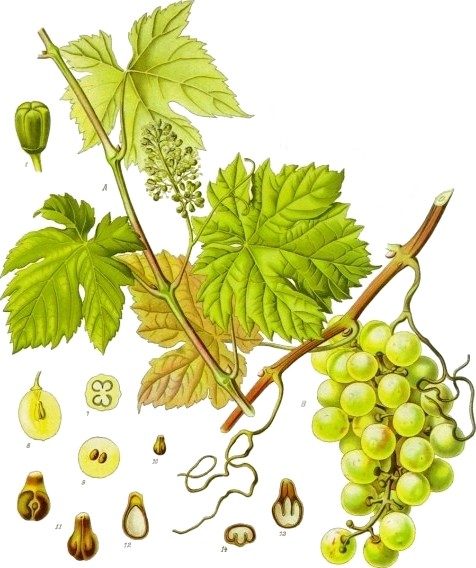
Raisins
Uva passa
- Known today as
- Dried grapes.
- Kind
- Food & Drink, in 2 older authorities
- Constituents
- glucose and fructose, fibre, potassium, and 1 more
- Earliest authority here
- Culpeper (1616–1654)
- In the Canale glossary
- On the Manner of Discerning and Healing the Bewitched, Appendix A: Part Three, Chapter 4: Stronger Purgatives and Compound Medicines
Revised October 3, 2026: Tradition, lore, modern assessment, and sources extended. Checked against its sources, each read in full, in part, or in its abstract. Version 1, first published September 25, 2026.
Raisins: what did Canale use it for?
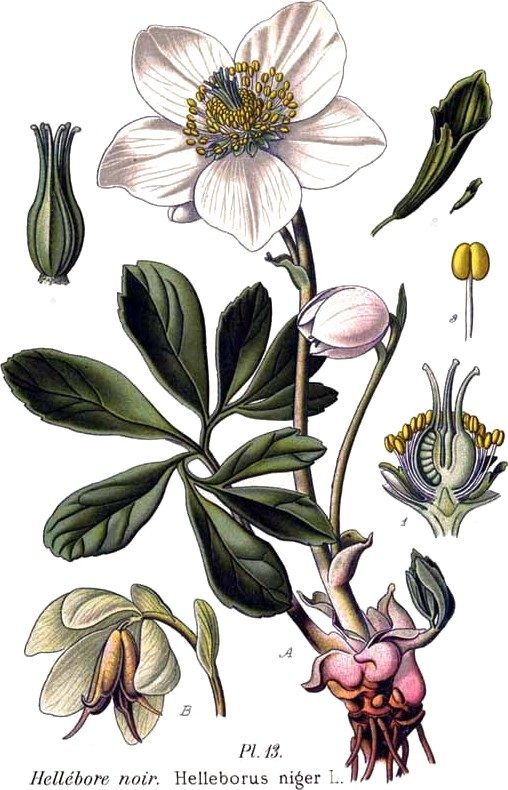
In the relaxing broths taken before hellebore (ch. 5).
Raisins: what does modern science say?
Demulcent, nutritive and mildly laxative, by the British Pharmaceutical Codex of 1911, and used for mucilaginous drinks; rich in fibre and potassium, with a low to moderate glycaemic index.
Pharmacognosy & Toxicology
- Constituents
- glucose and fructoseabout 65 per cent sugars
- fibreabout 4 per cent
- potassium ChEMBL
- tartaric acid ChEMBLas potassium acid tartrate
- Mechanism
- A demulcent, nutritive, mildly laxative fruit (Codex, 1911); in the relaxing broths before hellebore it went in with mallow and marshmallow.
- Toxic dose
- A food.
- Standing
- A food.
- Anderson, J. W., and Waters, A. R. (2013). “Raisin consumption by humans: effects on glycemia and insulinemia and cardiovascular risk factors.” Journal of Food Science 78. Abstract read · the text read
The abstract of each source, beneath its citation. For Club members. About the Club or sign in.
Constituent names open the compound’s record at PubChem, and “ChEMBL” beside a name opens its record at ChEMBL, the European Bioinformatics Institute’s database of bioactive molecules. Where a mechanism line was checked against ChEMBL (ChEMBL 37, read 1 October 2026), the check is shown with the measured value and its source paper, or says plainly that nothing has been measured. Doses are as the references give them, for description only; this is not medical advice. Each source carries the result of its check against Crossref, PubMed, or the authority’s page: see Verification.
What Medicine Makes of It
- Fasting, Vigil, and VisionWhat hunger and sleeplessness do to the senses.
Raisins: what lore surrounds it?
Culpeper’s dispensatory gives “Raisons of the Sun” for the breast and the liver; and the small black “raisins of Corinth” gave English its word currant, from the Anglo-French raisins de Corinthe.
Used in These Compounds
Raisins is an ingredient of 2 compound medicines in the database. For Club members. Create a free account or sign in.
Raisins: what did the older authorities say?
- Culpeper
- Says raisins of the sun “help infirmities of the breast and liver, restore Consumptions, gently clense and move to stool,” and counts them temperate in heat.
- The purging decoction
- Raisins of the sun stoned, with senna, polypody, ginger, sebestens, and prunes, were boiled into the College’s Decoctum Sennae Gereonis, which Culpeper called “a common Decoction for any purge.”
Sources
- [16] The British Pharmaceutical Codex (1911). London: Pharmaceutical Society of Great Britain. Monographs as transcribed at Henriette’s Herbal Homepage, henriettes-herb.com. Read in full · the text read
- The British Pharmaceutical Codex (1911), “Uvae. Raisins.” London: Pharmaceutical Society of Great Britain. As transcribed at Henriette’s Herbal Homepage. Read in full · the text read
- “Raisin.” Wikipedia (read 2 October 2026). Read in full · the text read
- “Zante currant.” Wikipedia (read 2 October 2026). Read in part · the text read
- Canale, F. (1622). Del modo di conoscer et sanare i maleficiati. Brescia. Read in part · the text read
Verification
- Checked
- October 1, 2026, and October 3, 2026
- Passes
- Every sentence read against its sources, in the pass over the remaining 343 entries
- The Standing line checked against the authority it names (EMA, WHO, FDA, CITES, Commission E)
- Every dated or regulatory claim checked by category across the database
- Every source read, in full, in part, or in its abstract, and every sentence checked against what was read (October 3, 2026)
- Sources
- 6 cited: 3 read in full, 2 read in part, 1 abstract read. 1 with the abstract on file.
- Corrections
- None were needed.
What was checked, how, and what was found is set out on the Verification page. A checked source is one whose record was found; it does not make the entry medical advice.
Cite This Entry
Version 1 · first published September 25, 2026 · last revised October 3, 2026
- Chicago
“Raisins.” In Materia Medica, edited by B. C. P. Statema. Version 1. The Thinking Press, 2026–. Last modified October 3, 2026. https://thethinkingpress.org/materia-medica/raisins.
- MLA
“Raisins.” Materia Medica, edited by B. C. P. Statema, version 1, The Thinking Press, 3 Oct. 2026, thethinkingpress.org/materia-medica/raisins. Accessed 8 Oct. 2026.
- APA
Raisins. (2026, October 3). In B. C. P. Statema (Ed.), Materia medica (Version 1). The Thinking Press. Retrieved October 8, 2026, from https://thethinkingpress.org/materia-medica/raisins
Club members keep entries on a shelf with private notes, print the plates as cards, and receive an entry by email each week. Create a free account before January 1, 2027 and all of it is yours for good. About the Club
See Also
Sharing fibre, potassium, tartaric acid
Prunus insititia · Taraxacum officinale · Cichorium endivia · Tamarindus indica
Also in Nicholas Culpeper
Red roses in Nicholas Culpeper · Ragwort in Nicholas Culpeper · Rosemary rice water in Nicholas Culpeper · Periwinkle in Nicholas Culpeper · everything Nicholas Culpeper names →
Drawing on the same sources: Canale, Anderson
Spirit of wine · Passarino’s white powder · Sweet almond, oil of · Pennyroyal · the bibliography →
Nearby in the alphabet
Ramps (the wild leek of the hardwood forests of the Great Lakes and the East) · Radish (Raphanus sativus (now classed by Kew as Raphanus raphanistrum subsp) · Red yeast rice (Rice fermented with a red mould) · Quince (Cydonia oblonga) · Reishi (red-brown bracket of hardwoods) · Quicksilver (and its salts such as calomel and corrosive sublimate)
Historical description, not medical advice.