
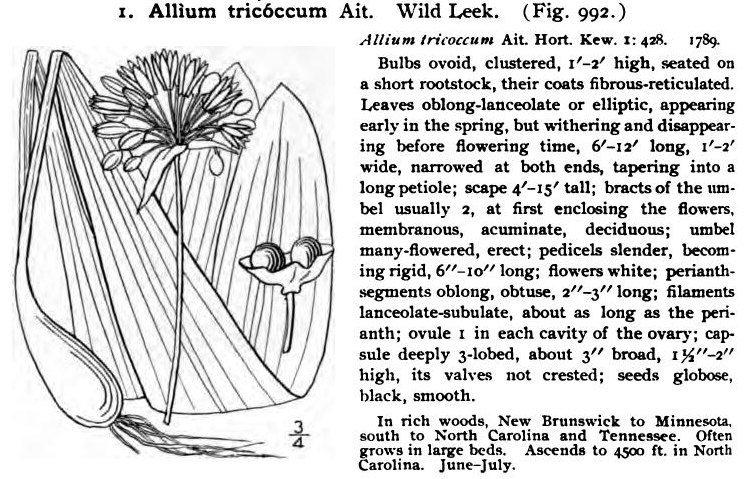
Ramps
Wild leek; Allium tricoccum of Aiton; the Ojibwe bûgwadjijîcagowûnj, the unusual skunk-plant, Winabojo’s onion; the Potawatomi bûgwadjica’gowûnj
- Known today as
- Allium tricoccum, the wild leek of the hardwood forests of the Great Lakes and the East: a spring ephemeral that puts up its broad leaves in late winter and early spring from a bulb, feeds through its roots and their fungi even in the leafless months, and is gathered for the bulb and the leaf together. The larger of the two wild onions of Ojibwe country; the smaller, the nodding wild onion Allium cernuum, is the sweeter.
- Kind
- Plant, in 3 older authorities
- Constituents
- thiosulfinates, cepaenes
- Earliest authority here
- Huron H. Smith
- In other databases
- Plants of the World Online search · GBIF search · Wikidata search
Caution. A food. Nothing read for this entry describes a poisoning by it, and nothing was read on the plants it can be mistaken for; gather what you know.
Ramps: what was it used for?
Food, by every Midwestern record read for this entry. The Flambeau and Pillager Ojibwe, Smith says, like both the wild onion and the wild leek in spring; the leek “is gathered in the spring when it is round and plumper than in the fall,” is also dried for future use, and “is somewhat bitter, while the smaller wild onion is sweet.” The Forest Potawatomi used it as a food too, and Smith quotes the early account of Nicolas Perrot of onions “of the size of one’s thumb” growing on moist fertile lands of the prairie tribes, the root like a leek, so acrid that whoever tried to swallow it spat it out at once. Densmore lists it among the foods of the Minnesota Chippewa.
Ramps: foraging it in the Midwest
- Part
- Bulb and leaf
- When
- Spring
The hardwood forests of the Lake country; gathered in spring when the bulb is round and plumper than in the fall, and dried for later use. The larger of the two wild onions; the smaller nodding onion is the sweeter.
After Smith. All the foragables of the Midwest. Historical record, not a field guide: identify before you gather, and read the whole entry.
Ramps: what does modern science say?
A 1998 analysis of ramp bulbs found the thiosulfinates the major sulphur compounds, with the cepaenes of onion juice and allyl cepaenes besides; the allicin of a ramp homogenate was a tenth to a half of garlic’s, and the greater share of methyl 1-propenyl thiosulfinates matched the flavour of the bulb. A 2015 study in a mature mixed hardwood forest found the roots most colonised by mycorrhizal fungi in late winter and early spring as the leaves emerged, and that the bulb’s nitrogen and phosphorus rose between late summer and spring, when the plant has no leaves at all: the ramp is at work underground through the winter.
Pharmacognosy & Toxicology
- Constituents
- thiosulfinatesthe major sulphur compounds of the bulb; allicin at a tenth to a half of garlic’s, methyl 1-propenyl thiosulfinates in greater share
- cepaenesthe α-sulfinyl disulfides of onion juice, with allyl-bearing kinds of their own
- Mechanism
- The flavour chemistry of an onion, between garlic and leek. The plant’s life is the other finding: a spring ephemeral whose roots and their mycorrhizal fungi take up nitrogen and phosphorus through the leafless months, with the fungi at their height in late winter and early spring as the leaves emerge.
- Toxic dose
- A food, gathered in spring when the bulb is round and plump, or dried.
- Standing
- A foraged vegetable of the hardwood forest; the chemistry and ecology have been studied, its harvest and sustainability not in anything read here.
- Calvey, E. M., White, K. D., Matusik, J. E., Sha, D., & Block, E. (1998). Allium chemistry: identification of organosulfur compounds in ramp (Allium tricoccum) homogenates. Phytochemistry 49: 359–364. doi:10.1016/s0031-9422(98)00191-5 Verified against its record · PMID 9747536
- Hewins, C. R., Carrino-Kyker, S. R., & Burke, D. J. (2015). Seasonal variation in mycorrhizal fungi colonizing roots of Allium tricoccum (wild leek) in a mature mixed hardwood forest. Mycorrhiza 25: 469–483. doi:10.1007/s00572-015-0628-5 Verified against its record · PMID 25634800
The abstract of each source, beneath its citation. For Club members. About the Club or sign in.
Constituent names open the compound’s record at PubChem, and “ChEMBL” beside a name opens its record at ChEMBL, the European Bioinformatics Institute’s database of bioactive molecules. Where a mechanism line was checked against ChEMBL (ChEMBL 37, read 1 October 2026), the check is shown with the measured value and its source paper, or says plainly that nothing has been measured. Doses are as the references give them, for description only; this is not medical advice. Each source carries the result of its check against Crossref, PubMed, or the authority’s page: see Verification.
Ramps: what lore surrounds it?
The city on the lake is named for this plant, by the Ojibwe account Smith took down: jîcago means skunk, and the skunk-plant of the river mouth gave Chicago its name. It is Winabojo’s onion, the one the trickster-hero pointed out for food. Perrot, among the prairie tribes two centuries earlier, could not get it down.
Ramps: what did the older authorities say?
- Huron H. Smith
- The Ojibwe name “really means skunk, and from this word Chicago was named. This is the larger wild onion and is known as Winabojo’s onion, or the one he pointed out for food. It is gathered in the spring when it is round and plumper than in the fall. It is also gathered and dried for future use.”
- Nicolas Perrot, as Smith quotes him
- “These tribes of the prairies also find in certain places, lands that are fertile, and kept moist by the streams that water them, whereon grow onions of the size of one’s thumb. The root is like a Leek, and the plant which grows from it resembles the salsify. This onion, I say, is so exceedingly acrid that if one tried to swallow it, it would all at once wither the tongue, the throat and the inside of the mouth”; and a wild garlic of the same places has an insupportable acridness.
- Frances Densmore
- In her study of the Minnesota Chippewa the wild leek stands in the tables of plants used as food, and the children, she notes elsewhere, cut the stems of the wild onion to make little toys.
Sources
- Smith, H. H. (1932). Ethnobotany of the Ojibwe Indians, Bulletin of the Public Museum of the City of Milwaukee 4(3), “Wild Leek” and “Wild Onion.” Project Gutenberg, 49527. Primary text
- Smith, H. H. (1933). Ethnobotany of the Forest Potawatomi Indians, Bulletin of the Public Museum of the City of Milwaukee 7(1), “Wild Leek,” with the passage from Perrot. Internet Archive, ethnobotany-of-the-forest-potawatomi-indians-by-huron-h.-smith-1933. Primary text
- Densmore, F. (1928). Uses of Plants by the Chippewa Indians, Forty-fourth Annual Report of the Bureau of American Ethnology, the tables of plants used as food. Internet Archive, usesofplantsbych00dens. Primary text
Verification
- Checked
- October 1, 2026
- Passes
- Every sentence read against its sources, in the pass over the remaining 343 entries
- The Standing line checked against the authority it names (EMA, WHO, FDA, CITES, Commission E)
- Every dated or regulatory claim checked by category across the database
- Sources
- 5 cited: 2 verified against its record, 3 primary text. 2 with the abstract on file.
- Corrections
- None were needed.
What was checked, how, and what was found is set out on the Verification page. A checked source is one whose record was found; it does not make the entry medical advice.
Cite This Entry
Version 1 · first published October 4, 2026
- Chicago
“Ramps.” In Materia Medica, edited by B. C. P. Statema. Version 1. The Thinking Press, 2026–. Last modified October 4, 2026. https://thethinkingpress.org/materia-medica/ramps.
- MLA
“Ramps.” Materia Medica, edited by B. C. P. Statema, version 1, The Thinking Press, 4 Oct. 2026, thethinkingpress.org/materia-medica/ramps. Accessed 8 Oct. 2026.
- APA
Ramps. (2026, October 4). In B. C. P. Statema (Ed.), Materia medica (Version 1). The Thinking Press. Retrieved October 8, 2026, from https://thethinkingpress.org/materia-medica/ramps
Club members keep entries on a shelf with private notes, print the plates as cards, and receive an entry by email each week. Create a free account before January 1, 2027 and all of it is yours for good. About the Club
See Also
Drawing on the same sources: Smith, Densmore
Nearby in the alphabet
Red roses (Dried petals of Rosa gallica) · Raisins (Dried grapes) · Red yeast rice (Rice fermented with a red mould) · Ragwort (Jacobaea vulgaris (syn) · Reishi (red-brown bracket of hardwoods) · Radish (Raphanus sativus (now classed by Kew as Raphanus raphanistrum subsp) · Rhubarb (Rheum officinale and R) · Quince (Cydonia oblonga)
Historical description, not medical advice.